
The Jousting Life
Showing posts with label saddles. Show all posts

Monday, May 26, 2014

Pictures Showing the Process of Creating a Historical Saddle

Jezz Smith, a jouster from New Zealand, also makes saddles based on historical designs. Here are a series of pictures, taken by him, showing the process of making a historical saddle. Jezz Smith's saddles are very similar to the saddles made by Joram van Essen and Wouter Nicolai that were discussed in the two part article, "Re-Creating Medieval and Renaissance Saddles" written by Arne Koets.

There are actually two different saddles shown in various stages of creation. However, the saddles are similar enough that, for the purpose of displaying the process of making a historical saddle, it doesn't matter that pictures from the making of two different saddles are used.
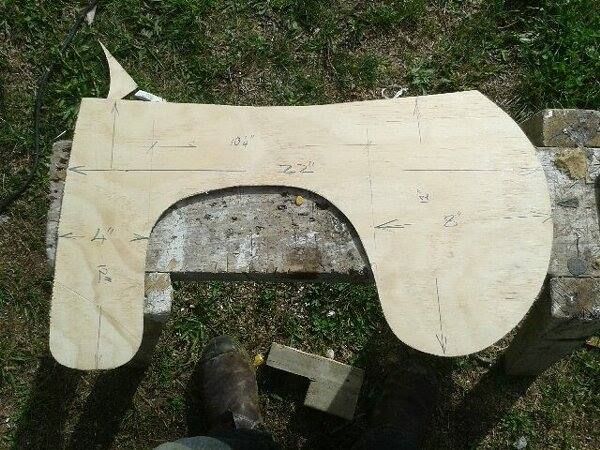

The template for the side bars of the saddle. The side bars are the part of the saddle that actually rests on the sides of the horse.(photo by Jezz Smith)
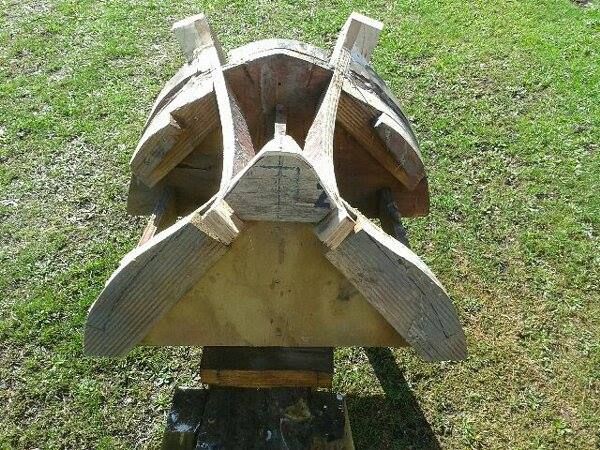

The laminating frame is used to create the curves necessary for the saddle to fit the horse's back.(photo by Jezz Smith)
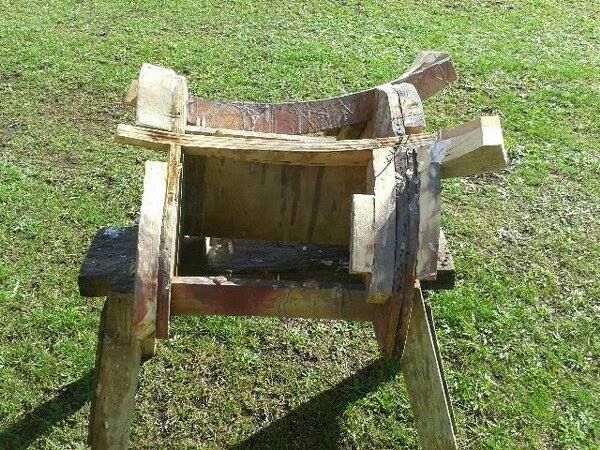

A side view of the laminating frame(photo by Jezz Smith)
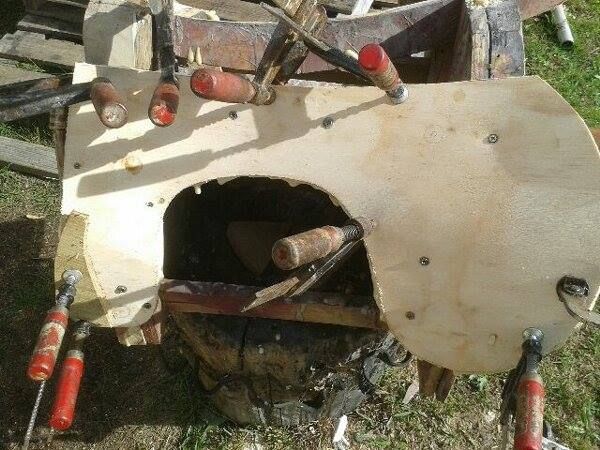

The side bar is clamped(and screwed when you run out of clamps) to the laminating frame. The screw holes will be filled in later.(photo by Jezz Smith)
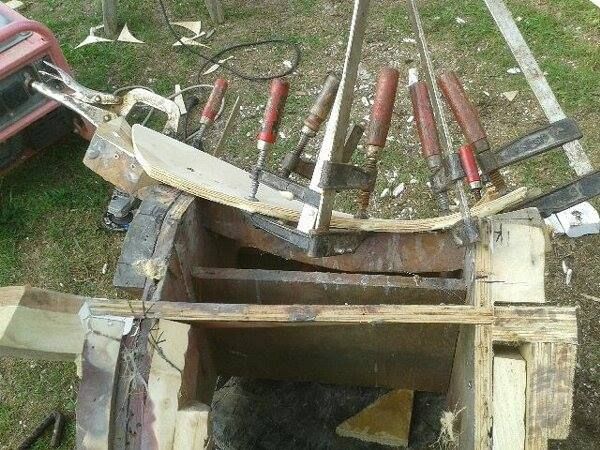

Four layers of 3mm plywood glued with polycarbonate laminating glue(photo by Jezz Smith)
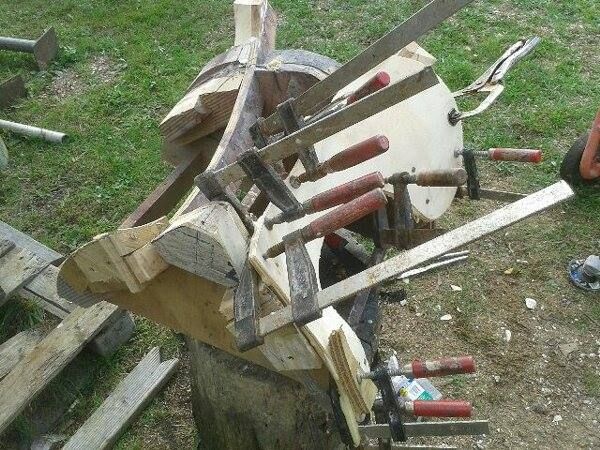

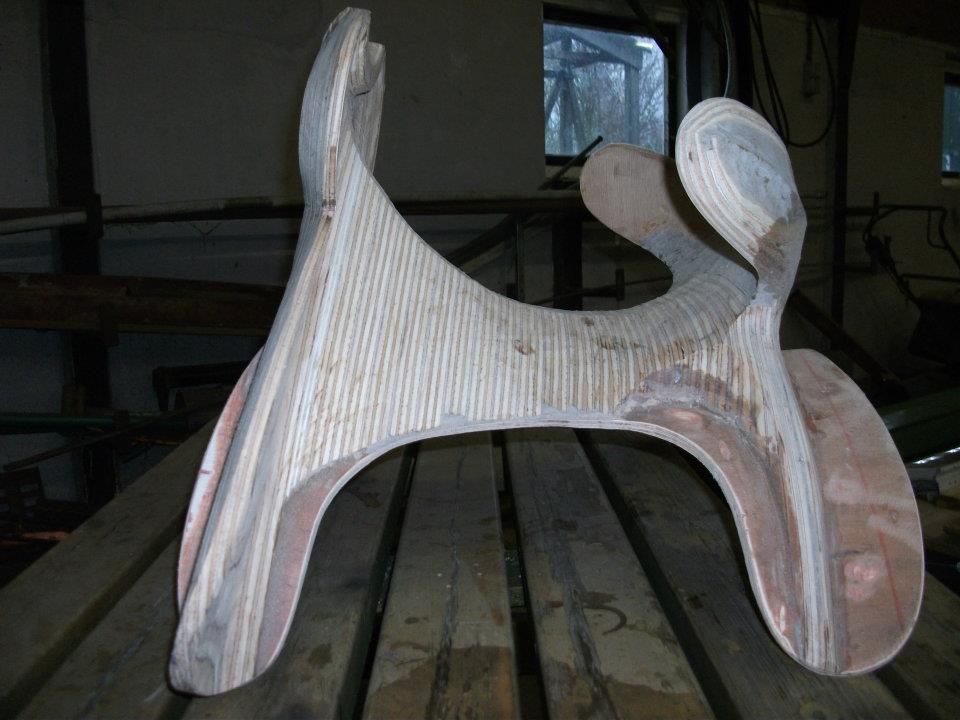
You can see where extra blocking can be added to the laminating frame to alter it to fit different horses.(photo by Jezz Smith)
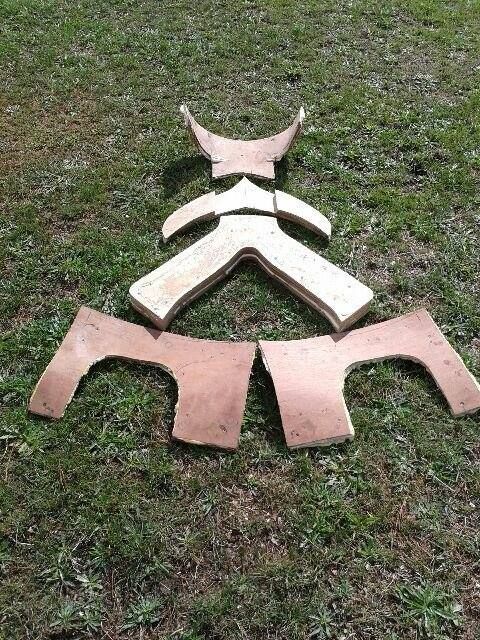

From top to bottom: The pieces used to create the cantle(back), pommel(front) and side bars of the saddle(photo by Jezz Smith)
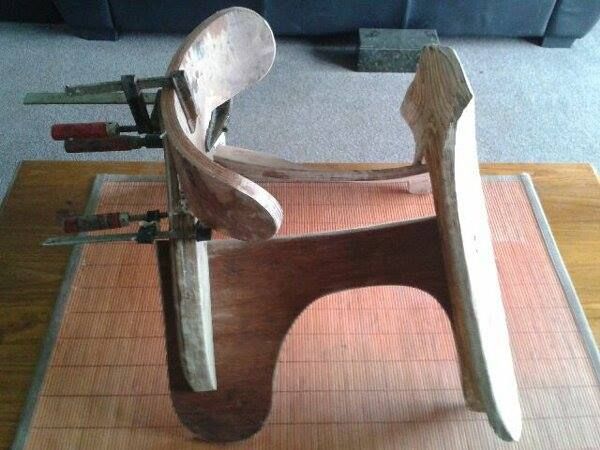

The pieces are temporarily glued together for a fitting(photo by Jezz Smith)
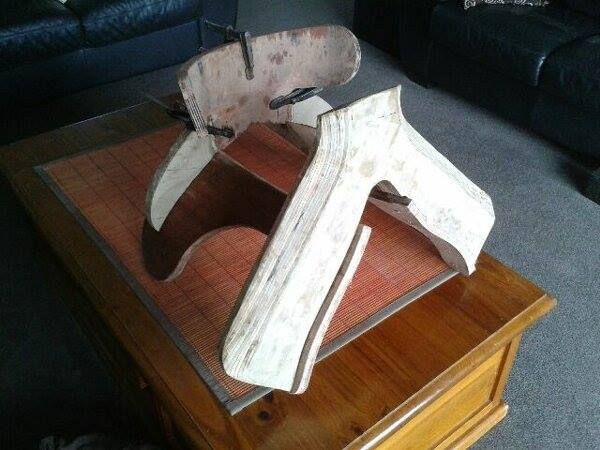

Another view of the pieces clamped and glued together(photo by Jezz Smith)
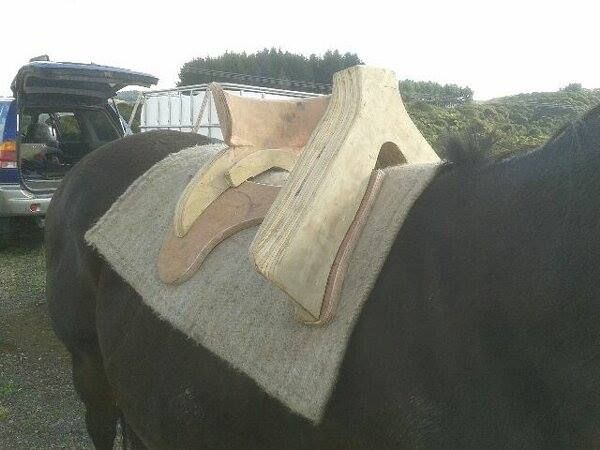

Checking to make sure the saddle fits the horse(photo by Jezz Smith)
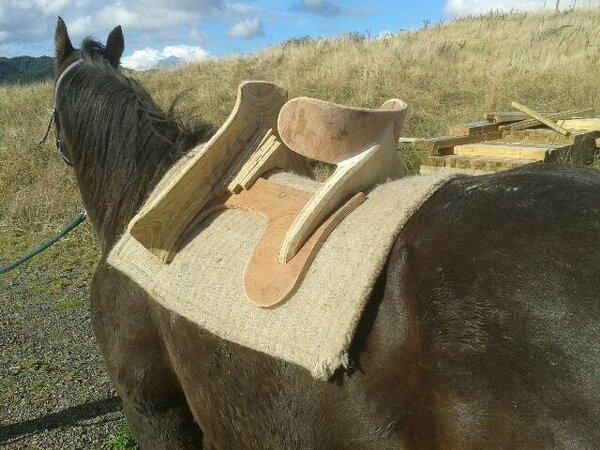

Rear view of the saddle on the horse(photo by Jezz Smith)
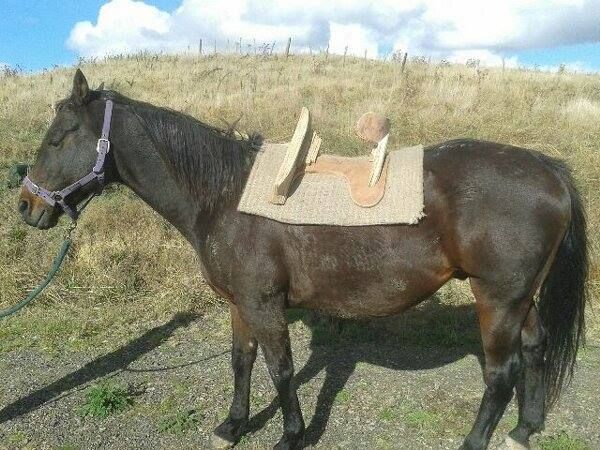

Side view of the saddle on the horse(photo by Jezz Smith)
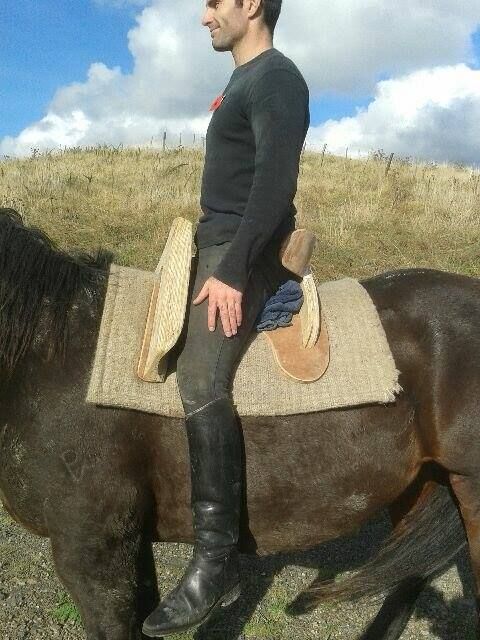

Checking to see if the saddle fits the rider,Simon Paul Tennant. According to Jezz, the cantle needed to be moved forward about an inch.(photo by Jezz Smith)
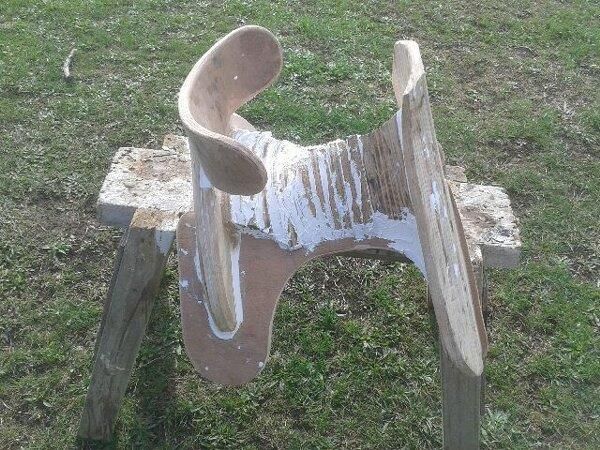

After adjusting the cantle, the pommel and cantle are permanently glued into place, and the pieces making up the seat are added(photo by Jezz Smith)
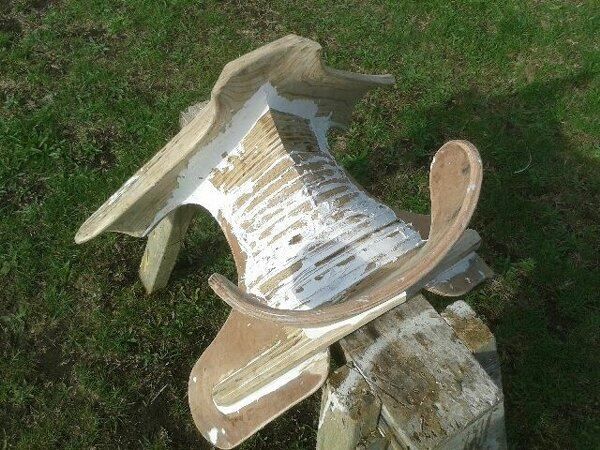

A top view of the seat pieces glued into place(photo by Jezz Smith)
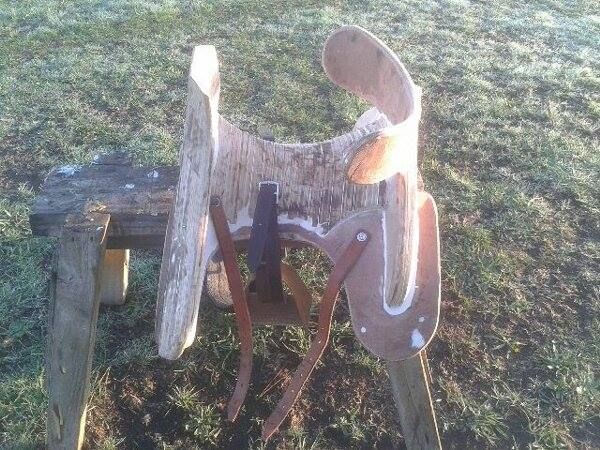

After the glue dries, the seat pieces are sanded into a smooth shape, and strap placement is checked(photo by Jezz Smith)
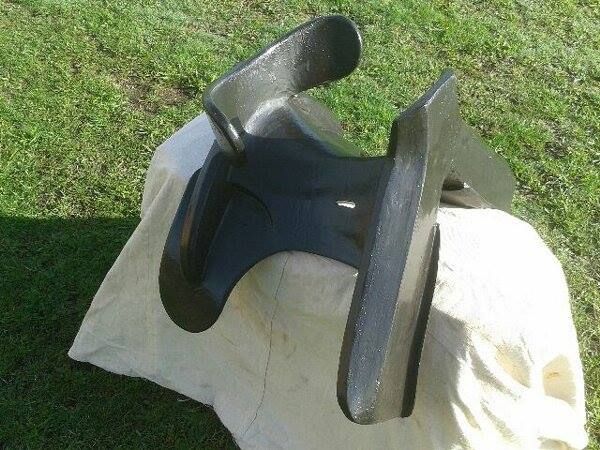

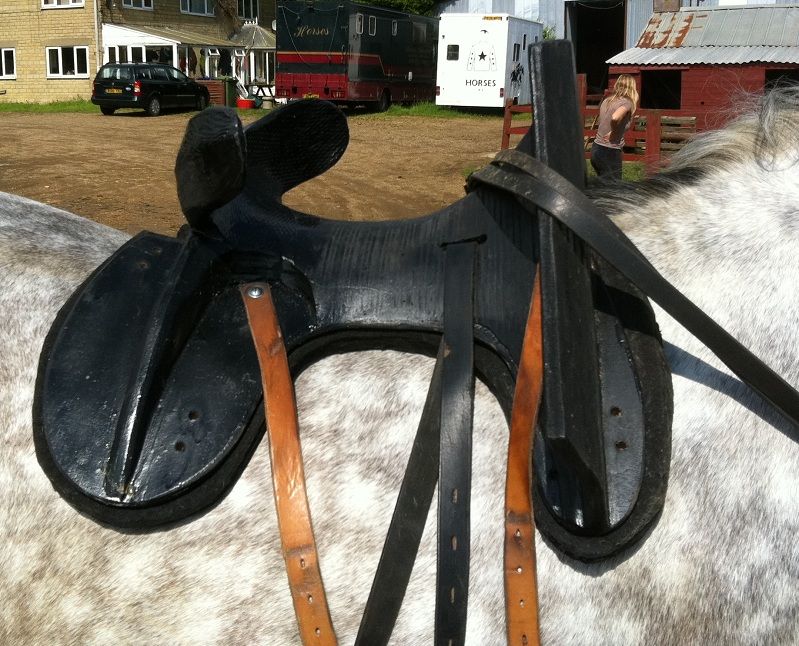
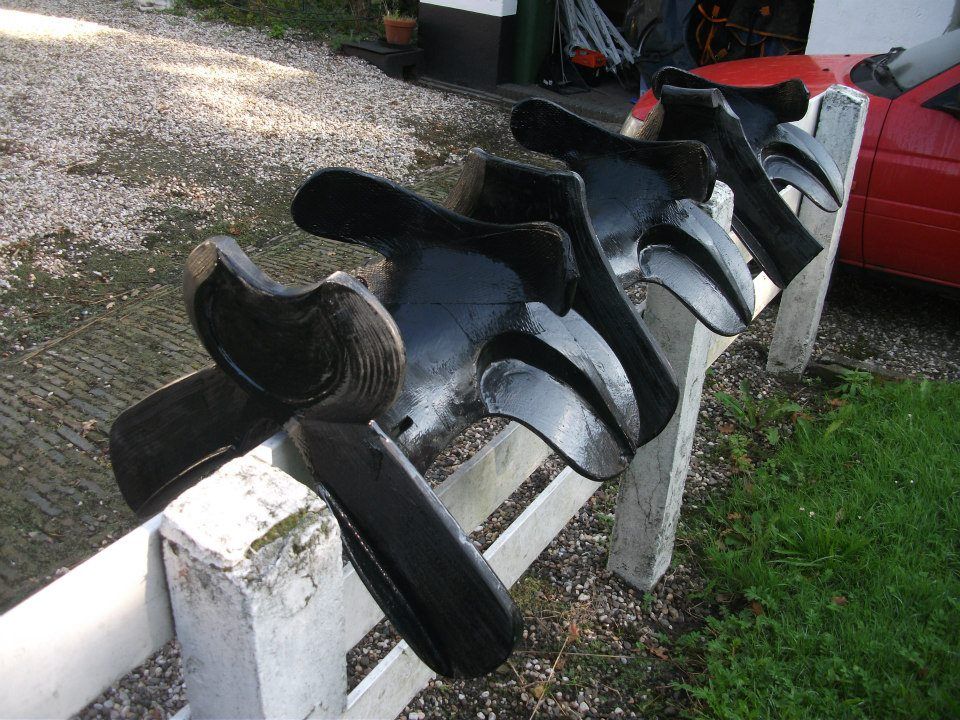
The saddle is covered in black resin(photo by Jezz Smith)
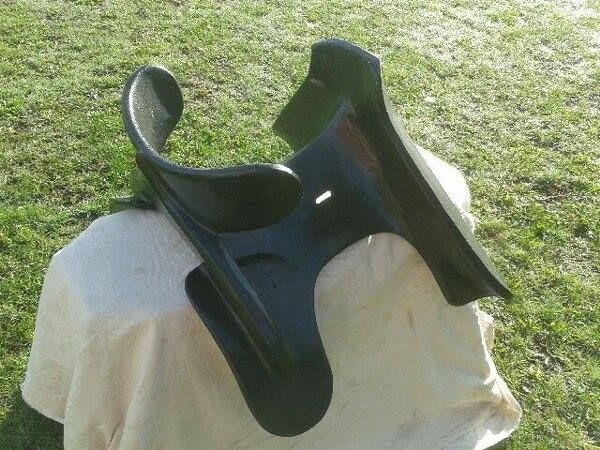

Another view of the black resin covered saddle(photo by Jezz Smith)

According to Jezz and others who use this style of saddle, padding for the seat is not necessary, though the seat and other parts of the saddle can be covered in leather. Decoration can also be added to suit the owner of the saddle.

Related articles:
Re-Creating Medieval and Renaissance Saddles: Part One

Re-Creating Medieval and Renaissance Saddles: Part Two

An Interview with Joram van Essen: Grand Champion of "The Grand Tournament in Sankt Wendel"

Thursday, March 20, 2014

Re-Creating Medieval and Renaissance Saddles: Part Two

Written by: Arne Koets
Edited by: Zhi Zhu

Continued from: Re-Creating Medieval and Renaissance Saddles: Part One


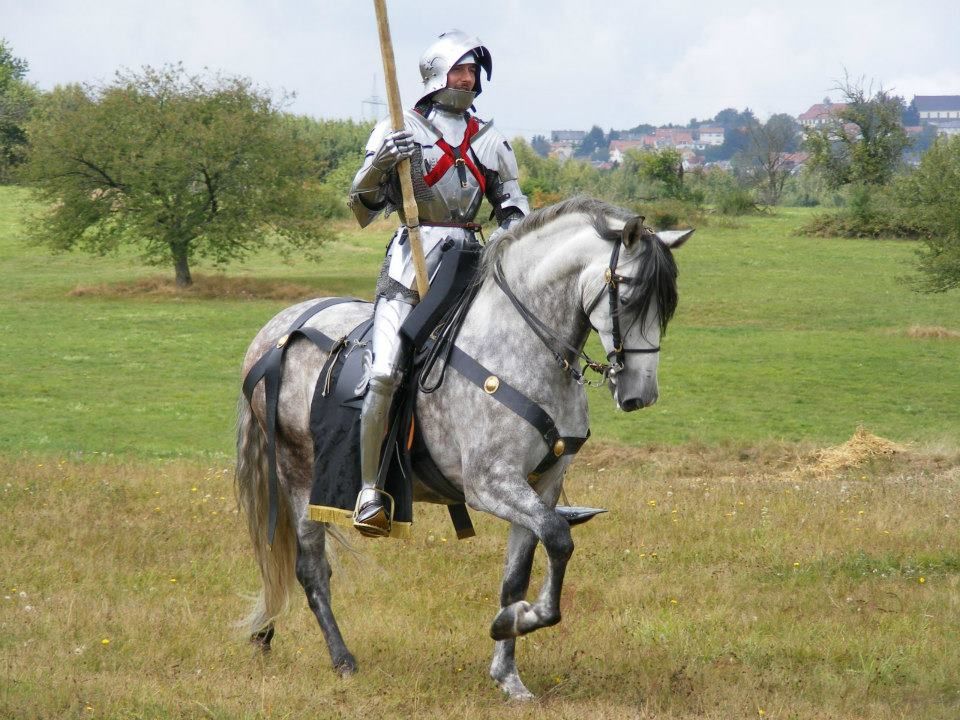
The historic war saddles created by Joram van Essen and Wouter Nicolai have become our favourite saddles. In my personal case, the saddle that Joram made for my horse Maximilian has been instrumental in some of the more ambitious dressage training, as it helped my seat to such an extent that the horse went much better under it than any other saddle.


Arne Koets and Joram van Essen demonstrate mounted combat using their historic war saddles(video by Ben van Koert/Kaos Historical Media)

The saddles seem much smaller than you would expect for either the man or the horse, yet they fit very well. This is one of the reasons most people working from photographs make the reproductions much too big. Having said that, some of the original saddles were for some very narrow (and/or small) horses. For instance, I myself am 193cm(apx 6' 4") tall, yet my saddle has a seat length of about 34 cm, (just over 13”), and when measured in the same way as a modern saddle, potentially less, yet it works fine, even with armour.


Arne Koets sits in his historic war saddle on his Andalusian gelding Maximilian at Nyborg 2013
(photo by Isis Sturtewagen)

When riding in these war saddles, the leg is really close to the horse, as the upper leg is not impeded by a broad tree or lots of padding and leather, yet the surface area in contact with the horse is large. According to Wouter Nicolai:

"A large contact surface means that the weight of the rider is divided over a much larger area, making it easier, and more comfortable for the horse to carry the (armoured) rider. This is especially true when a rider gets hit and transfers part of the force of impact to the horse (in the joust for example). In that situation, the historic war saddle is more efficient than any modern saddle to keep the horse safe from excessive pressure on the back.

Looking carefully at the shape of medieval saddle, one will notice that the contact surface is especially large at the back section of the saddle; this is where the force of impact to a rider who gets hit is transferred to. A second purpose of the larger contact surface, is to keep the saddle in place and prevent it from shifting to the side. This is essential, because no saddle should ever press directly on the spine of a horse. I think it is fair to say that the large contact surface, especially at the back of the saddle is one of, if not the most important feature of a late medieval war saddle." -- Wouter Nicolai

Furthermore, the solid seat is relatively narrow in front, allowing a slightly better angle of the rider's femur. Also, the slope of the front of the seat is such as to roll the riders hips back so as to sit in the center of gravity. In addition, the cantle is positioned to keep the center of gravity in the correct spot for the horses' anatomy.

The front section of the boards comes down quite a lot, yet less then it looks like in photos of the originals when seen on display. This means that the front Arçon plate comes down the leg and provides support and helps (again) to open the hip, even better then modern dressage saddles hold the rider.


Arne Koets sits in his historic war saddle on his Andalusian gelding Maximilian at Bexbach 2012
(photo by Franziska Schatek)

When done correctly, the support around the front of the saddle allows mounting from the ground, even with no girth, without the saddle rocking precariously -- mounting from a step is always better for the horse -- but it is possible. Both front and back tree come down the sides of the horse, and they support the saddle in an impact so it does not rotate horizontally and thereby hurt the horse's loins.

Once Joram had his ‘little’ breakthrough, and we started riding with the saddles, there were several things that surprised me:
  • how well the horses go under these saddles in bending exercises (shoulder-in, haunches-in, Half-pass, etc)
  • how easy it is to fit the saddle to different horses
  • how often I have seen horses go MUCH better under these saddles then treeless and dressage saddles
  • how much it tends to improve a riders' seat and thereby his ability to ride harder exercises
  • how much MORE knee action the horses offer (these saddles have adequate shoulder freedom, but particularly encourage the rider to sit more 'collecting' thereby giving greater freedom to the horse to throw his legs out from the driving back leg.
  • how comfortable they are, in particular in armour on long rides
  • how much better armour works in them:
    • The front allows much better interaction with the tassets and fauld.
    • The armour is MUCH more quiet, both in terms of 'Tasset flap' and 'mail scratch'.
    • The leg lies much better. The cuisse can be pushed out by broad saddles, like Portuguese saddles, meaning that leg use in armour is almost impossible sometimes, whereas in these saddles one forgets one wears armour.
  • how little the 'high' arçon plate impedes the rein hand, because it is not just bolted onto a saddle, thereby sitting much closer to the belly of the rider.

These saddles are very short, overall, and thereby fit the short coupled horses we prefer quite well, yet many short modern saddles dig into the back. When they have a straight back edge it is clear, but with a dressage saddle it is less apparent but equally true. If you think about a dressage saddle, it is shaped like a rider's bum, yet the medieval saddle is shaped like the horse's loin.

One of the final pieces to the puzzle was how to make sure you could fold back onto the horse, or put all your weight back, yet not dig into the horse's loin. This allows very deliberate use of the seat which helps a lot in more collected work.


The back and 'ears' of Arne's historic war saddle sit under his maille skirt(breyette) allowing close contact between his seat and his saddle(photo by Asa Cidh)

These war saddles work better for taller horses (15-16 hands or potentially larger) as opposed to the raised seat saddles, which to me seem conceived for smaller horses. The much lower (but still narrow) seat allows much closer feeling of the seat to the horse -- both more feedback and more opportunity for aids. This would fit well with the archeological record which shows Dutch finds of male horses of up to 161cm(apx 15.3 hands) height in a context of the siege of Utrecht in the second half of the fifteenth century, much(inches) taller than most evidence seems to point to in earlier periods.

What is also surprising is how light these saddles are, (and how light un-armoured original examples are), they are generally less than half the weight of a regular GP[general purpose, in the US an AP(all purpose)] saddle, which is a nice bonus as we are already adding up quite a lot of weight with large riders and heavy armour with regards to the horses’ carrying capabilities.

After this little rant it must be said that although I myself have been involved in the research, most credit must go to Joram van Essen and Wouter Nicolai with their repeated attempts and dogged determination to reproduce viable saddles with which to make these experiences, and in particular Joram's breakthrough in 2011, when all of the major problems disappeared in quick succession.


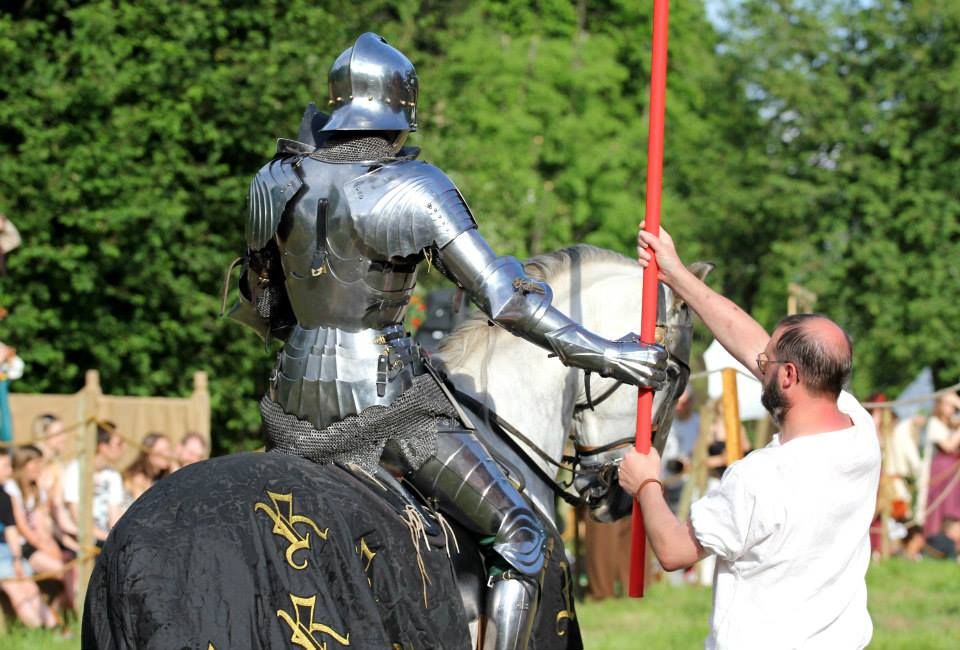
Arne Koets and Joram van Essen joust at Sankt Wendel 2012(photo by Hanno van Harten)


Wednesday, March 19, 2014

Re-Creating Medieval and Renaissance Saddles: Part One

Written by: Arne Koets
Edited by: Zhi Zhu

Over the last 15 years our loose band of jousting brothers, including Joram van Essen, Wouter Nicolai and myself among others, have been doing research and conducting various experiments regarding Medieval and Renaissance saddles and their use in contemporary jousting and mounted combat.

At first we mostly experimented with modified cavalry saddles of various kinds. These experiments gave rise to problems as the proportions were clearly wrong. All sorts of problems arose as a result of these modified saddles looking all right but being grossly out of proportion. This included the Royal Armouries ‘facsimile’ saddles, as we started to call them.

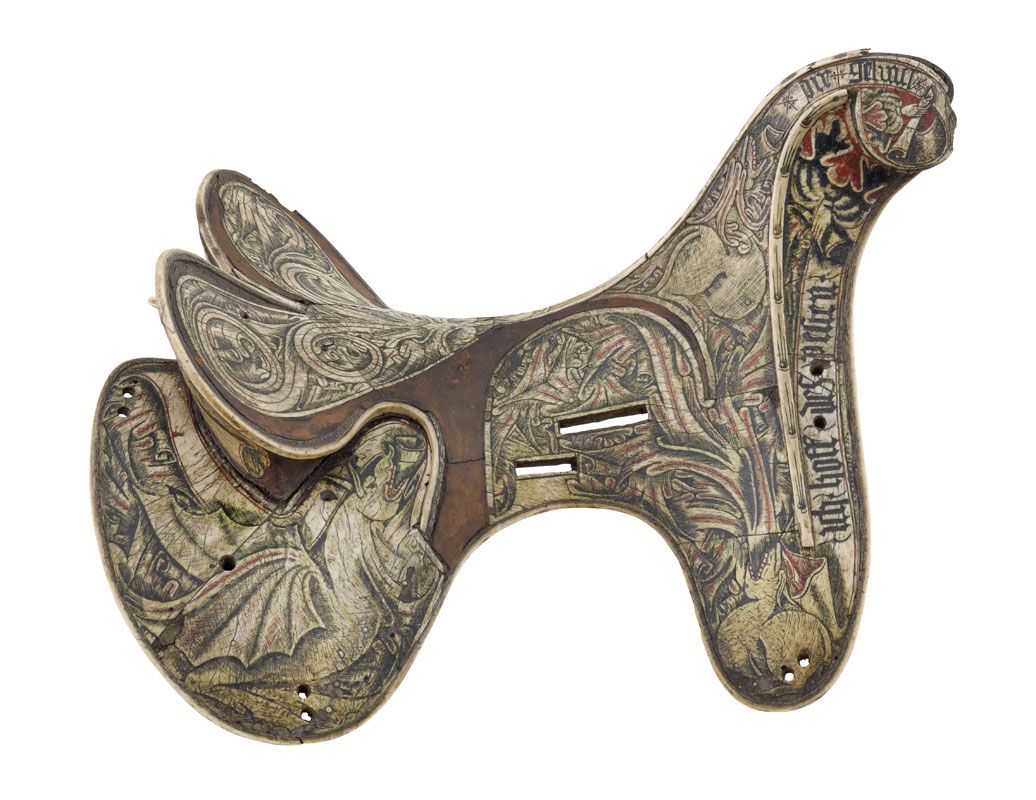
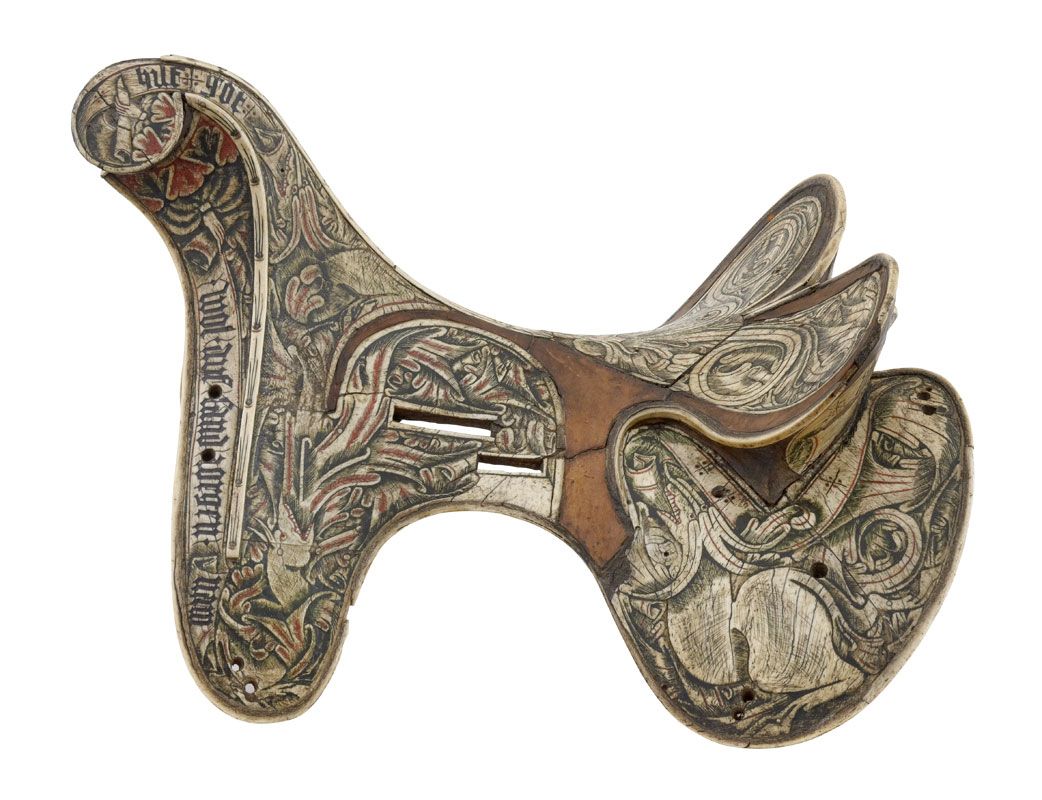
Later, we got the opportunity to examine and measure a number of historic saddles:  the 'Elfenbein' saddle in the Royal Armouries,


Saddle VI.95, 'Elfenbein' saddle, 'riding' style, 15th century Hungarian saddle, in the Royal Armouries(photo from Royal Armouries)

the saddles in the Wallace collection, including the A21 when it was off display,


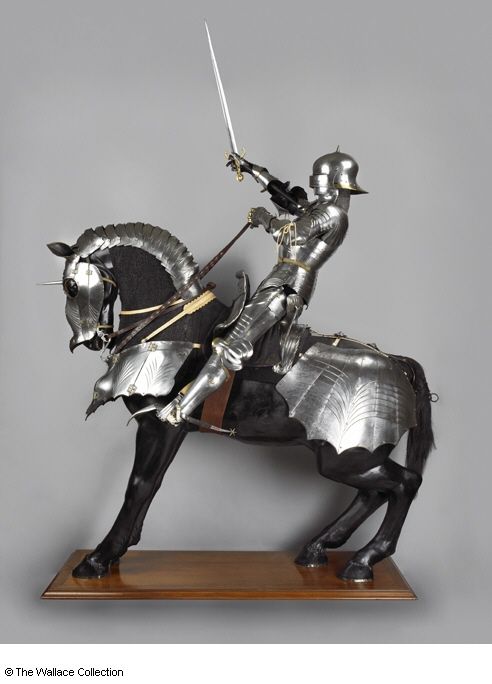
Equestrian Armour A21, featuring a 'war' saddle, in the Wallace Collection
(photo from The Wallace Collection)

the Arundel saddle and others. Various actual re-creations of these saddles were attempted over time.

The first attempts were mostly based around the raised seat concept of the so called ‘Henry V’ saddle and the Madrid saddle. The 'Henry V' saddle has an iron bar supporting the seat much like the wooden parts of the tree in Hohenzeug saddles(the saddles with the huge shields built into the fronts). Though there is some doubt as to whether this feature is original, it has shown to have some interesting effects.


The Henry V funeral saddle, in Westminster Abbey Museum(photo from Westminster Abbey)

Due to raising the seat, the weight of the rider acts as a lever, so that when any seat aid is applied, it is amplified. Unfortunately, it means that unbalanced riders are more detrimental to their horses. This is why I tend to call this style ‘the curb bit of saddles’.

This style of saddle does help greatly to get a good lower leg connection with the horse, especially when riding smaller horses. The raised seat makes it much easier for men over 180cm(apx 6') tall(not uncommon for nobility of the period, as archeological evidence from grave sites clearly shows) to ride horses under 15 hands high(so common in medieval times). However, the rider does lose the contact between the horse and the rider's inner thigh, meaning that the rider must depend more on the effect of the bit. Of course, guiding a horse using only the bit can be done to a high degree, as long rein work from classical dressage(and higher driving dressage, for that matter) clearly shows.

The style of riding necessitated by the raised seat saddle seems to be what Duarte describes in his treatise as the 'Third Style' of riding -- "those who ride firm and erect on the stirrups" -- frequently referred to as the 'a la brida' style of riding. This style of riding is commonly depicted, in particular in the second half of the 14th and the first quarter of the 15th century, but other styles of riding and saddles are also depicted throughout this time period.


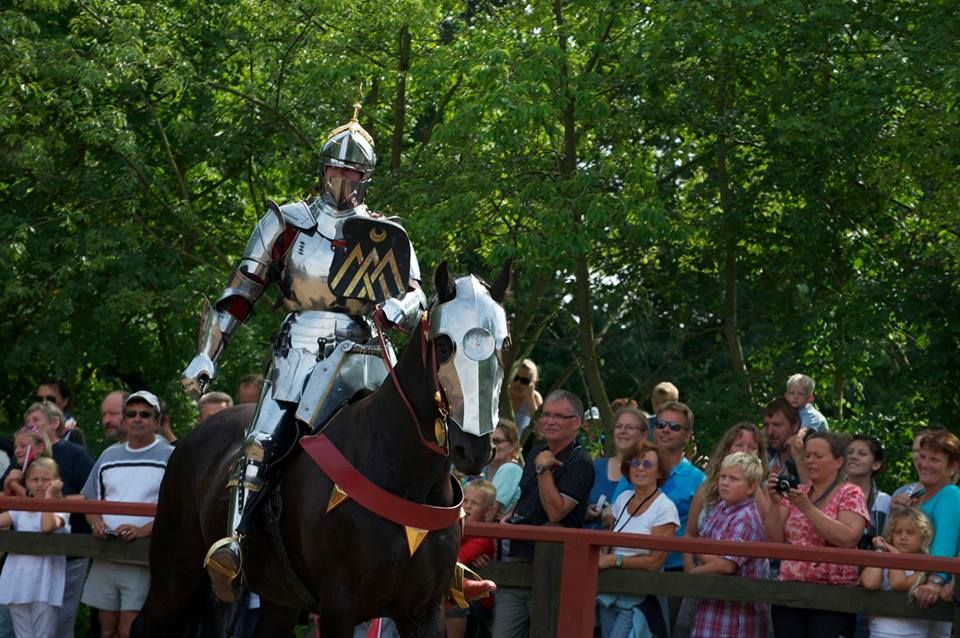
Dr. Tobias Capwell riding 'a la brida' in a raised seat saddle(photo by unknown)

However, many problems arose when we experimented with these raised seat saddles. They were uncomfortable, they could shift on the horses’ backs as a result of impact or imbalance, they were hard to fit, etc...So we decided that this style of saddle was not optimal for what we were trying to do and looked for other historic styles of saddles that might work better.

Two other styles of saddles that looked interesting enough to experiment with were what we came to call the ‘riding’ saddles and the ‘war' saddles of 'Bravante' style. Based on the description in Dom Duarte's treatise, we interpreted the ‘Bravante’ saddles to mean saddles similar in shape to the A21 saddle (which is a 16th century example) and one of the Vienna saddles(which is clearly datable to the middle of the 15th century, see photo below). The terms 'riding' and 'war' might be ambiguous, but they are at least descriptive.

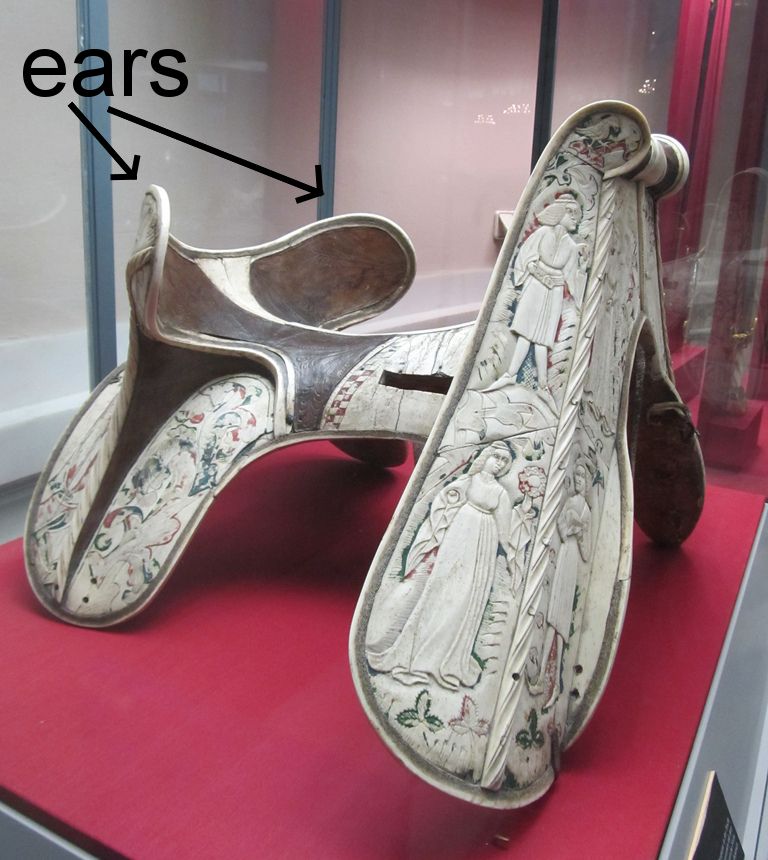
We called the saddles with 'ears' enveloping the hips more extensively ‘war saddles’.


'Elfenbein' saddle, 'war' style, in the Kunst Historisches Museum Vienna
(photo by Andrea Carloni(Rimini))

The ‘riding’ saddles are the saddles shaped like all but two of the ‘Elfenbein’ saddles, (which are actually not covered in ivory, as the German term suggests, but bone).


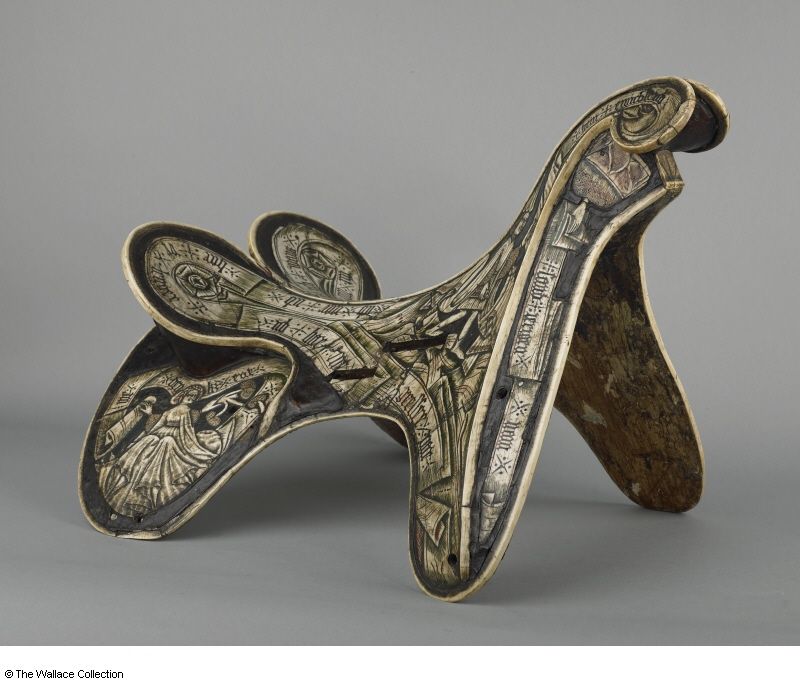
'Elfenbein' saddle A408, 'riding' style, in The Wallace Collection
(photo from The Wallace Collection)

It has to be noted that there are depictions of the ‘riding’ saddles being used in war, both by half armoured (fairly common) and fully armoured (fairly uncommon) men, and also for jousting. Also, the 'war' saddles are depicted being used for civilian purposes by riders in plain clothes, as in one of of the Schilling Chronicles (Tschachtlanchronik of 1470). However, the numbers are very skewed towards their named uses.

Bearing in mind medieval issues of logistics, it makes perfect sense that a saddle was generally transported by the animal it was meant to be worn by. Therefore one had to make do with what one had at hand. Also, it seems reasonable that some fighters only could afford a 'riding' saddle and not an additional 'war' saddle, which would explain why depictions of the half armoured fighters make up 1/3 of the depictions of 'riding' saddles.

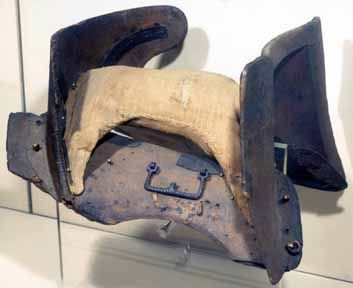
Both these saddle types derive from the same side board layout, however, and both types are made as continual composite blocks of wood.


Many pieces of wood are combined to form the composite that creates the saddle's form
(photo by Joram van Essen)

(Although the later 16th century examples of these war saddles are made of just the side boards with the seat shape made of felt, covered in leather… and they are just as hard to the touch.)

This side board layout is where the plot thickens:  the side boards are an inverted u-shape. Meaning that the side boards are comparatively narrow in the middle, but much wider in the front and back of the saddle, ‘drooping’ down the sides of the horse.


The side boards are the parts of the saddle that form an inverted U against the sides of the horse and that support the seat of the saddle(photo by Arne Koets)

This is similar to the shape of the cushions on Iberian saddles, yet, unlike the Iberian saddles, this shape is actually part of the trees in these historic saddles, and thereby interact with the horse in different ways.

Most professional saddlers we initially talked to took one look at the photos and immediately (by misinterpreting the scale) assumed that these saddle boards would restrict the horse very badly. The professionals shied away from the project in droves. It was the work some re-enactors -- Robert McPherson among others -- did in attempting to re-create these historic saddles that made real contributions to our understanding of what we were looking at when we handled the originals.

Based on the information gathered from historic sources and contemporary re-enactors, Joram van Essen and Wouter Nicolai made a plethora of experimental saddles with varying levels of success. Unlike other re-enactors who were trying to incorporate modern saddlery into historic looking saddles, Joram and Wouter were much more ambitious about their experiments and goals of historical correctness, trying to make their saddles as close to the originals as possible. What was learned from these initial reproductions led to the development of ergonomic and effective saddles that are not only historical, but also ergonomic to the horse and rider.

Joram and Wouter's historically based saddles will be discussed further in:
Re-Creating Medieval and Renaissance Saddles: Part Two

Friday, September 7, 2012

An Interview with Joram van Essen: Grand Champion of "The Grand Tournament in Sankt Wendel"

As mentioned in a previous article, Joram van Essen was the "Winner of the Great Honor Award"/the grand championship of "Das Grosse Turnier in Sankt Wendel"/"The Grand Tournament in Sankt Wendel"(GTSW).


Joram van Essen (photo by Ulrike Otto)

According to "The Knights" page of the official GTSW website:
New Zealand born Joram van Essen, teacher and amateur historian, has had a lifetime interest in Historical Martial and Equestrian pursuits. He moved to the Netherlands in 1999 where he was a founding member of the Foundation Historical Education Initiative (Stichting HEI) that was started in 2000 to promote Historical Education in the Netherlands. An avid jouster he has competed in the international jousts at the Royal Armouries in Leeds, England, where he won the world individual championship in 2003 and the world team championships in 2003 and 2005, amongst many other jousts around the world.

Joram’s philosophy is that jousting is an Art, which requires training, dedication and team work between horse and rider.

Joram was kind enough to answer a few questions about his involvement in the tournament.

How did you become involved with “The Grand Tournament of Sankt Wendel”(GTSW)?

Joram: I was contacted about two years ago by the organizer, Arne Koets, as he was looking for riders with the ability, armour and mindset to participate in this level of event.


Arne Koets(left) and Joram van Essen(right) face off during a melee
(photo by Hanno van Harten)

Tell me the name of and a little about your history/relationship with the horse you rode in the GTSW.

Joram: I was introduced to the Murgese stallion Zogo di san Paolo just over a year ago at the Fürstliche Hofreitschule Bückeburg on my first visit there as part of the training preparations for the tournament. After trying him out, I was offered the chance to buy him as they thought we would make a good team.


Joram van Essen on the Murgese stallion Zogo di san Paolo(photo by Michael Sicher)

Your company Historic Saddles made a number of the saddles that were used during the GTSW. Tell me a little about that.

Joram: There were 11 saddles made by myself present at Sankt Wendel, although due to horse/rider changes, not all of them were used at the same time. Leading up to the event in particular, I had three saddles to finish for the Norwegian competitors which kept me pretty busy for the last two weeks.


The three jousting saddles made by Joram for the Norwegian competitors at Sankt Wendel(photo by Joram van Essen/Historic Saddles)

The saddles are based on artwork of the period and surviving saddles such as the A64 saddle in the Vienna museum. One of the main features of these styles of saddle is the high cantle that wraps around the hips, making it very difficult to fall off from a large impact in the joust. I recall a couple of jousters saying if it hadn't been for the saddles, they would have come off during the event.

It was unfortunate that you were injured and unable to complete the competition. Could you please describe how you were injured?

Joram: This is the result of a steel coronel on a solid wooden lance. One of the prongs manged to get past my gauntlet, the other two being stopped by it. Nothing seriously damaged, just a tear through the skin and muscle. The end result though...
is that I will be using vamplates on the solid lances. Interestingly, you see the style of jousting we were doing illustrated in the same period and geographical location, both with and without vamplates.


Joram was injured during the last pass(at apx 3:00) between himself and Arne Koets (video by Riccardo Zanconato)

Congratulations Joram! Even though you were injured and unable to complete the competition, you were still the winner of “The Grand Tournament of Sankt Wendel”!

Joram: Despite the injury which saw me withdrawing from the final day's jousting, I had a high enough score lead and was was able to get back in time to ride in the team melee, which fortunately did not stipulate in the rules that I had to wear armour. So I rode in place of the banner bearer, which each team had assigned as a non combatant position, meaning they couldn't be hit, but were allowed to use their horse in blocking moves to help defend their team mates.


Joram(right) protects teammate Alix van Zijl(left) during the melee
(photo by Wendy Van Harten-de Bruin)

What would you like to say about/to the squires, ground crew and/or others who helped you during your participation in the GTSW?

Joram: In running such an event, a big thanks would also have to go to all the ground crew, valets, and grooms who came together as a very effective team, making it possible for the competitors to have horses ready on time, have lances to joust with and to get their armour on and off. Not to mention the water they constantly provided us with and the trips to the emergency ward for stitching us up.


Joram's stitches a few days after the tournament (photo by Joram van Essen)

What would you like to say about/to Arne Koets and the other organizers of the GTSW?

Joram: The tournament itself was organized, and ran very smoothly, and is a great credit to the dedication of Arne Koets and all the people who supported and made possible this incredible event. The competition was generally of a very high level, particularly in regards to the horsemanship shown in the melee by all the contestants. I think everyone felt that all the placings were well deserved.


Joram van Essen holds the "Prize for Greatest Honor" (photo by Oliver Dunsch)