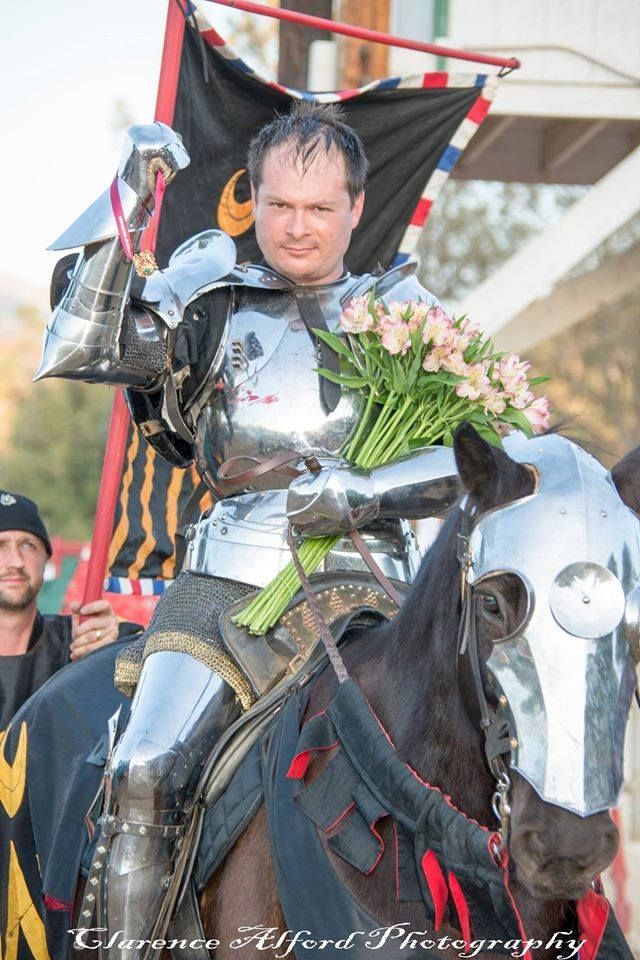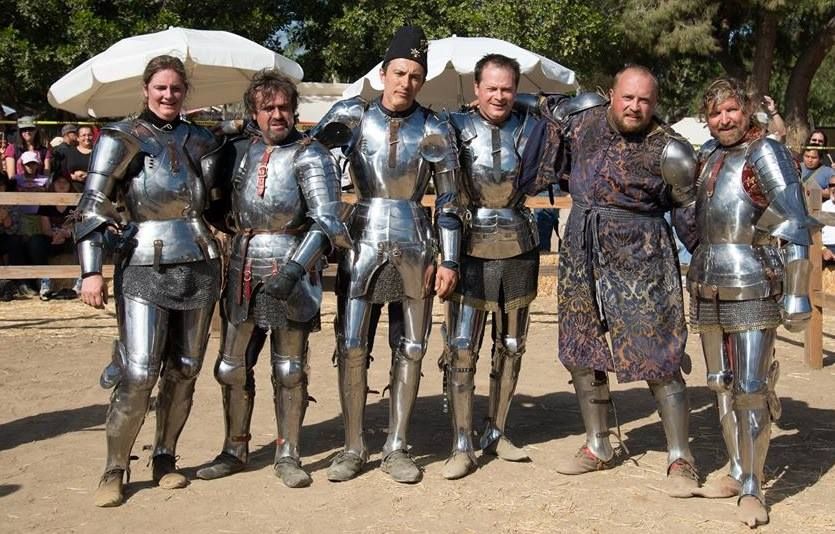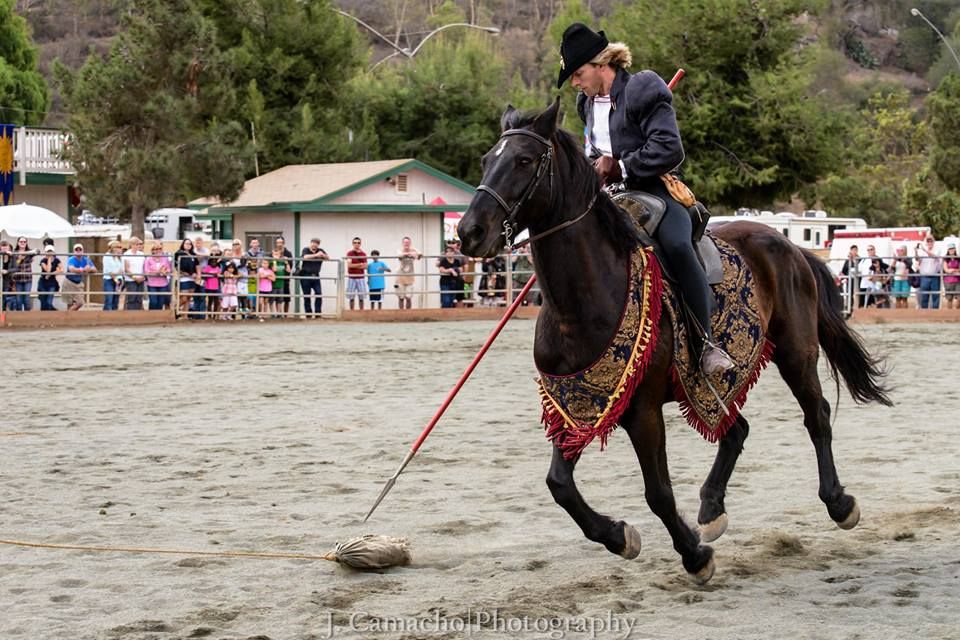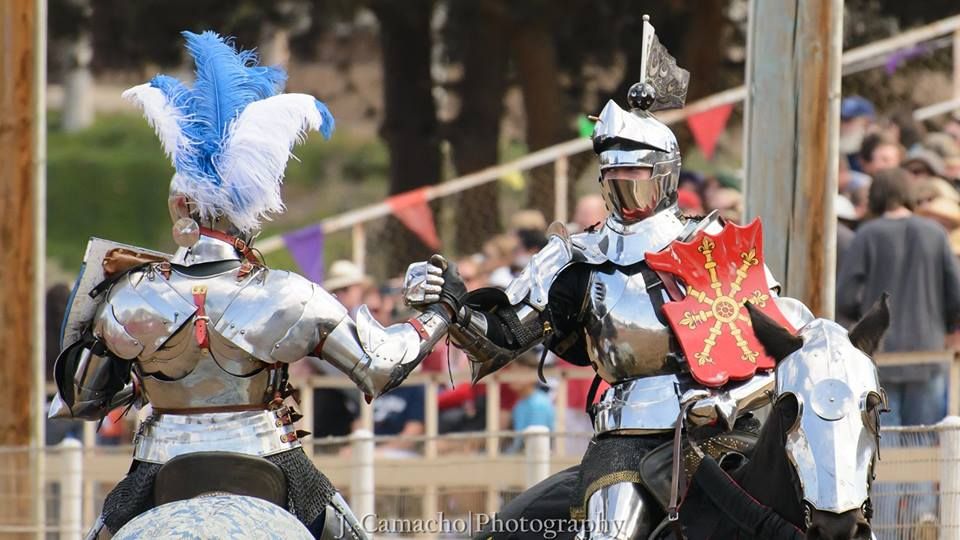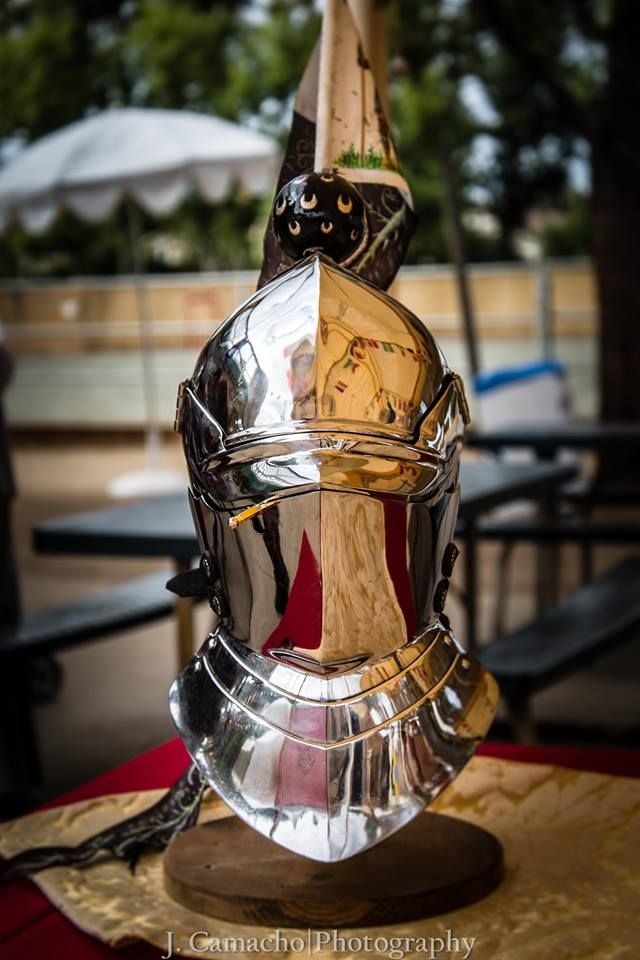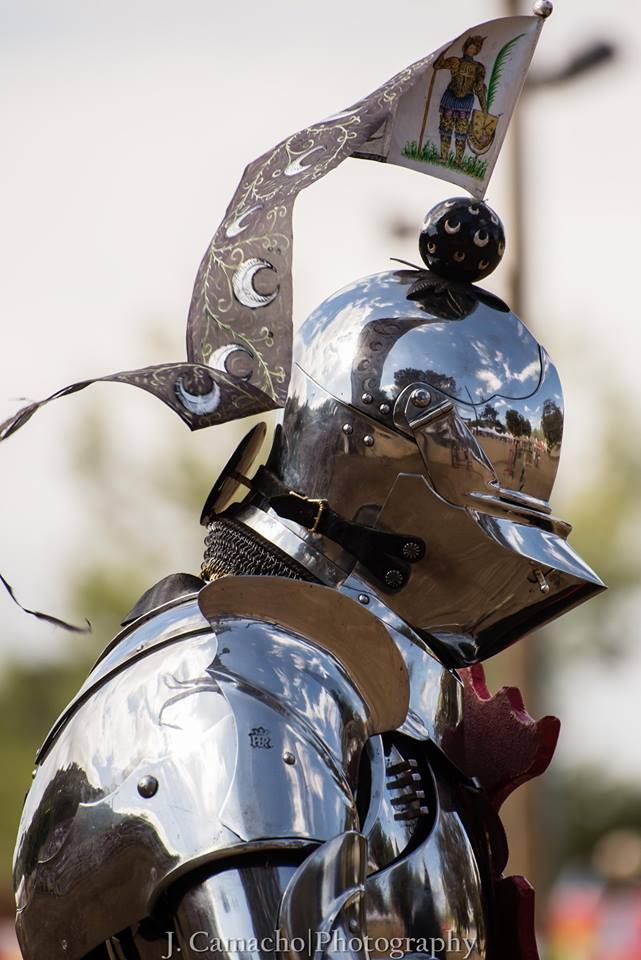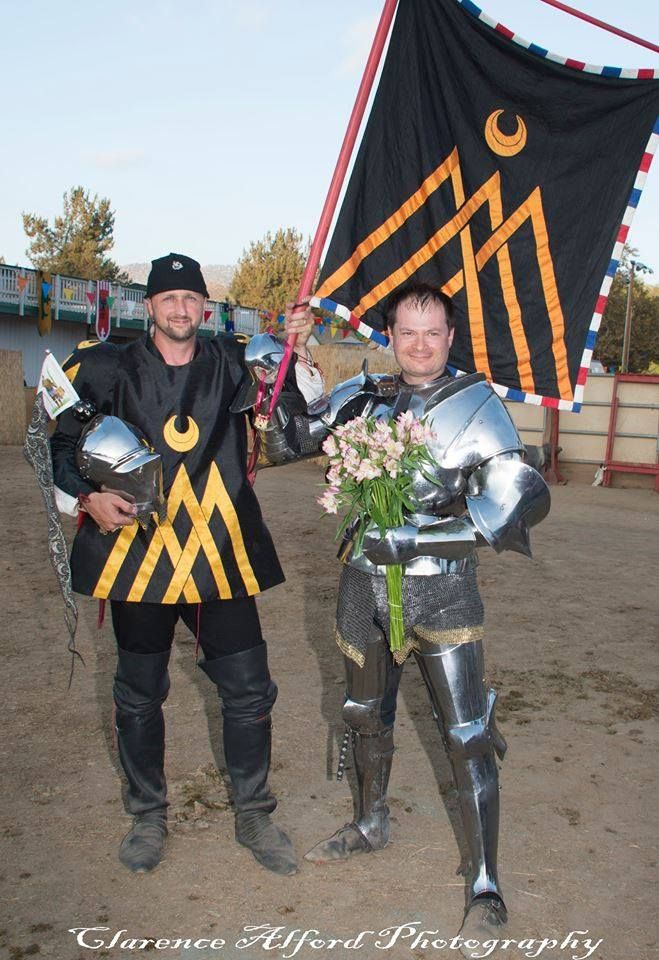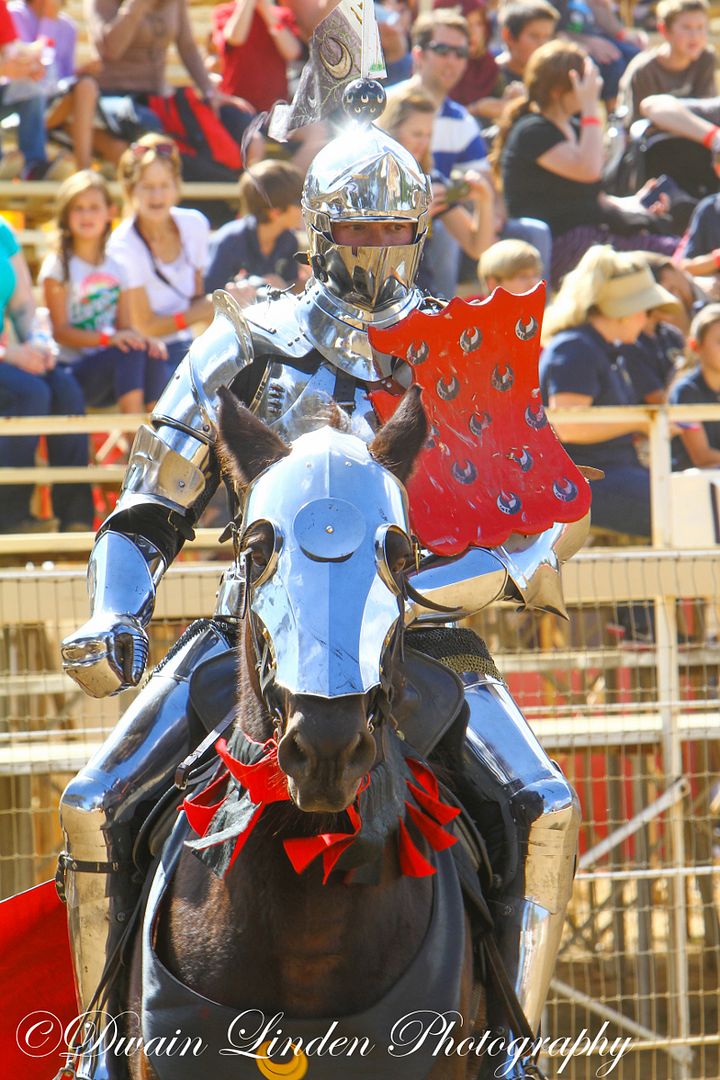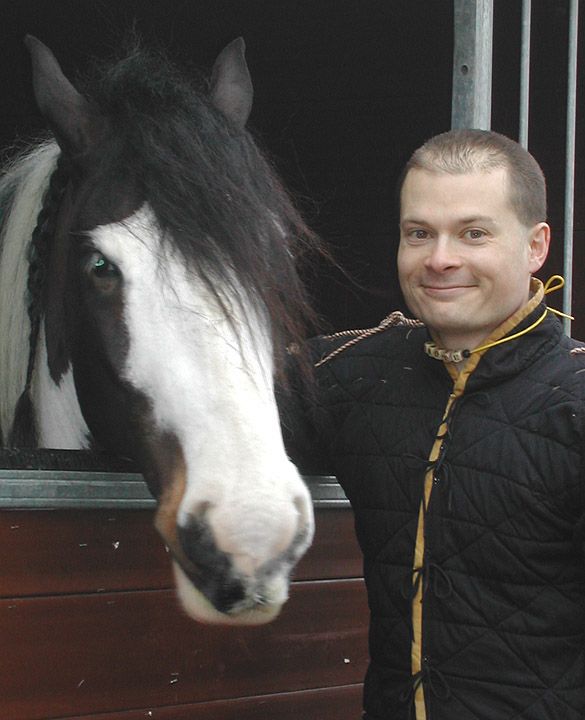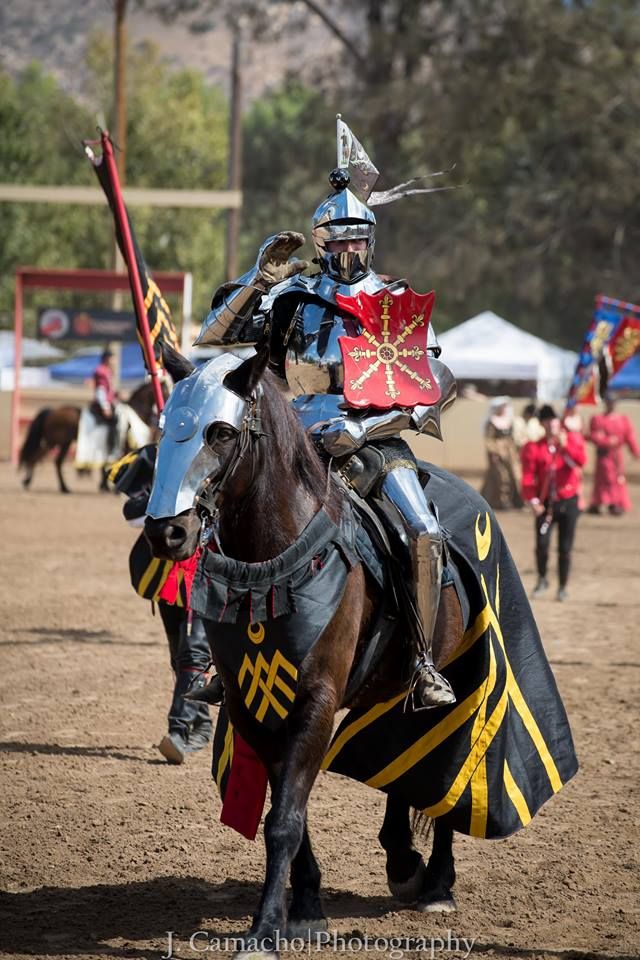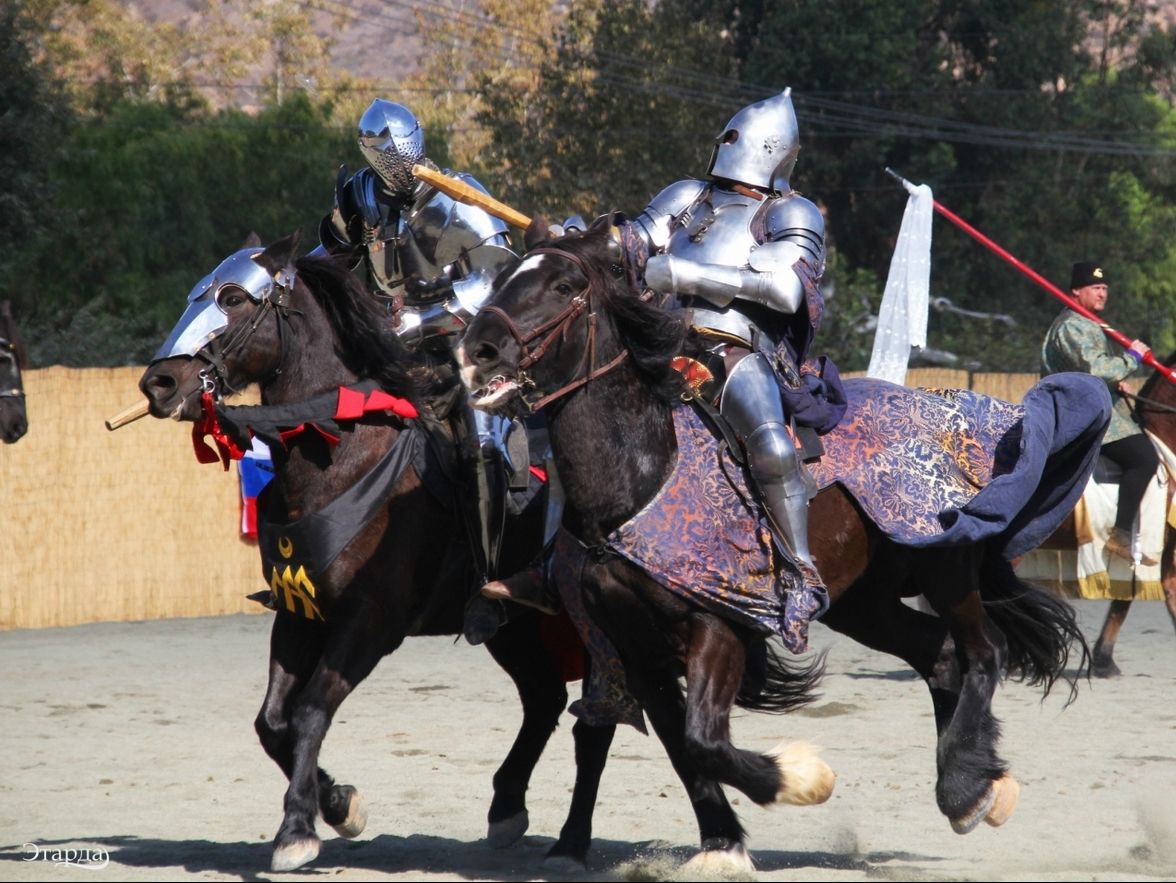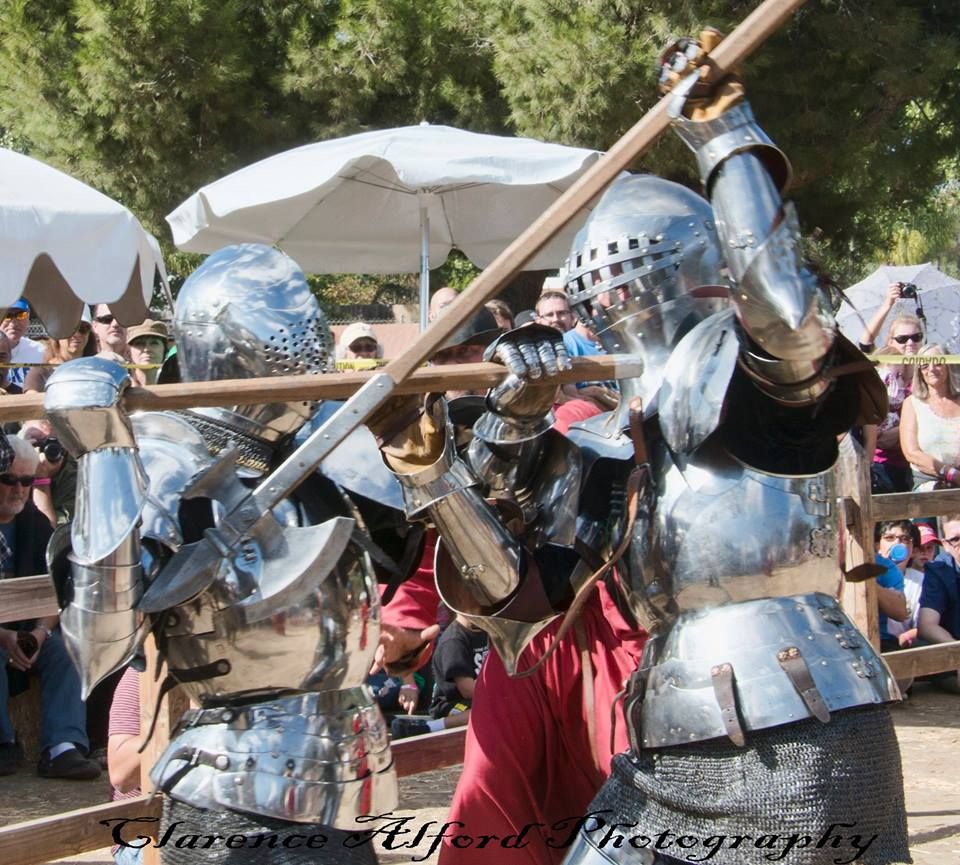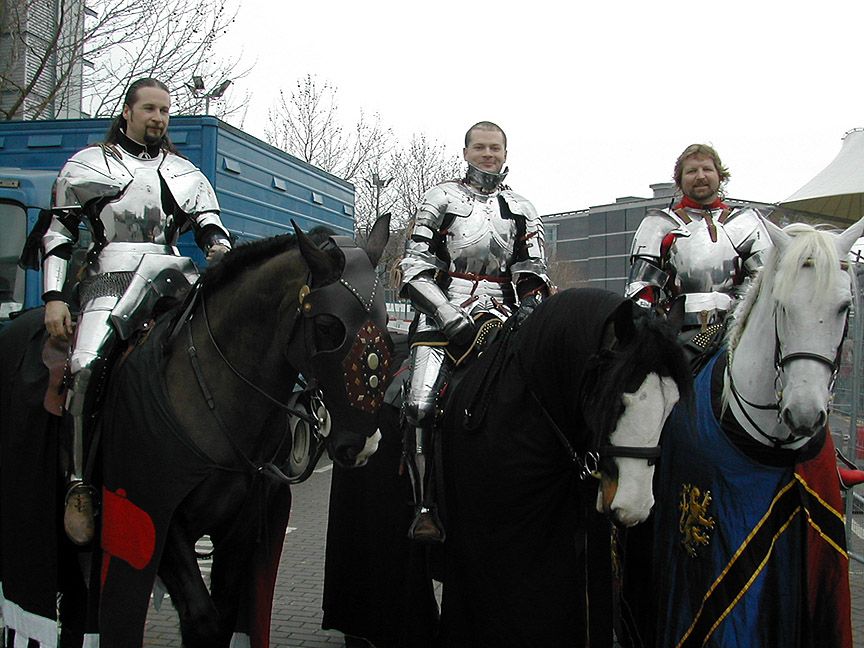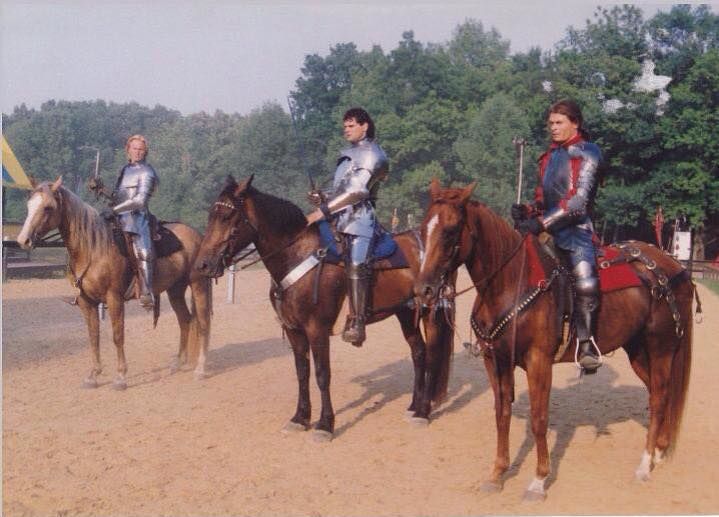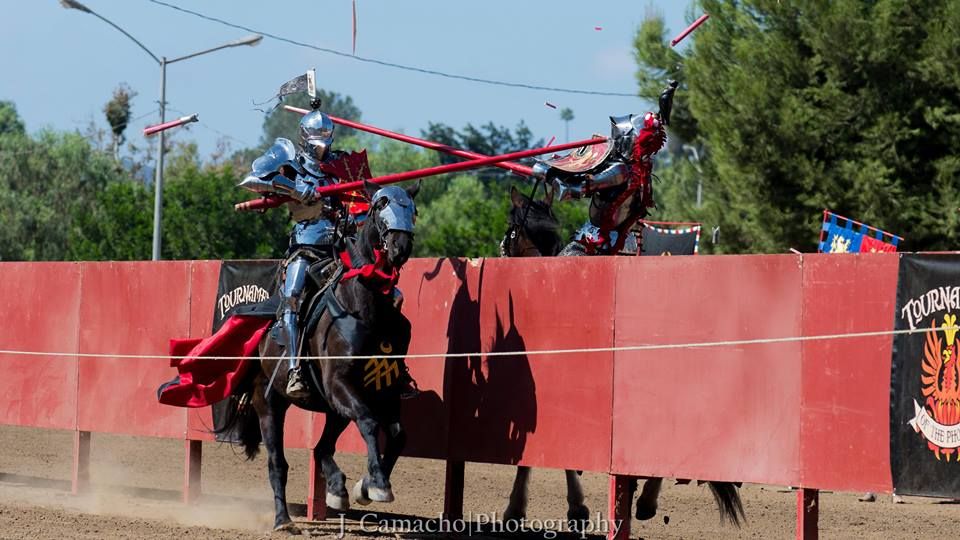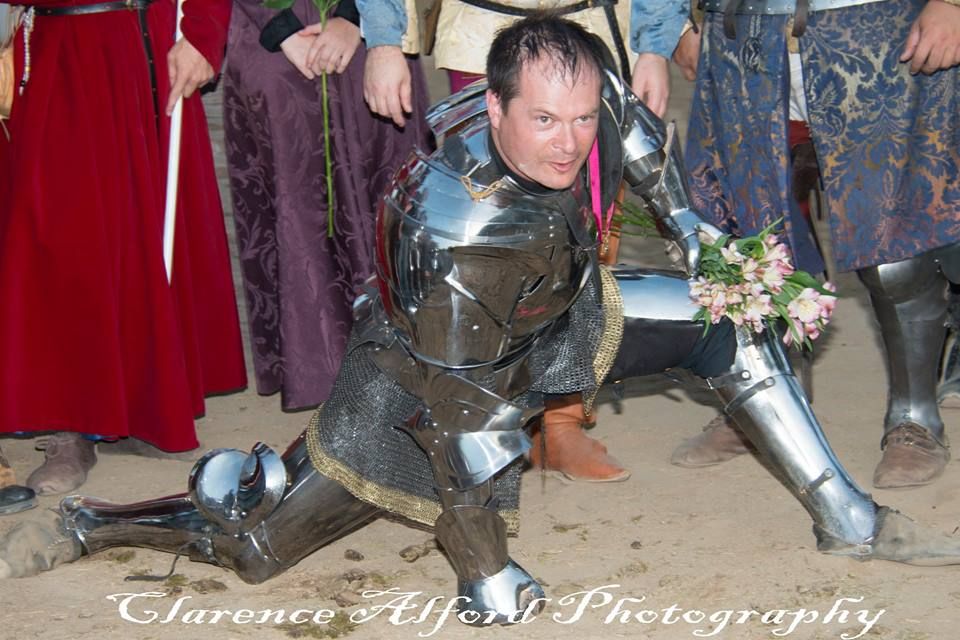

The Grand Tournament at Schaffhausen was a grueling ten day tournament display held in conjunction with an exhibition of knightly arms and armour at the Museum zu Allerheiligen in northern Switzerland. Arne Koets, who organized The Grand Tournament of Sankt Wendel in 2012, was also the tournament organizer for the joust in Schaffhausen.

Arne Koets during the Grand Tournament at Schaffhausen (photo by Andreas Petitjean)
A total of eight jousters participated in the tournament including: Bertus Brokamp, Toby Capwell, Petter Ellingsen, Arne Koets, Wouter Nicolai, Dominic Sewell, Joram van Essen and Alix van Zijl. The jousters did not ride the same horses throughout the tournament because that would have been too hard on the horses. However, the horses that were ridden were: Bertus' Andalusian stallion Talento, Toby's Friesian stallion Duke, Petter's Andalusian gelding Sigismund, Arne's Andalusian gelding Maximillian and his Lusitano stallion Sultan, Wouter's Andalusian stallion Flamenco, Dominic's Andalusian gelding Coralito(in his first jousting season) and his Belgian Warmblood stallion Marduc, Joram's Murgese stallion Zogo, and Alix's Andalusian stallion Torero. Interestingly, Talento and Torero are half-brothers.
The Lady of Honour was Christine Krischke and she rode her Berber stallion Raisulih. The Tournament Master was Wolfgang Krischke, Court Riding Master of the Fürstlichen Hofreitschule Bückeburg, who rode his magnificent Knabstrubber stallion Olymp.
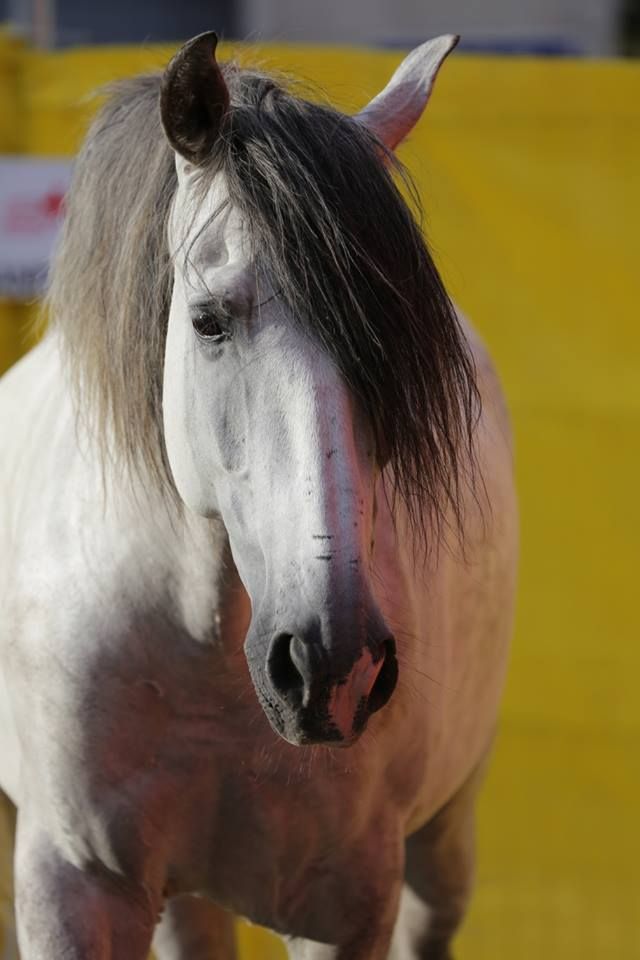
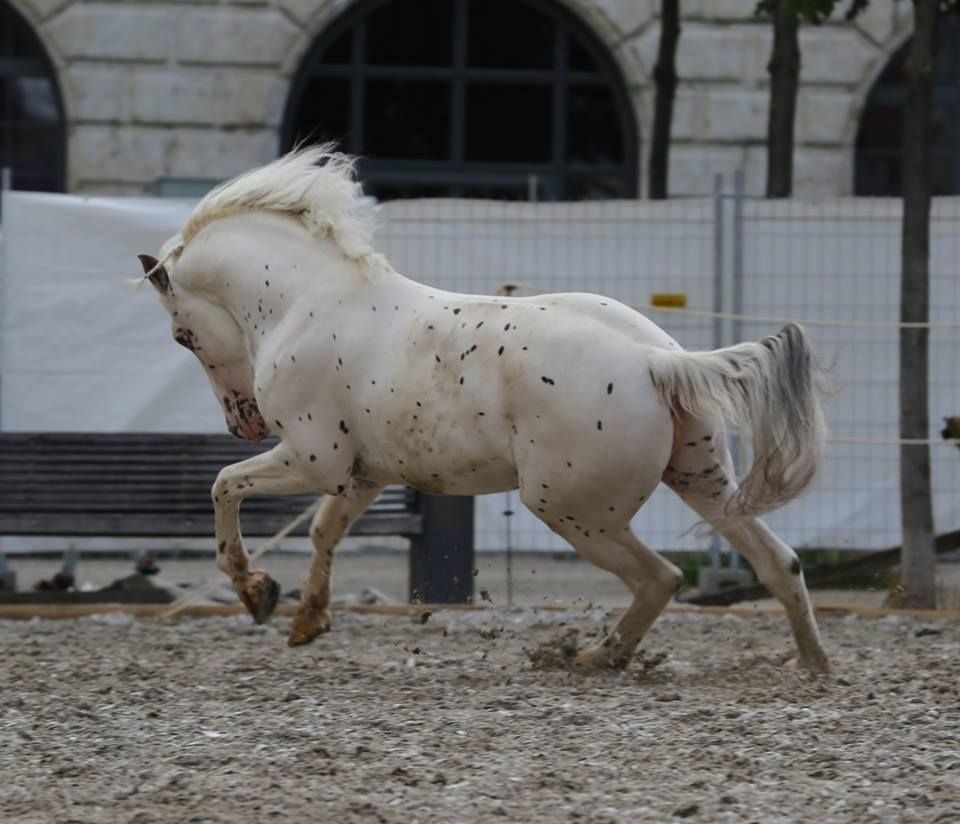
Left: Arne Koets' Andalusian jousting horse Maximillian,
Right: Wolfgang Krischke's Knabstrubber stallion Olymp (photos by Andreas Petitjean)
There were two sessions of jousting/mounted melee each day, and many of those sessions sold out. In fact, during the course of the whole ten day event, approximately 80% of the jousting tickets, which cost 30 - 45 francs and also allowed entry to the museum exhibition, were sold.
Despite somewhat uncooperative weather, none of the sessions were cancelled, and only one was delayed. Before each session of jousting/mounted melee, an explanation of the history and rules of the tournament was given to the audience. Other information, such as details on the art of riding, was also provided.
Each session of jousting actually involved five separate parts, all based on an extant description of an actual tournament that was held in that very square in Schaffhausen in 1436.
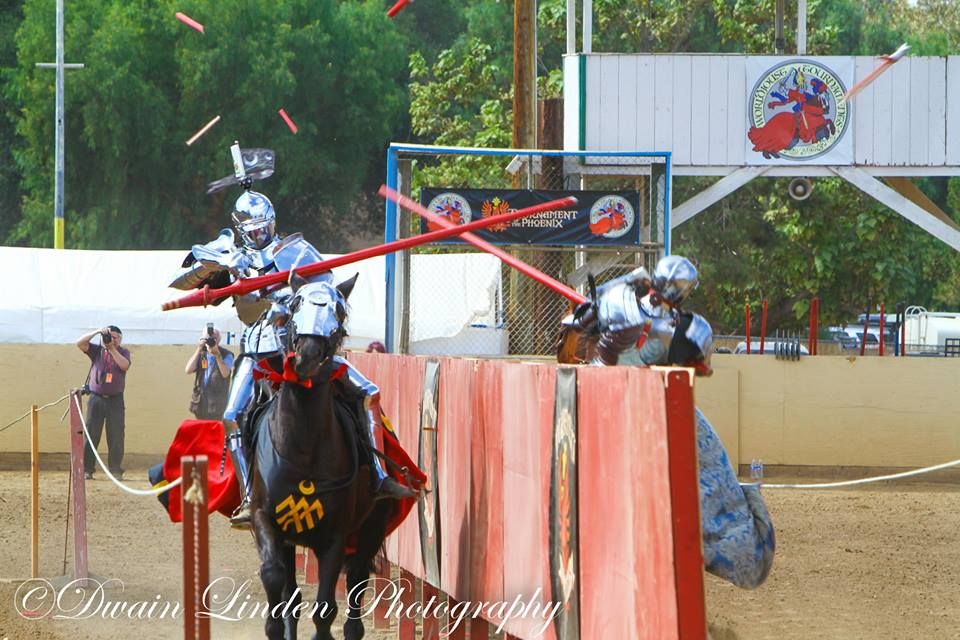
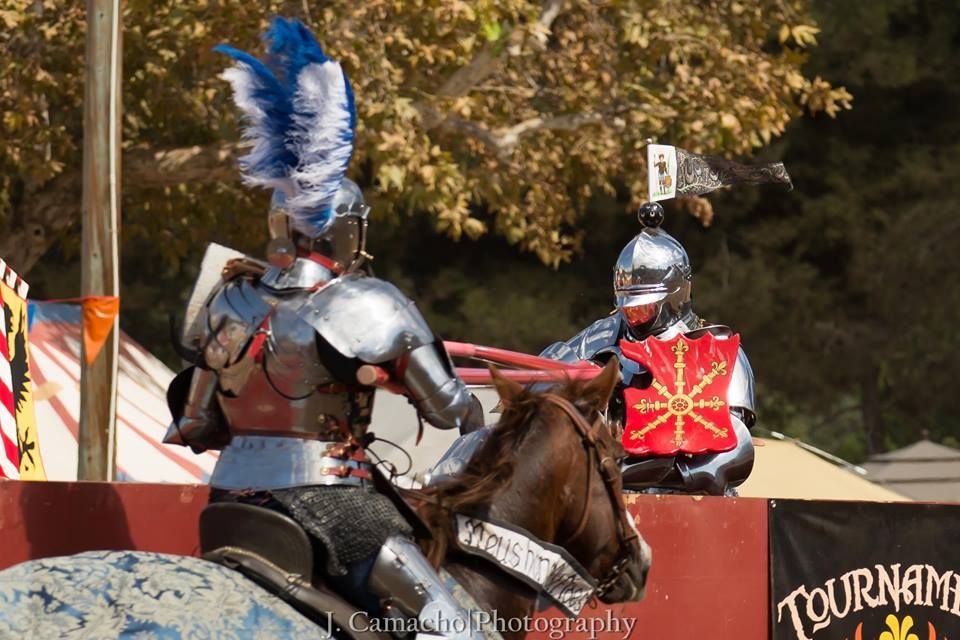
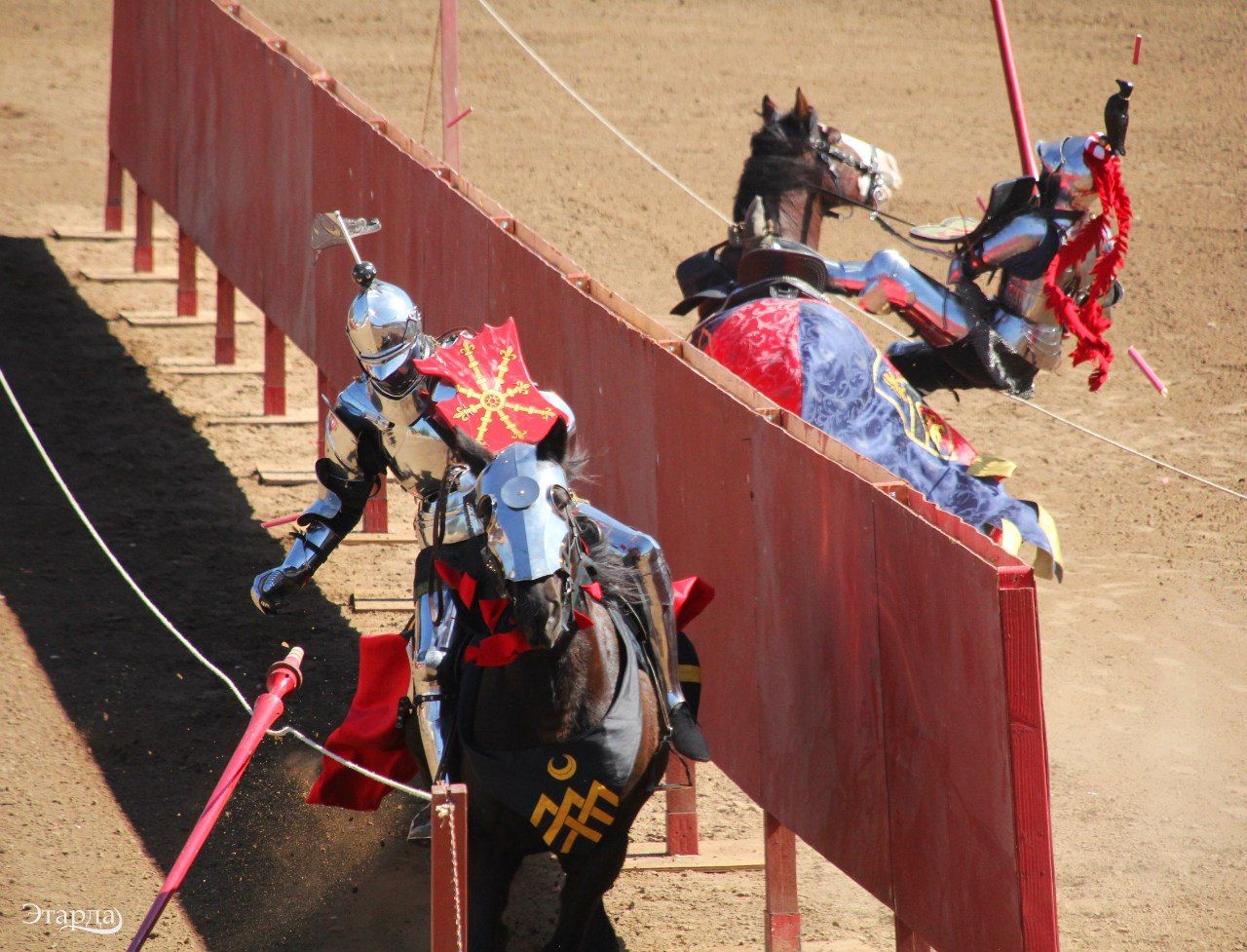
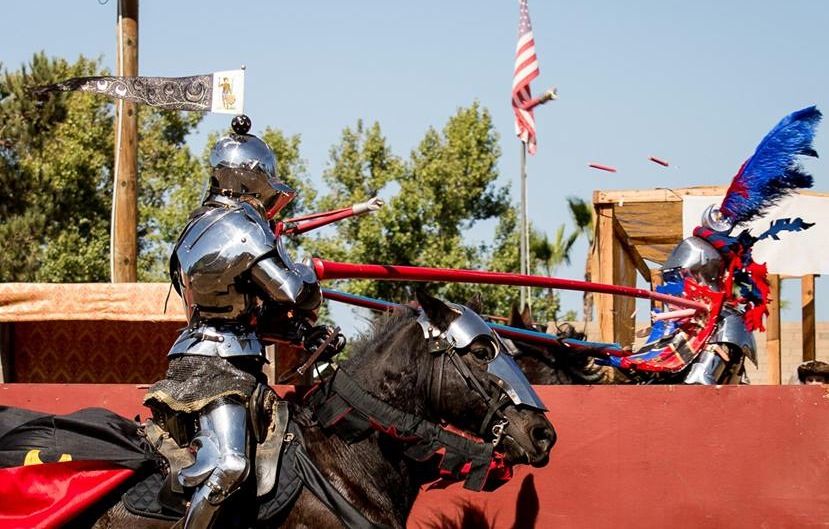
First, there were two matches of jousting, with two different jousters in each match. Each match consisted of three passes with lances down the length of the tilt. The lances used for the jousting were shaped solid wood with sharp steel coronels. A winner for each pass was declared based on a set of historical rules involving riding, lance handling, where the opponent was hit and whether the lance broke. The jouster with the best two passes out of three won the match.
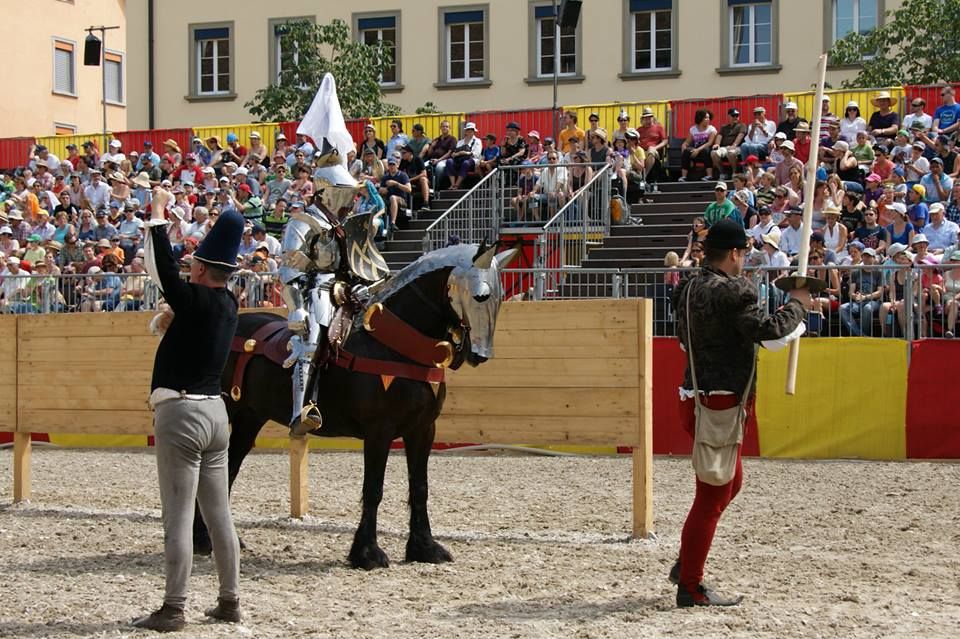
Toby Capwell waits at the end of the tilt as a member of the ground crew carries
away his broken lance, and a line judge signals the score for that pass.
(photo by Ingrid Isabella von Altdorf)
Second was a Mounted Duel using steel swords on horseback. The duels were judged by the Tournament Master and the Ladies Court, and the winner was determined based on both riding ability/horse positioning and the number of strikes landed against the opponent. According to Arne Koets, in every case, the competitor who rode the best also landed the most strikes, so determining the winner was easy.
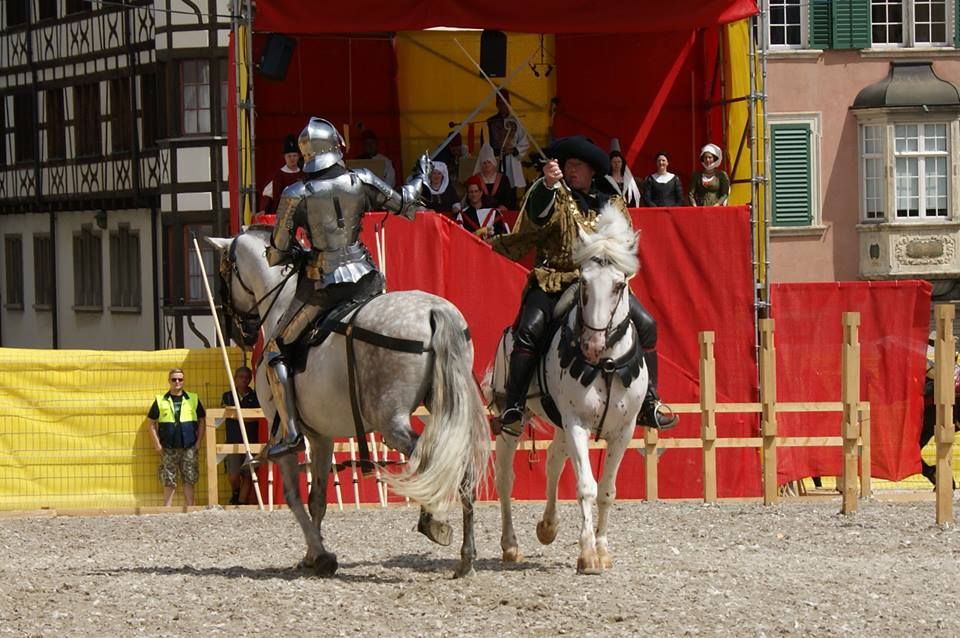
Wolfgang Krischke takes a break from judging to participate in a mounted duel
with Arne Koets. You can see members of the Court in the stands behind them.
(photo by Ingrid Isabella von Altdorf)
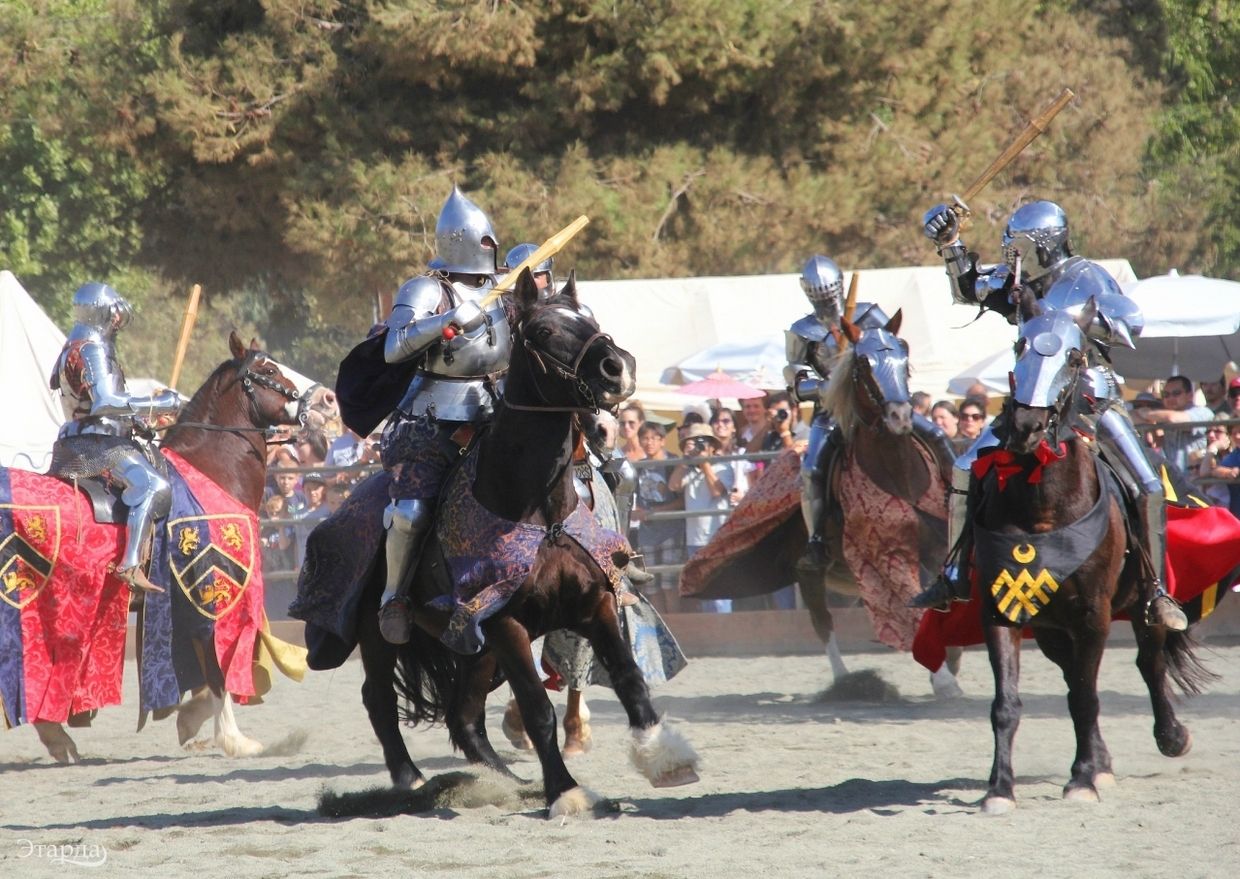
Third was a Team Turnier(mounted melee), which consisted of two teams of three riders each charging at each other and attempting to strike the members of the opposing team with wooden clubs. Acceptable target areas included any part of the body covered by armour above the waist. For each session, the charge was repeated three times. When a rider broke a club, he could collect a new one from the squires. As many as 12 clubs were broken PER SESSION.
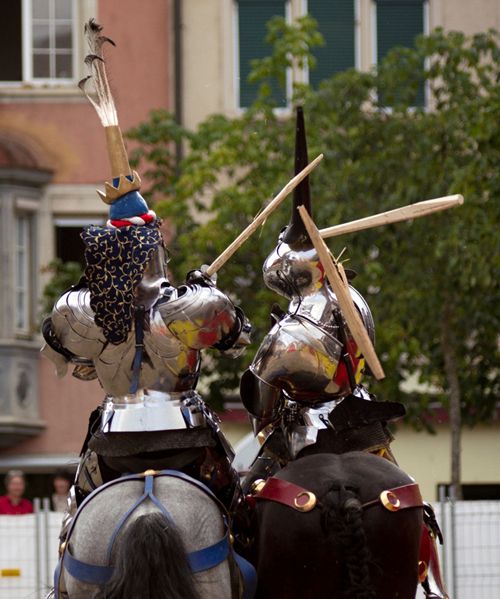
Joram van Essen breaks his melee club over Toby Capwell's helm
(photo by Isis Sturtewagen)
Fourth was a living history display of the 'punishments' that were described in the historical record of the tournament. These historical re-enactments were based on the museum's interpretation of the documents describing them.
Fifth, and finally, there was a Nachturnier or 'after-tournament'. This was an individual Crest Melee where competitors used steel swords to try and knock the crests off of everyone else's helms. The last competitor with his crest still attached to his helm was the winner.
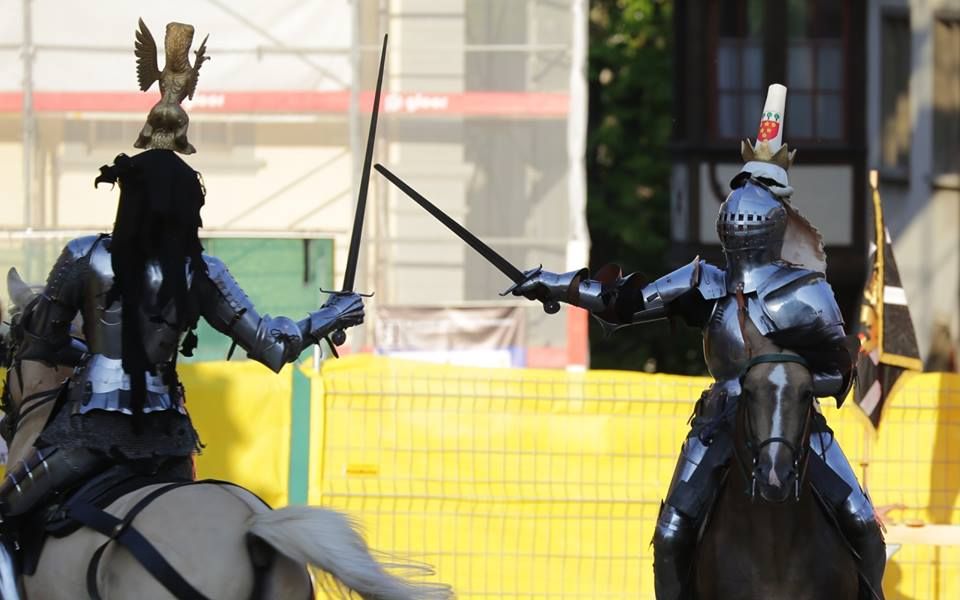
Arne Koets and Alix van Zijl during the Grand Tournament at Schaffhausen
(photo by Andreas Petitjean)
Even though this type of mounted combat can be dangerous, especially when doing it twice a day for ten days, only two injuries occurred – both caused by impacts with the crossguards of the steel swords used in the Nachturnier.
Not long after the Grand Tournament at Schaffhausen, Arne Koets graciously answered several questions about the event. [Due to various circumstances, it took quite a while to publish this interview. My apologies to both Arne and to the readers of The Jousting Life.]
How did the Grand Tournament at Schaffhausen come into being?
I was recommended to organize the tournament for the museum, whose director had organized an event in Berne some years ago. He wanted to enhance his knightly arms and armour exhibition, and we were meant to give a slice of history, doing it for real. Hence the combat was competitive, but in a medieval, not in a modern sense. We were to capture the image of the original historical tournament.
The jousting/mounted melee sessions were a museum ‘interpretation’ and the texts were straight out of the original sources (edited by the director himself). We re-created the whole four day tournament in the space of one hour. Twice a day. For ten days running. The only thing we didn't have was 195 riders on the field like there were in 1436.
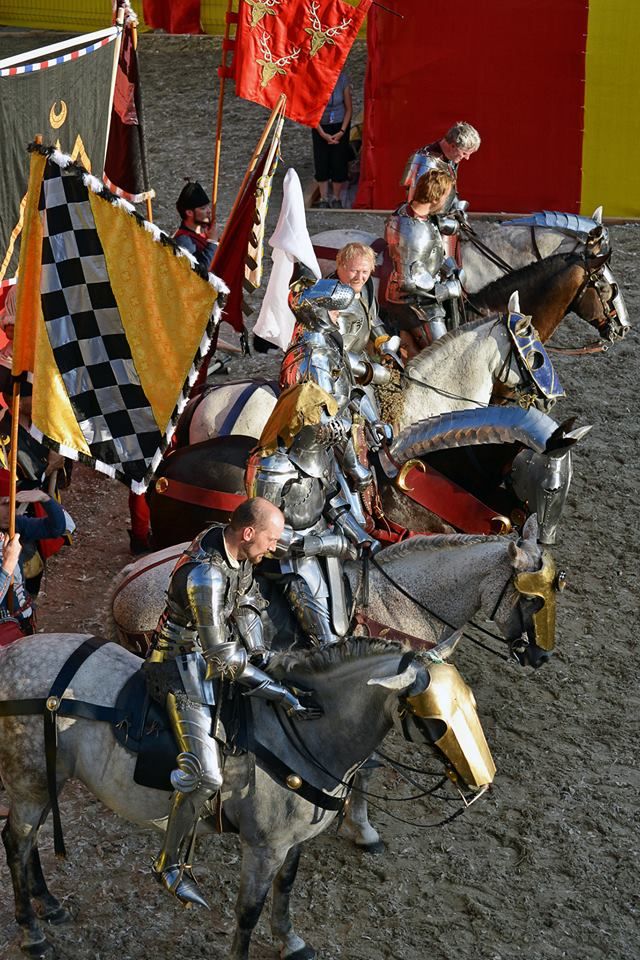
Six of the eight jousters who participated in Schaffhausen. From bottom left to top right: Arne Koets, Wouter Nicolai, Toby Capwell, Petter Ellingsen, Bertus Brokamp and Dominic Sewell
(photo by Stefan Kiss)
What were the biggest challenges in organizing the tournament?
The amount of shows. Twenty shows is a lot, but 20 shows with up to 5 melees in each is even more insane! The level of what we wanted to do was really high in terms of riding, saddlery, armour, fighting technique and weapons accuracy, but also we made a marathon of it. Due to the long duration, the team size was very limited, and we were a bit understaffed due to the cap on overall team numbers.
A HUGE challenge was to manage the workload on the horses. The weather was really hot, as well, and we rotated the horses and riders, as planned from the start. The horse transport was also very complicated due to customs, and that cost a great deal of money.
Also the site is very strongly sloped and small due to the requirements of the grandstands and the surrounding shops. In medieval times, the square's outside track would have been the audience area. Now, it needed to be kept free, reducing the field to tiny proportions.
There were very many challenges to get such a complex event to run. Too many to mention.
Explain how the tournament related to the exhibition at the Museum zu Allerheiligen?
We really did a museum display, where we showed a slice of history, and the actual combat was there to supply one of the aspects of authenticity. The arms and armour exhibition was showing in great detail many of the aspects of German tournament culture, and we wanted to incorporate as many of these in the display as possible. We rejected the set notions of how shows are normally run, and instead, first formulated what would have actually been seen in the historical tournament, and only then reduced it to a watchable show for a modern audience.
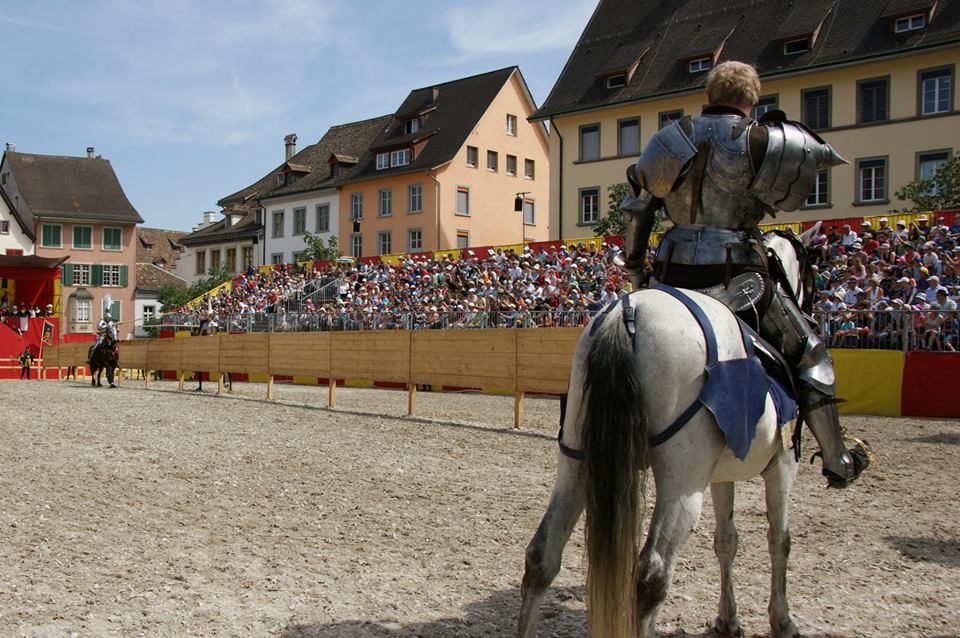
Petter Ellingsen waits at the end of the tilt while two other jousters compete
in front of a sold out audience (photo by Ingrid Isabella von Altdorf)
How do you think tournaments such as this one can benefit those who study history?
Due to using a great deal of rare pieces of equipment (like saddles and special helmets), we were able to experiment in new directions, but also the completeness of the ‘experiment’ made it worthwhile to get new insights. There were several visitors from America – academics who flew over for the occasion. We had a lot of museum curators and directors there to see it, and they were able to confirm our interpretation, as well as see things in a different light – understanding much more of the culture and the mechanics of what they study as static objects and written accounts.
Describe any specific training you and/or the other jousters did in preparation for this tournament?
The process started really in 2010, when we replaced almost all the horses in the team and started riding in a more historical way, and being helped a great deal to develop the collected exercises. The team of horses, the time to prepare and the equipment was made and extended. Especially in Holland, several test training's were run, but also clinics in England and Germany were run, so that we could develop the lances, the clubs, the tactics, the riding, the saddles....
Most of the riders worked daily on this development over the last 4 years, ordering armour, riding, learning, reading up on riding theory, etc....
There was also a significant push for mounted martial arts.
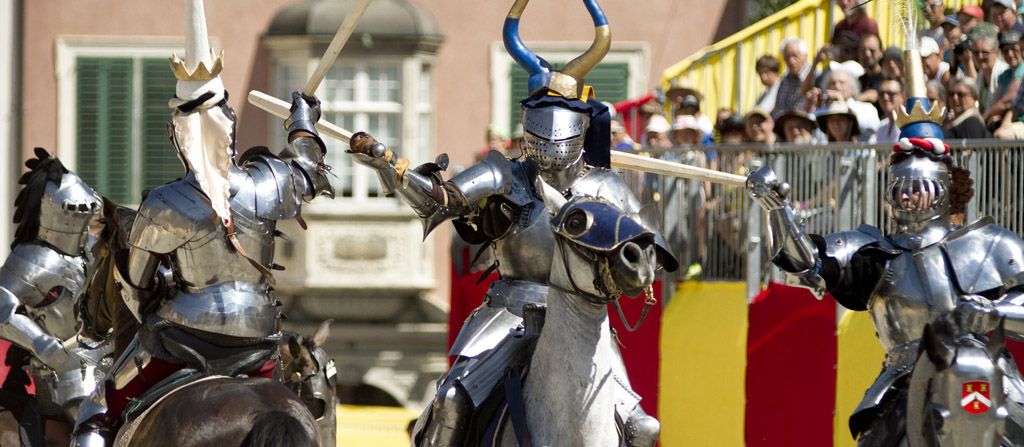
Bertus Brokamp, Alix van Zijl, Petter Ellingsen and Joram van Essen during a mounted melee, Schaffhausen 2014 (photo by Isis Sturtewagen)
What can you tell us about the two injuries that were sustained during the mounted melees?
Two horses running at one another have a lot of force, so the dynamics of the swordwork in the Turnier(mounted melee) are quite impressive, and sometimes things go wrong. Bertus' hand punched into a crossguard. The thing was that Bertus' injury was an unfortunate accident. He was hit on the inside of his hand where the leather glove is inside the gauntlet.
Joram was struck in the face with Toby's crossguard. During the melee both men were riding like furies and came upon one another frontally. Whilst they were targeting each others' crests, they noticed they were about to crash and made a last minute swerve to make sure the horses did not collide. However, that could not be said of the riders themselves. Not only did the armoured men hit each other, the hilt of Toby's sword punched onto the visor of Joram's helm with the force of the two colliding horses.
Despite needing stitches, in true warrior fashion Joram came back to the tournament almost instantly and kept rocking the event with his skill and presence...
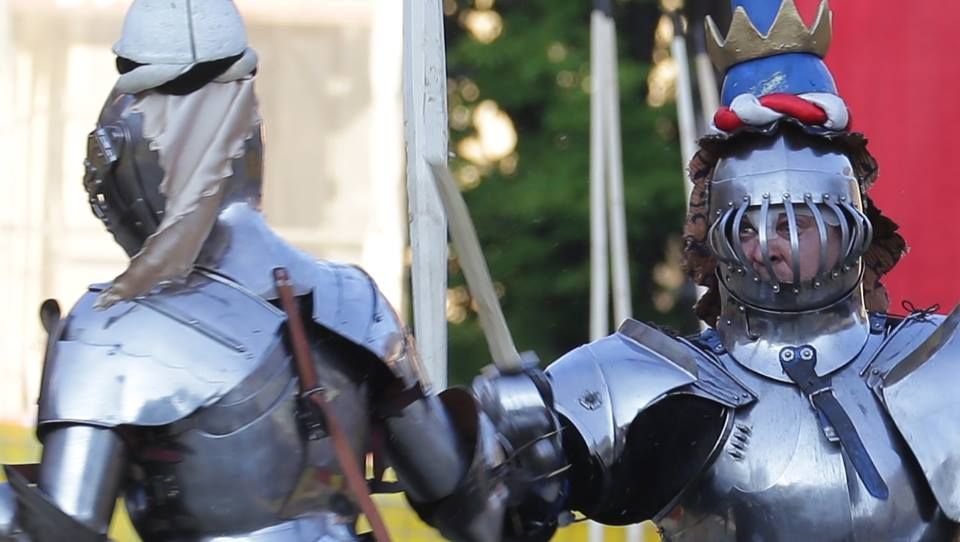
Alix van Zijl and Joram van Essen. Through Joram's visor you can see the bandages
from being injured during a previous Turnier (photo by Andreas Petitjean)
Please describe the type of lances used during the tournament and why that style of lance was chosen.
Fir tree-trunks. The lances were grown, naturally-tapered fir lances with steel coronels, vamplates and grappers. They are representative of 15th century lances as depicted, described and extant.
Please tell us about your armour.
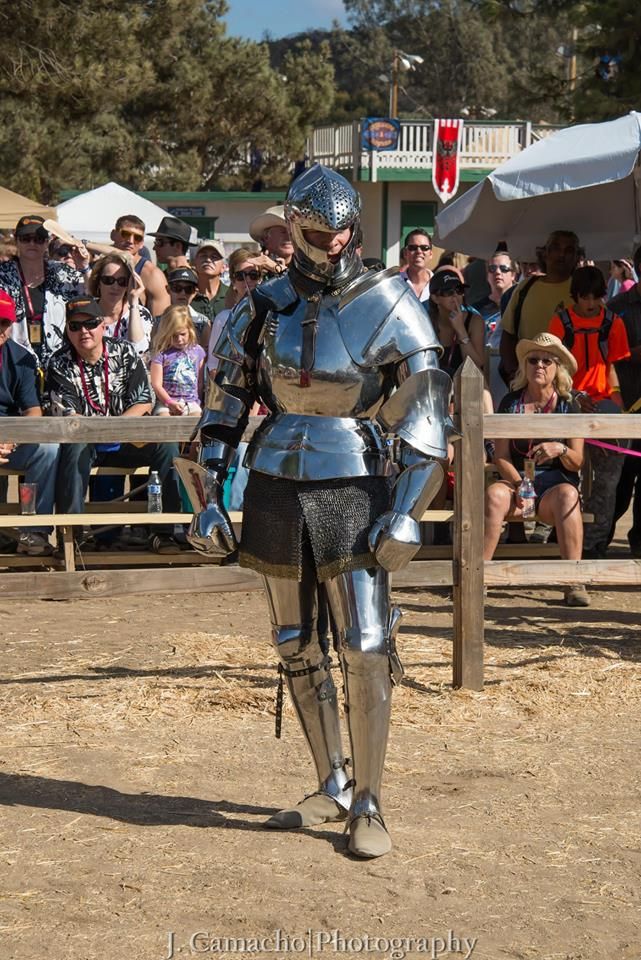
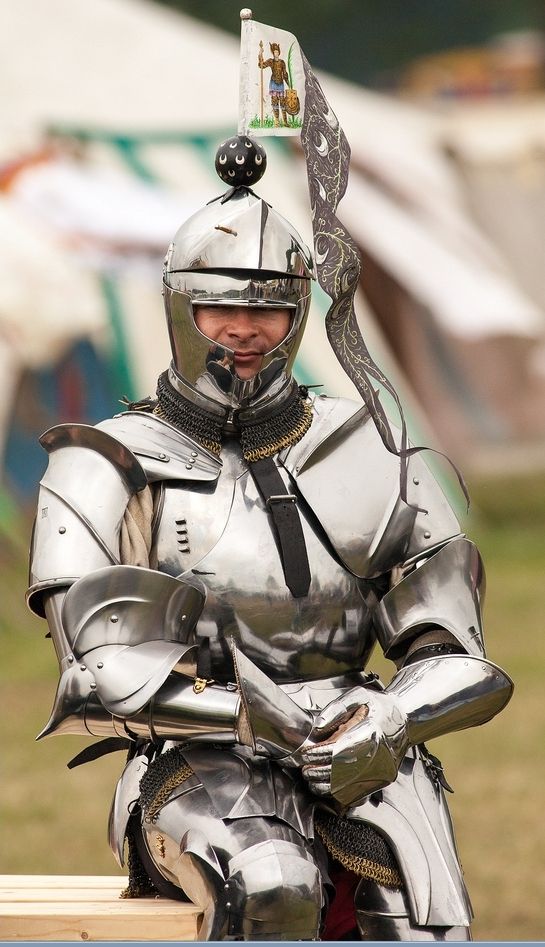
We use field armour with sport specific exchange pieces, as was the norm in 1460s. My personal armour is based on effigies of Ulrich Busch and Ulrich von Hohenrechbrech (both +1458) with exchange elements from Michael Pacher and Talhoffer. The armour is clearly German in design. Across Europe, the hinged cuirass was used in England, Iberia, France, lowlands, the empire, Italy… mostly everywhere. The silhouette and design of the armour is otherwise distinctly German and specific to the distinctly German style of this period.
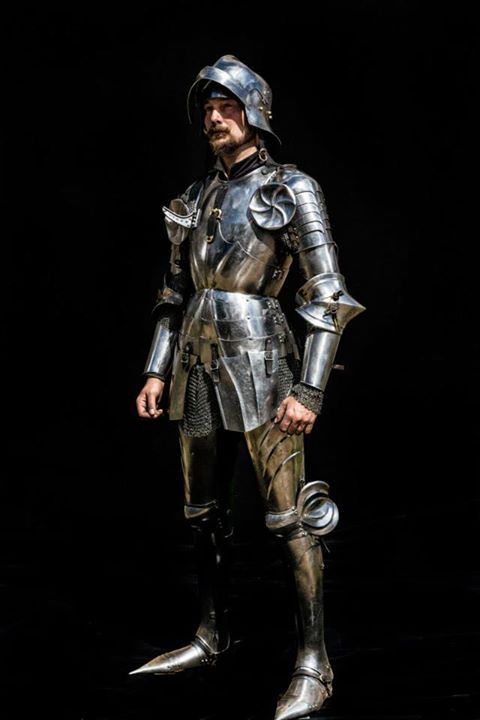
Arne Koets in his 15th century German field armour
(photo by Michael Kennedy)
My armour was made by Luke Binks, Craig Sitch and Jeffrey Hedgecock. I have horse armour by Joram van Essen and Roman Tereschenko. What I like about my armour is the shape, fitting, maneuverability, the design I insisted on, the frogmouth helm and kolbenturnierhelm, the sallet for general use, the finger gauntlets,... It is a little thin in places but has stood up fairly well.
If I need to mention bad things: The buckles are really weak and the leather quality is rather bad. There are some design features I ordered which were not implemented in the core set of armour, and that made a difference. Steel thickness was reduced relative to specific order, some sliding rivets were not implemented, bevor's height… stuff like that.
But all in all, this armour is a really workable rig. It keeps soldiering on, and it is comfortable and has good lines.
Please tell us about the horses that you rode during the tournament.
I rode Maximilian, an eight year old Andalusian gelding, and Sultan, a fourteen year old Lusitano stallion.
Max is my old friend, veteran of Sankt Wendel and many other events. He was dependable and did some really nice collected work. He also has opinions, and he needs convincing sometimes. He has done a lot of historical dressage and garrocha work, as well as desensitization in terms of guns, fire, all sorts of things. Stamina was an important part of the preparation for this event, and I built that up over the last year or so. Including riding out, etc...
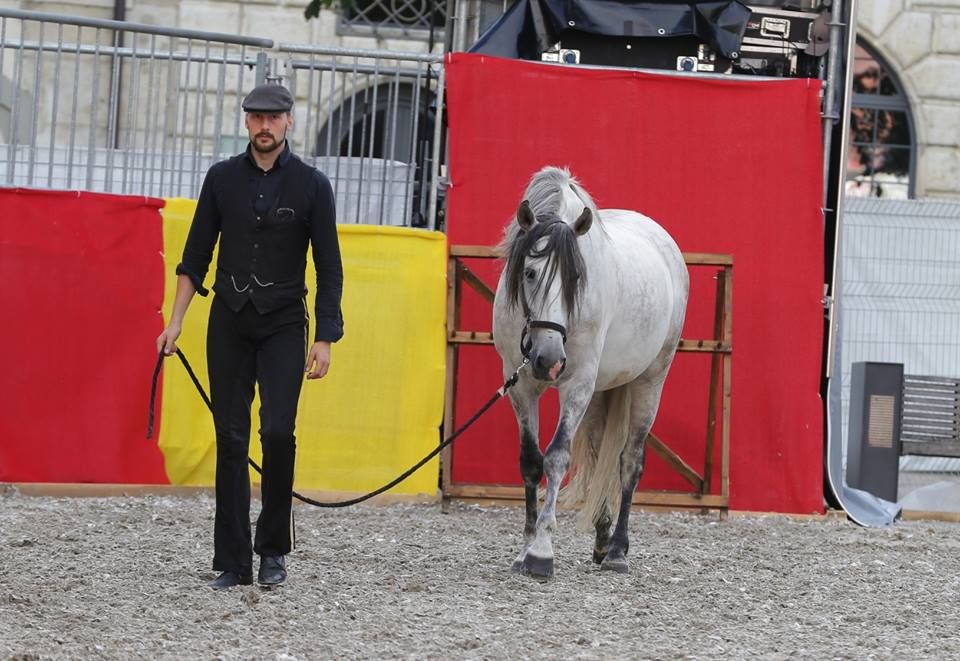
Arne Koets and his Andalusian gelding Maximillian (photo by Andreas Petitjean)
Sultan is my new horse, a former rejoneo horse. He is very quick on his feet, but he needed to be taught to be less defensive. Bullfighting horses might be quick, but they are taught to dodge at the last moment. Doing this on command is great, but they want to do it as a matter of course. Sultan clicked with me at the event, and I was able to ride him much more offensively, and he did a great job.
I am indebted to Wolfgang Krischke for retraining Sultan. The horse as he came from Spain was ridden very much with the bit and very little on the seat, so he needed a lot of training to be able to work as he does now.
What were some of your favorite moments of the tournament?
The first Sunday was the highlight. Everything fell into place, the Turniers(mounted melees) were hard and well ridden, everybody seemed to give their all on the eve of the rest day. It all just looked great and worked well. The whole team seemed proud of what they achieved
Then again on a personal note, I really liked the fight I had with Wouter at the end of the Nachturnier on one particular occasion. I could still pirouette my horse after all that and could just keep him exactly where I wanted, turning inside him for a while before closing in for the kill. That was nice.
What would you like to say about/to the other participants in the tournament?
Everybody worked soooo hard!
The grooms, the squires, the rest of the crew making 120 crests to be destroyed, prepping the lances, making new clubs (because we broke so many), repairing armour, dodging running horses to remove broken timber from the Turnier,… Wolfgang and Christine riding, doing falconry, speaking, acting… every day. Everybody worked to exhaustion in that heat.
We had a new commentator that no one had met before who was a genius!
The typical working day started at 7:00 am – repairing, preparing, mucking, feeding, free-running horses, etc... And we all worked without a break until dinner at 22:00. We still had meetings after that to coordinate stuff. There were no exceptions. We all worked until we dropped.
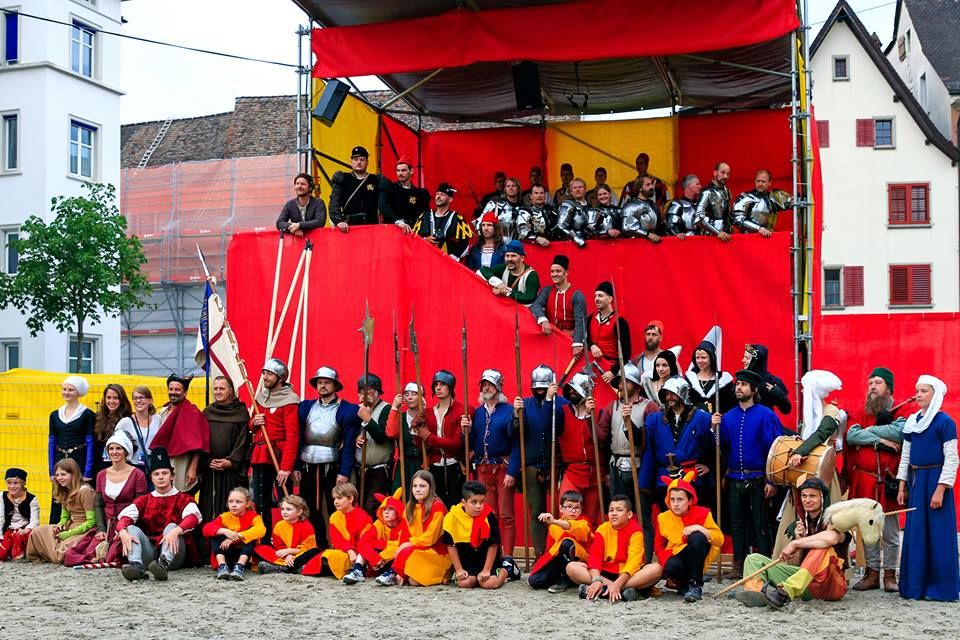
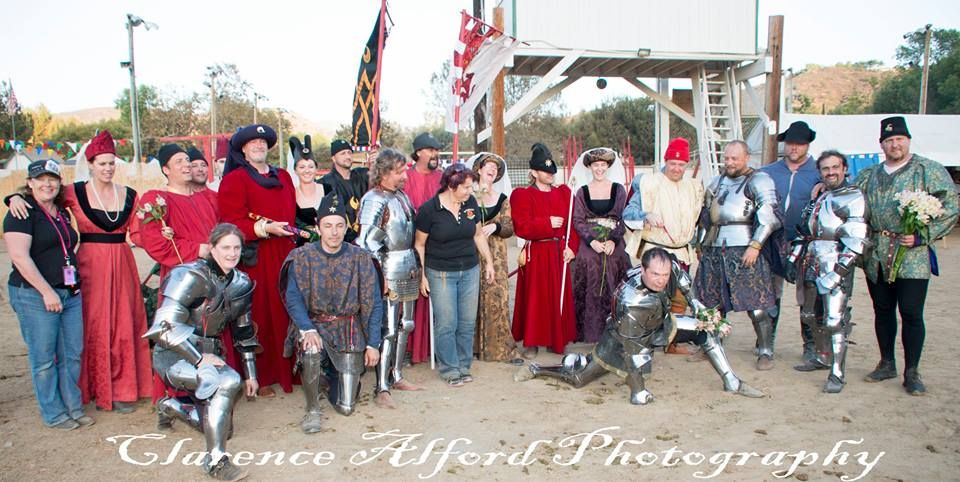
The crew and jousters for the Grand Tournament at Schaffhausen
(photo from the Museum Zu Allerheiligen)
What are your plans/hopes for the future?
There is talk of a repeat of this event, and I was officially invited to another really exciting one. However, we will not do this workload again on the horses. Hopefully by subtle means, we can take it down a peg. This was too much, for too long.
Thank you for taking the time to answer these questions and best of luck with your future endeavors.
A few more pictures from the Grand Tournament at Schaffhausen:
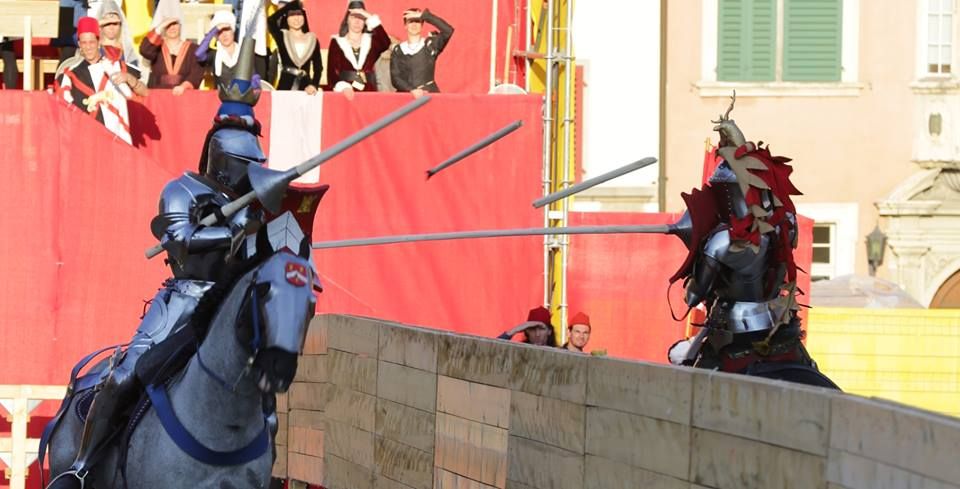
Joram van Essen(left) breaks his lance against Dominic Sewell(right). In the background,
you can see the Ladies Court watching the joust. (photo by Andreas Petitjean)
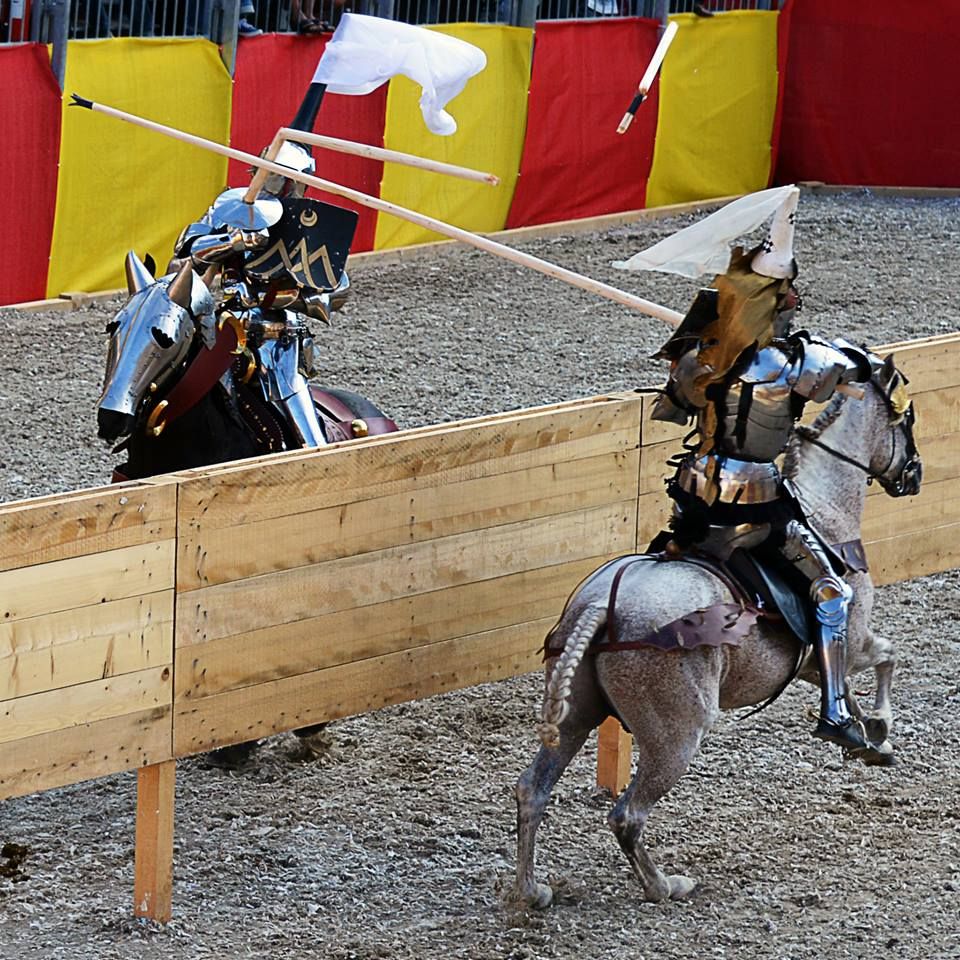
Toby Capwell breaks his lance against Wouter Nicolai (photo by Stefan Kiss)
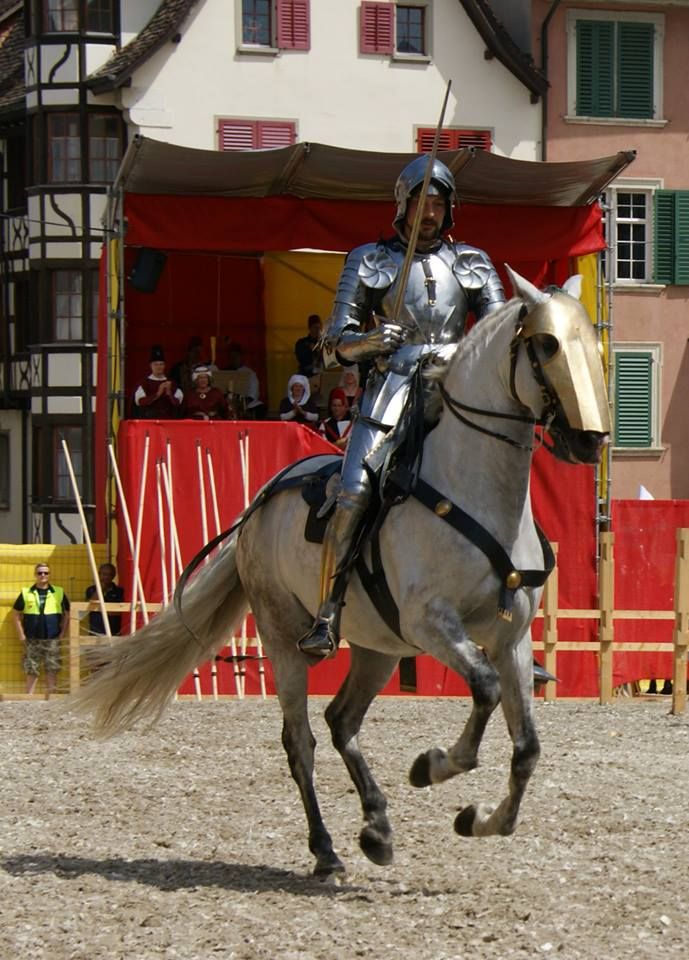
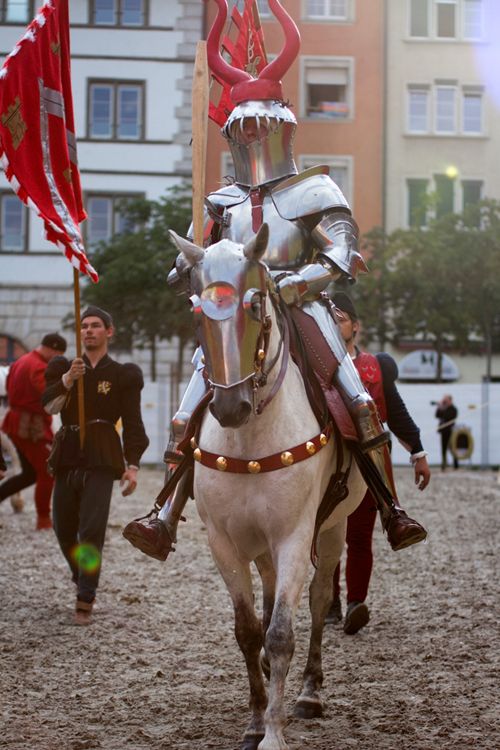
Left: Arne Koets and his Andalusian gelding Maximillian (photo by Ingrid Isabella von Altdorf)
Right: Dominic Sewell riding his Andalusian gelding Coralito (photo by Isis Sturtewagen)
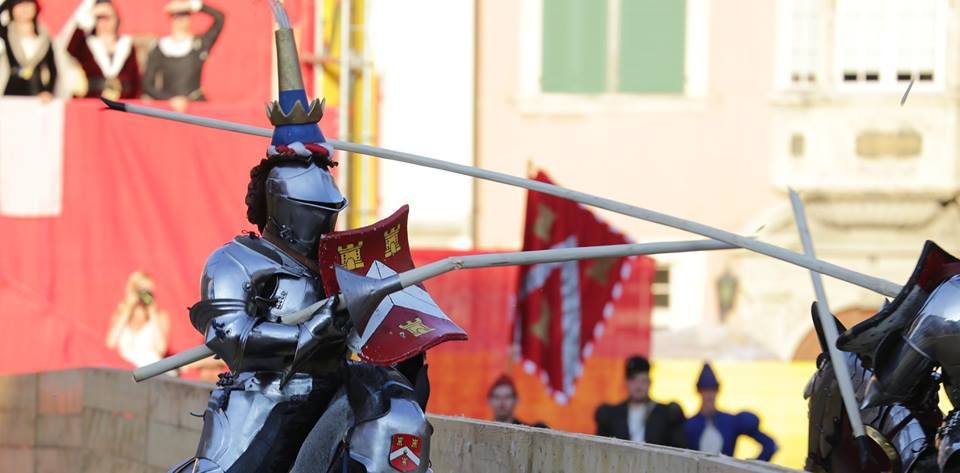
Joram van Essen breaks his lance against his opponent(photo by Andreas Petitjean)
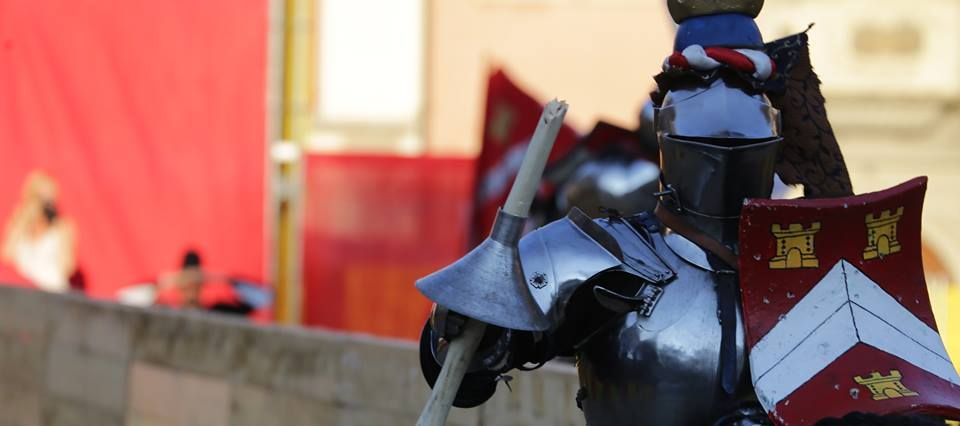
Joram van Essen holds the remains of his broken lance (photo by Andreas Petitjean)
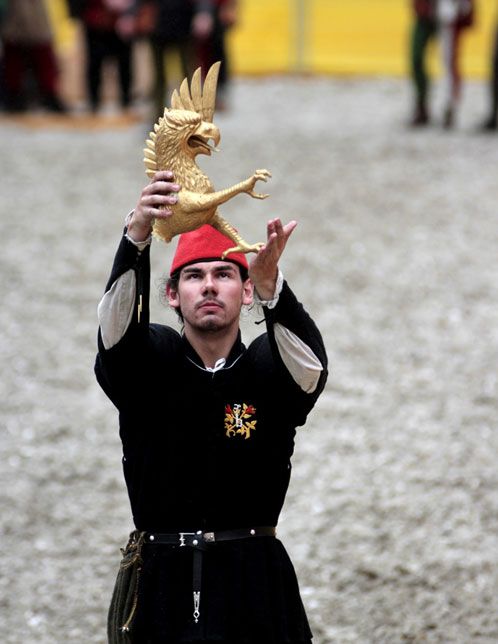
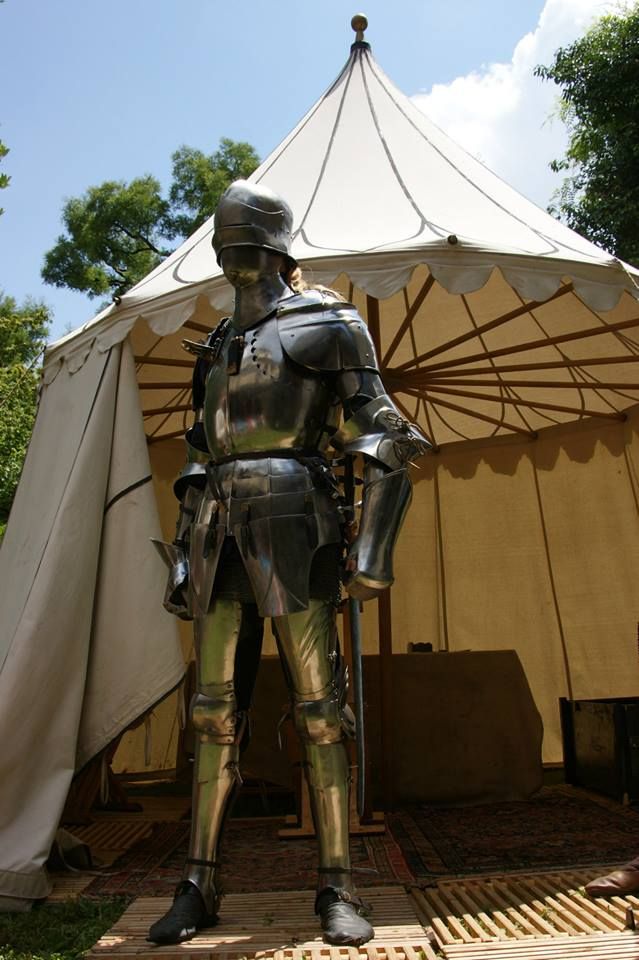
Left: Groundcrew member Max Knegjens holds aloft Arne Koets' broken crest (photo by Isis Sturtewagen) Right: Jouster Wouter Nicolai stands armoured as part of a demonstration (photo by Ingrid Isabella von Altdorf)
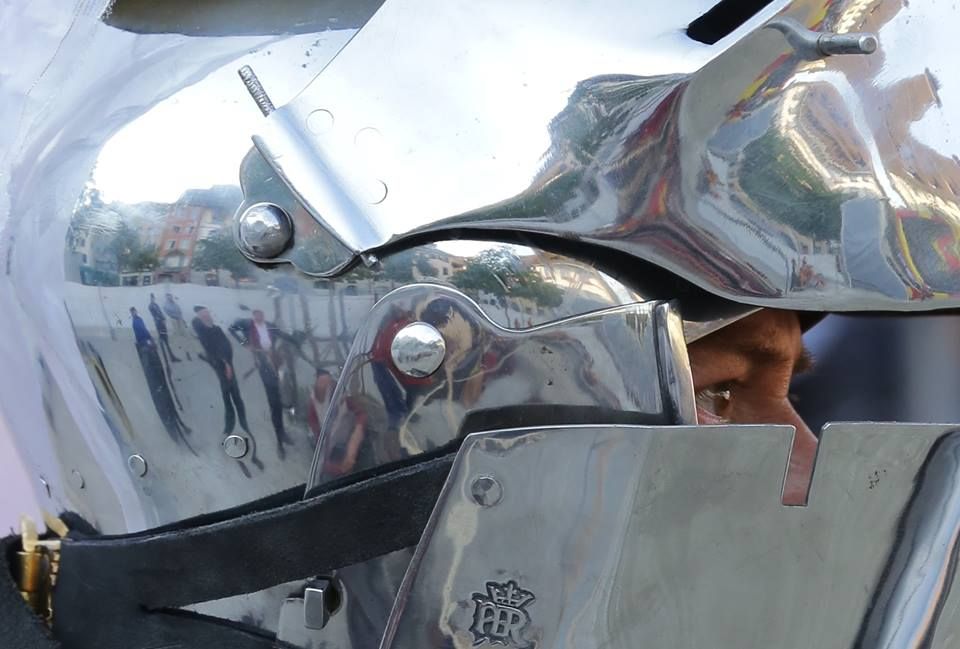
Toby Capwell's jousting helm reflects the ground crew (photo by Andreas Petitjean)
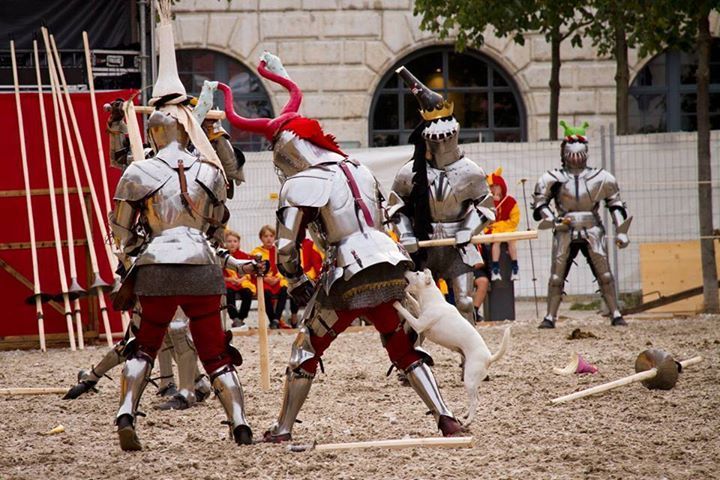
After the final jousting session, the jousters decided to dismount and engage in foot combat.
L-R: Alix van Zijl, Dominic Sewell, Capri the dog, Bertus Brokamp and Joram van Essen.
(photo by Isis Sturtewagen)
Related articles:
Video Report on the Grand Tournament at Schaffhausen
The Grand Tournament at Schaffhausen in the News
Jousting in Schaffhausen a Success!
Arne Koets Comments on the Tournament So Far, Plus More TV News Coverage of the Grand Tournament at Schaffhausen
An Interview with Arne Koets: Chosen by the Ladies Jury as the Bravest Competitor at The Grand Tournament in Sankt Wendel
Arne Koets during the Grand Tournament at Schaffhausen (photo by Andreas Petitjean)
A total of eight jousters participated in the tournament including: Bertus Brokamp, Toby Capwell, Petter Ellingsen, Arne Koets, Wouter Nicolai, Dominic Sewell, Joram van Essen and Alix van Zijl. The jousters did not ride the same horses throughout the tournament because that would have been too hard on the horses. However, the horses that were ridden were: Bertus' Andalusian stallion Talento, Toby's Friesian stallion Duke, Petter's Andalusian gelding Sigismund, Arne's Andalusian gelding Maximillian and his Lusitano stallion Sultan, Wouter's Andalusian stallion Flamenco, Dominic's Andalusian gelding Coralito(in his first jousting season) and his Belgian Warmblood stallion Marduc, Joram's Murgese stallion Zogo, and Alix's Andalusian stallion Torero. Interestingly, Talento and Torero are half-brothers.
The Lady of Honour was Christine Krischke and she rode her Berber stallion Raisulih. The Tournament Master was Wolfgang Krischke, Court Riding Master of the Fürstlichen Hofreitschule Bückeburg, who rode his magnificent Knabstrubber stallion Olymp.
Left: Arne Koets' Andalusian jousting horse Maximillian,
Right: Wolfgang Krischke's Knabstrubber stallion Olymp (photos by Andreas Petitjean)
There were two sessions of jousting/mounted melee each day, and many of those sessions sold out. In fact, during the course of the whole ten day event, approximately 80% of the jousting tickets, which cost 30 - 45 francs and also allowed entry to the museum exhibition, were sold.
Despite somewhat uncooperative weather, none of the sessions were cancelled, and only one was delayed. Before each session of jousting/mounted melee, an explanation of the history and rules of the tournament was given to the audience. Other information, such as details on the art of riding, was also provided.
Each session of jousting actually involved five separate parts, all based on an extant description of an actual tournament that was held in that very square in Schaffhausen in 1436.
First, there were two matches of jousting, with two different jousters in each match. Each match consisted of three passes with lances down the length of the tilt. The lances used for the jousting were shaped solid wood with sharp steel coronels. A winner for each pass was declared based on a set of historical rules involving riding, lance handling, where the opponent was hit and whether the lance broke. The jouster with the best two passes out of three won the match.
Toby Capwell waits at the end of the tilt as a member of the ground crew carries
away his broken lance, and a line judge signals the score for that pass.
(photo by Ingrid Isabella von Altdorf)
Second was a Mounted Duel using steel swords on horseback. The duels were judged by the Tournament Master and the Ladies Court, and the winner was determined based on both riding ability/horse positioning and the number of strikes landed against the opponent. According to Arne Koets, in every case, the competitor who rode the best also landed the most strikes, so determining the winner was easy.
Wolfgang Krischke takes a break from judging to participate in a mounted duel
with Arne Koets. You can see members of the Court in the stands behind them.
(photo by Ingrid Isabella von Altdorf)
Third was a Team Turnier(mounted melee), which consisted of two teams of three riders each charging at each other and attempting to strike the members of the opposing team with wooden clubs. Acceptable target areas included any part of the body covered by armour above the waist. For each session, the charge was repeated three times. When a rider broke a club, he could collect a new one from the squires. As many as 12 clubs were broken PER SESSION.
Joram van Essen breaks his melee club over Toby Capwell's helm
(photo by Isis Sturtewagen)
Fourth was a living history display of the 'punishments' that were described in the historical record of the tournament. These historical re-enactments were based on the museum's interpretation of the documents describing them.
Fifth, and finally, there was a Nachturnier or 'after-tournament'. This was an individual Crest Melee where competitors used steel swords to try and knock the crests off of everyone else's helms. The last competitor with his crest still attached to his helm was the winner.
Arne Koets and Alix van Zijl during the Grand Tournament at Schaffhausen
(photo by Andreas Petitjean)
Even though this type of mounted combat can be dangerous, especially when doing it twice a day for ten days, only two injuries occurred – both caused by impacts with the crossguards of the steel swords used in the Nachturnier.
Not long after the Grand Tournament at Schaffhausen, Arne Koets graciously answered several questions about the event. [Due to various circumstances, it took quite a while to publish this interview. My apologies to both Arne and to the readers of The Jousting Life.]
How did the Grand Tournament at Schaffhausen come into being?
I was recommended to organize the tournament for the museum, whose director had organized an event in Berne some years ago. He wanted to enhance his knightly arms and armour exhibition, and we were meant to give a slice of history, doing it for real. Hence the combat was competitive, but in a medieval, not in a modern sense. We were to capture the image of the original historical tournament.
The jousting/mounted melee sessions were a museum ‘interpretation’ and the texts were straight out of the original sources (edited by the director himself). We re-created the whole four day tournament in the space of one hour. Twice a day. For ten days running. The only thing we didn't have was 195 riders on the field like there were in 1436.
Six of the eight jousters who participated in Schaffhausen. From bottom left to top right: Arne Koets, Wouter Nicolai, Toby Capwell, Petter Ellingsen, Bertus Brokamp and Dominic Sewell
(photo by Stefan Kiss)
What were the biggest challenges in organizing the tournament?
The amount of shows. Twenty shows is a lot, but 20 shows with up to 5 melees in each is even more insane! The level of what we wanted to do was really high in terms of riding, saddlery, armour, fighting technique and weapons accuracy, but also we made a marathon of it. Due to the long duration, the team size was very limited, and we were a bit understaffed due to the cap on overall team numbers.
A HUGE challenge was to manage the workload on the horses. The weather was really hot, as well, and we rotated the horses and riders, as planned from the start. The horse transport was also very complicated due to customs, and that cost a great deal of money.
There were very many challenges to get such a complex event to run. Too many to mention.
Explain how the tournament related to the exhibition at the Museum zu Allerheiligen?
We really did a museum display, where we showed a slice of history, and the actual combat was there to supply one of the aspects of authenticity. The arms and armour exhibition was showing in great detail many of the aspects of German tournament culture, and we wanted to incorporate as many of these in the display as possible. We rejected the set notions of how shows are normally run, and instead, first formulated what would have actually been seen in the historical tournament, and only then reduced it to a watchable show for a modern audience.
Petter Ellingsen waits at the end of the tilt while two other jousters compete
in front of a sold out audience (photo by Ingrid Isabella von Altdorf)
How do you think tournaments such as this one can benefit those who study history?
Due to using a great deal of rare pieces of equipment (like saddles and special helmets), we were able to experiment in new directions, but also the completeness of the ‘experiment’ made it worthwhile to get new insights. There were several visitors from America – academics who flew over for the occasion. We had a lot of museum curators and directors there to see it, and they were able to confirm our interpretation, as well as see things in a different light – understanding much more of the culture and the mechanics of what they study as static objects and written accounts.
Describe any specific training you and/or the other jousters did in preparation for this tournament?
The process started really in 2010, when we replaced almost all the horses in the team and started riding in a more historical way, and being helped a great deal to develop the collected exercises. The team of horses, the time to prepare and the equipment was made and extended. Especially in Holland, several test training's were run, but also clinics in England and Germany were run, so that we could develop the lances, the clubs, the tactics, the riding, the saddles....
Most of the riders worked daily on this development over the last 4 years, ordering armour, riding, learning, reading up on riding theory, etc....
There was also a significant push for mounted martial arts.
Bertus Brokamp, Alix van Zijl, Petter Ellingsen and Joram van Essen during a mounted melee, Schaffhausen 2014 (photo by Isis Sturtewagen)
What can you tell us about the two injuries that were sustained during the mounted melees?
Two horses running at one another have a lot of force, so the dynamics of the swordwork in the Turnier(mounted melee) are quite impressive, and sometimes things go wrong. Bertus' hand punched into a crossguard. The thing was that Bertus' injury was an unfortunate accident. He was hit on the inside of his hand where the leather glove is inside the gauntlet.
Joram was struck in the face with Toby's crossguard. During the melee both men were riding like furies and came upon one another frontally. Whilst they were targeting each others' crests, they noticed they were about to crash and made a last minute swerve to make sure the horses did not collide. However, that could not be said of the riders themselves. Not only did the armoured men hit each other, the hilt of Toby's sword punched onto the visor of Joram's helm with the force of the two colliding horses.
Despite needing stitches, in true warrior fashion Joram came back to the tournament almost instantly and kept rocking the event with his skill and presence...
Alix van Zijl and Joram van Essen. Through Joram's visor you can see the bandages
from being injured during a previous Turnier (photo by Andreas Petitjean)
Please describe the type of lances used during the tournament and why that style of lance was chosen.
Fir tree-trunks. The lances were grown, naturally-tapered fir lances with steel coronels, vamplates and grappers. They are representative of 15th century lances as depicted, described and extant.
Please tell us about your armour.
We use field armour with sport specific exchange pieces, as was the norm in 1460s. My personal armour is based on effigies of Ulrich Busch and Ulrich von Hohenrechbrech (both +1458) with exchange elements from Michael Pacher and Talhoffer. The armour is clearly German in design. Across Europe, the hinged cuirass was used in England, Iberia, France, lowlands, the empire, Italy… mostly everywhere. The silhouette and design of the armour is otherwise distinctly German and specific to the distinctly German style of this period.
Arne Koets in his 15th century German field armour
(photo by Michael Kennedy)
My armour was made by Luke Binks, Craig Sitch and Jeffrey Hedgecock. I have horse armour by Joram van Essen and Roman Tereschenko. What I like about my armour is the shape, fitting, maneuverability, the design I insisted on, the frogmouth helm and kolbenturnierhelm, the sallet for general use, the finger gauntlets,... It is a little thin in places but has stood up fairly well.
If I need to mention bad things: The buckles are really weak and the leather quality is rather bad. There are some design features I ordered which were not implemented in the core set of armour, and that made a difference. Steel thickness was reduced relative to specific order, some sliding rivets were not implemented, bevor's height… stuff like that.
But all in all, this armour is a really workable rig. It keeps soldiering on, and it is comfortable and has good lines.
Please tell us about the horses that you rode during the tournament.
I rode Maximilian, an eight year old Andalusian gelding, and Sultan, a fourteen year old Lusitano stallion.
Max is my old friend, veteran of Sankt Wendel and many other events. He was dependable and did some really nice collected work. He also has opinions, and he needs convincing sometimes. He has done a lot of historical dressage and garrocha work, as well as desensitization in terms of guns, fire, all sorts of things. Stamina was an important part of the preparation for this event, and I built that up over the last year or so. Including riding out, etc...
Arne Koets and his Andalusian gelding Maximillian (photo by Andreas Petitjean)
Sultan is my new horse, a former rejoneo horse. He is very quick on his feet, but he needed to be taught to be less defensive. Bullfighting horses might be quick, but they are taught to dodge at the last moment. Doing this on command is great, but they want to do it as a matter of course. Sultan clicked with me at the event, and I was able to ride him much more offensively, and he did a great job.
I am indebted to Wolfgang Krischke for retraining Sultan. The horse as he came from Spain was ridden very much with the bit and very little on the seat, so he needed a lot of training to be able to work as he does now.
What were some of your favorite moments of the tournament?
The first Sunday was the highlight. Everything fell into place, the Turniers(mounted melees) were hard and well ridden, everybody seemed to give their all on the eve of the rest day. It all just looked great and worked well. The whole team seemed proud of what they achieved
Then again on a personal note, I really liked the fight I had with Wouter at the end of the Nachturnier on one particular occasion. I could still pirouette my horse after all that and could just keep him exactly where I wanted, turning inside him for a while before closing in for the kill. That was nice.
What would you like to say about/to the other participants in the tournament?
Everybody worked soooo hard!
The grooms, the squires, the rest of the crew making 120 crests to be destroyed, prepping the lances, making new clubs (because we broke so many), repairing armour, dodging running horses to remove broken timber from the Turnier,… Wolfgang and Christine riding, doing falconry, speaking, acting… every day. Everybody worked to exhaustion in that heat.
We had a new commentator that no one had met before who was a genius!
The typical working day started at 7:00 am – repairing, preparing, mucking, feeding, free-running horses, etc... And we all worked without a break until dinner at 22:00. We still had meetings after that to coordinate stuff. There were no exceptions. We all worked until we dropped.
The crew and jousters for the Grand Tournament at Schaffhausen
(photo from the Museum Zu Allerheiligen)
What are your plans/hopes for the future?
There is talk of a repeat of this event, and I was officially invited to another really exciting one. However, we will not do this workload again on the horses. Hopefully by subtle means, we can take it down a peg. This was too much, for too long.
Thank you for taking the time to answer these questions and best of luck with your future endeavors.
A few more pictures from the Grand Tournament at Schaffhausen:
Joram van Essen(left) breaks his lance against Dominic Sewell(right). In the background,
you can see the Ladies Court watching the joust. (photo by Andreas Petitjean)
Toby Capwell breaks his lance against Wouter Nicolai (photo by Stefan Kiss)
Left: Arne Koets and his Andalusian gelding Maximillian (photo by Ingrid Isabella von Altdorf)
Right: Dominic Sewell riding his Andalusian gelding Coralito (photo by Isis Sturtewagen)
Joram van Essen breaks his lance against his opponent(photo by Andreas Petitjean)
Joram van Essen holds the remains of his broken lance (photo by Andreas Petitjean)
Left: Groundcrew member Max Knegjens holds aloft Arne Koets' broken crest (photo by Isis Sturtewagen) Right: Jouster Wouter Nicolai stands armoured as part of a demonstration (photo by Ingrid Isabella von Altdorf)
Toby Capwell's jousting helm reflects the ground crew (photo by Andreas Petitjean)
After the final jousting session, the jousters decided to dismount and engage in foot combat.
L-R: Alix van Zijl, Dominic Sewell, Capri the dog, Bertus Brokamp and Joram van Essen.
(photo by Isis Sturtewagen)
Related articles:
Video Report on the Grand Tournament at Schaffhausen
The Grand Tournament at Schaffhausen in the News
Jousting in Schaffhausen a Success!
Arne Koets Comments on the Tournament So Far, Plus More TV News Coverage of the Grand Tournament at Schaffhausen
An Interview with Arne Koets: Chosen by the Ladies Jury as the Bravest Competitor at The Grand Tournament in Sankt Wendel