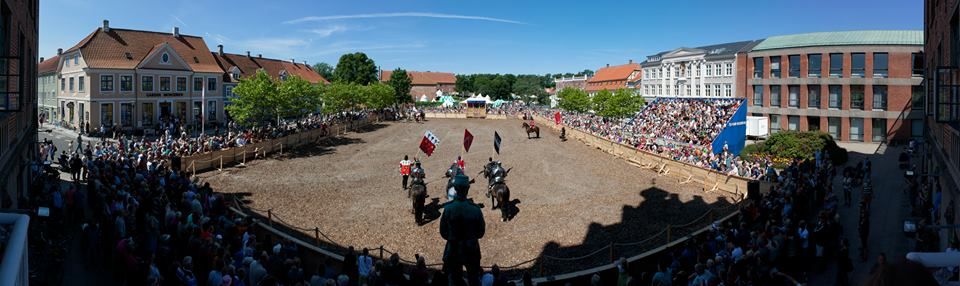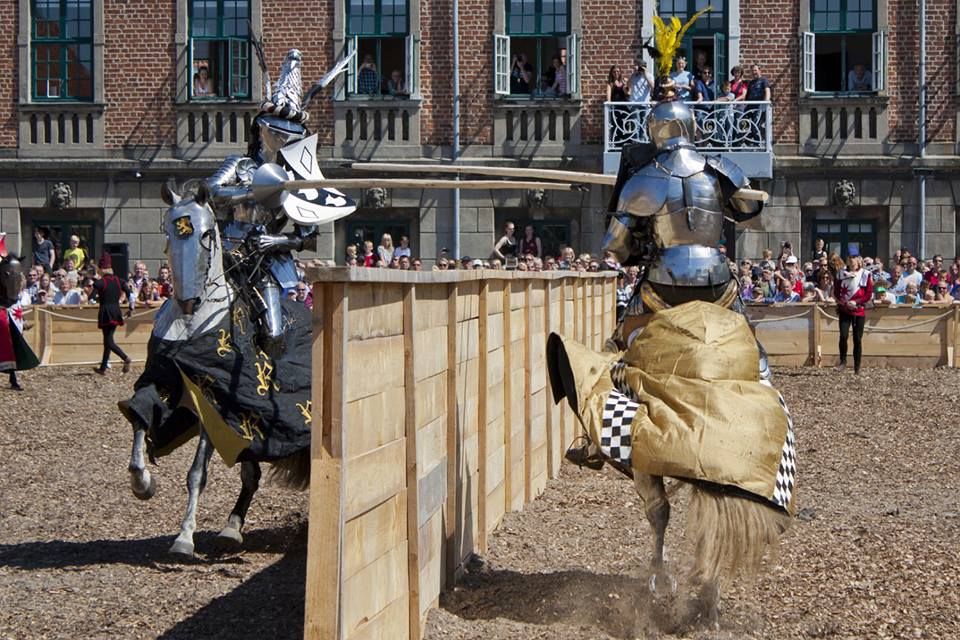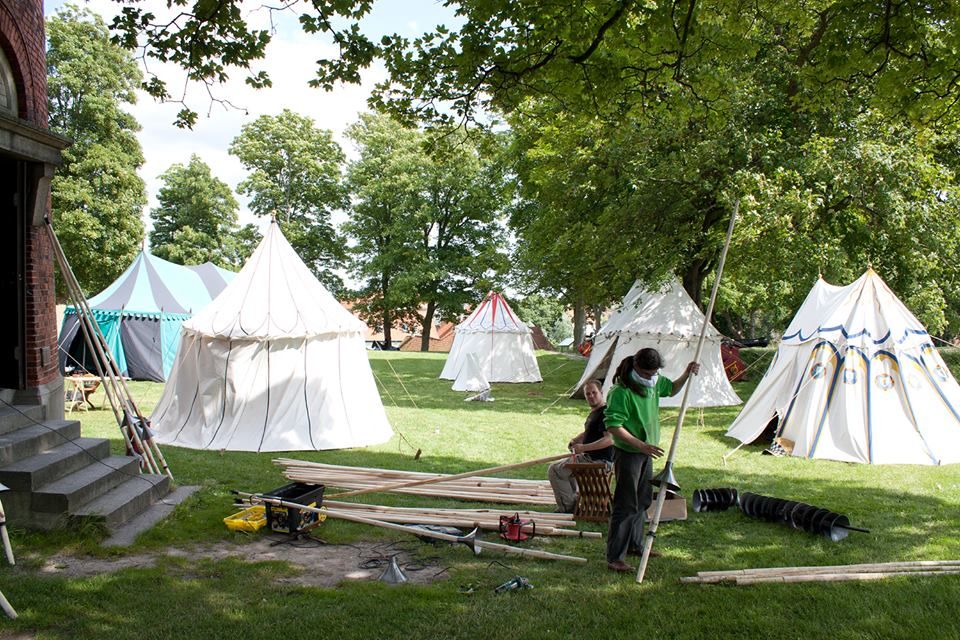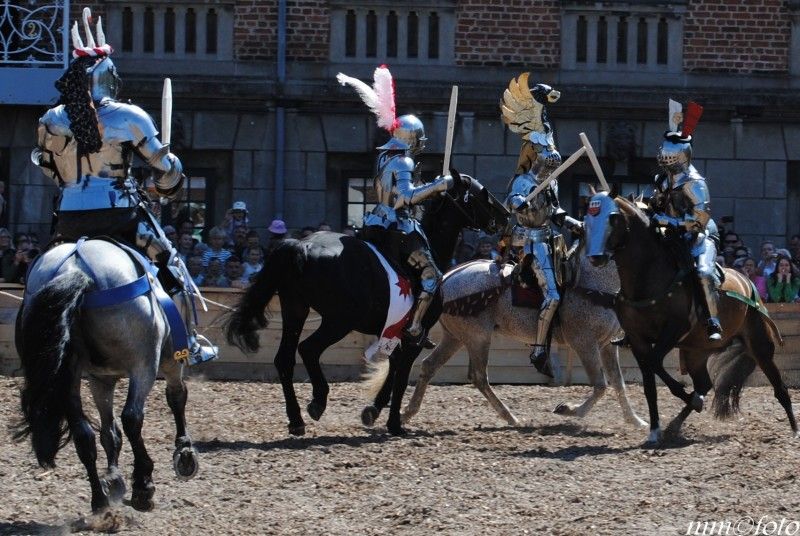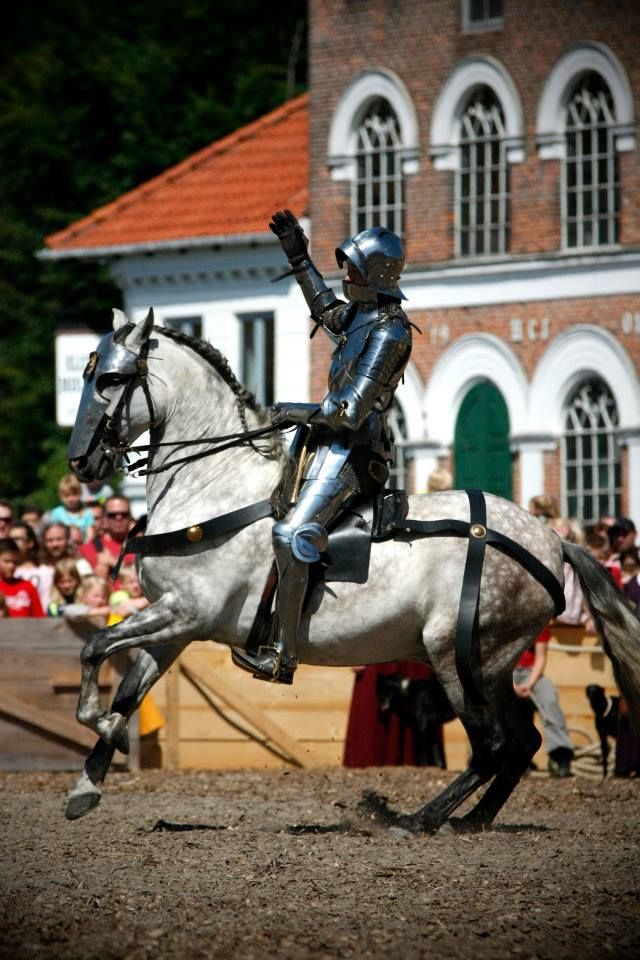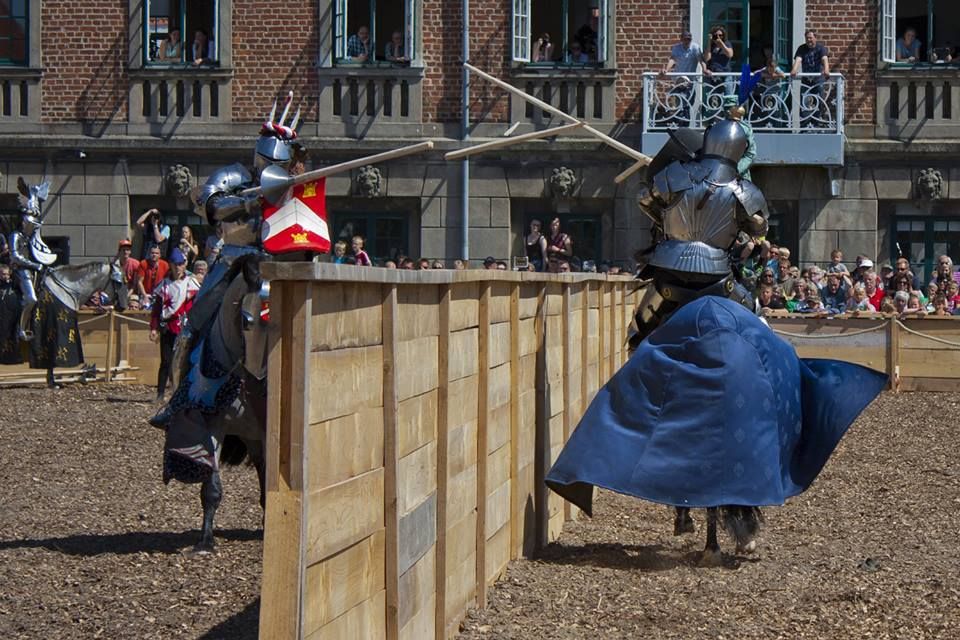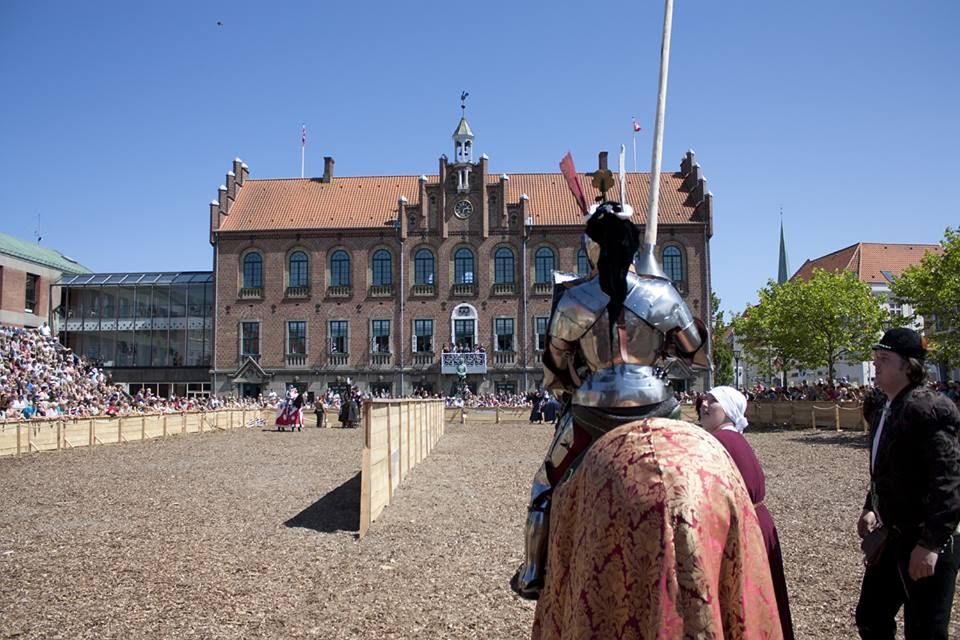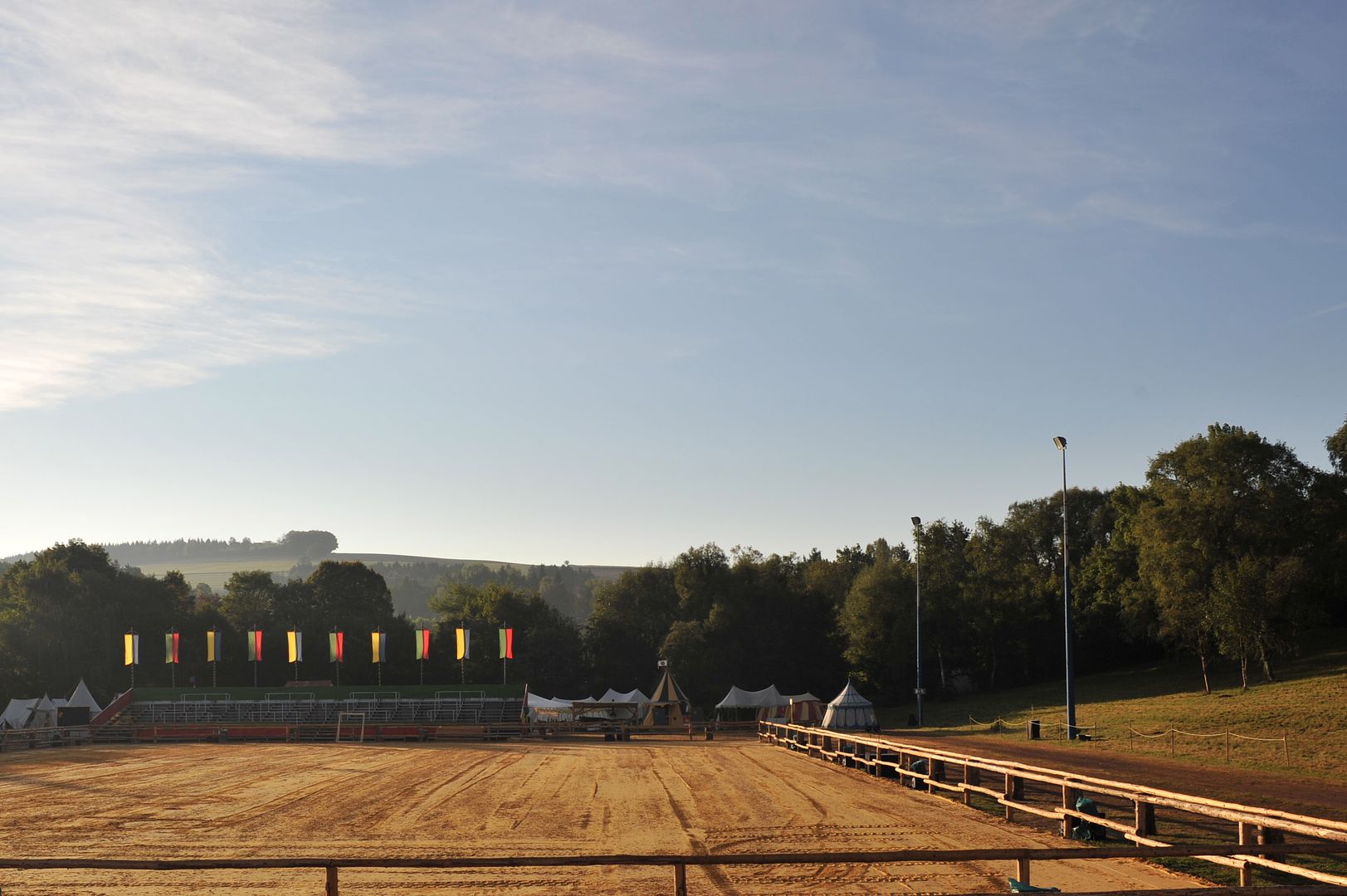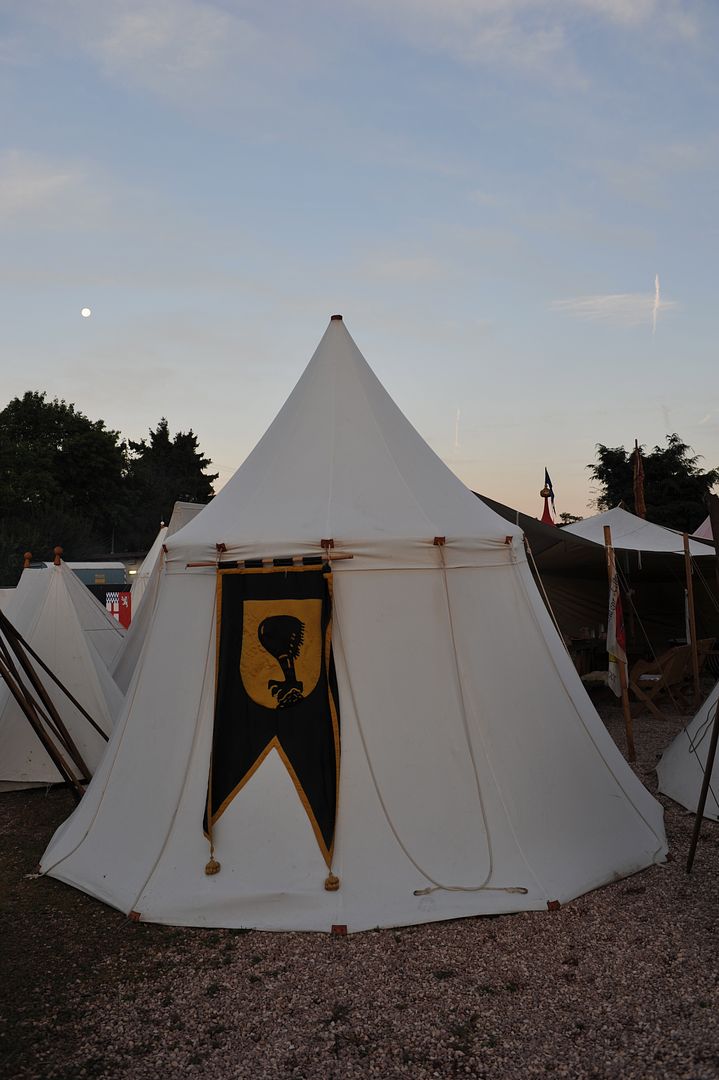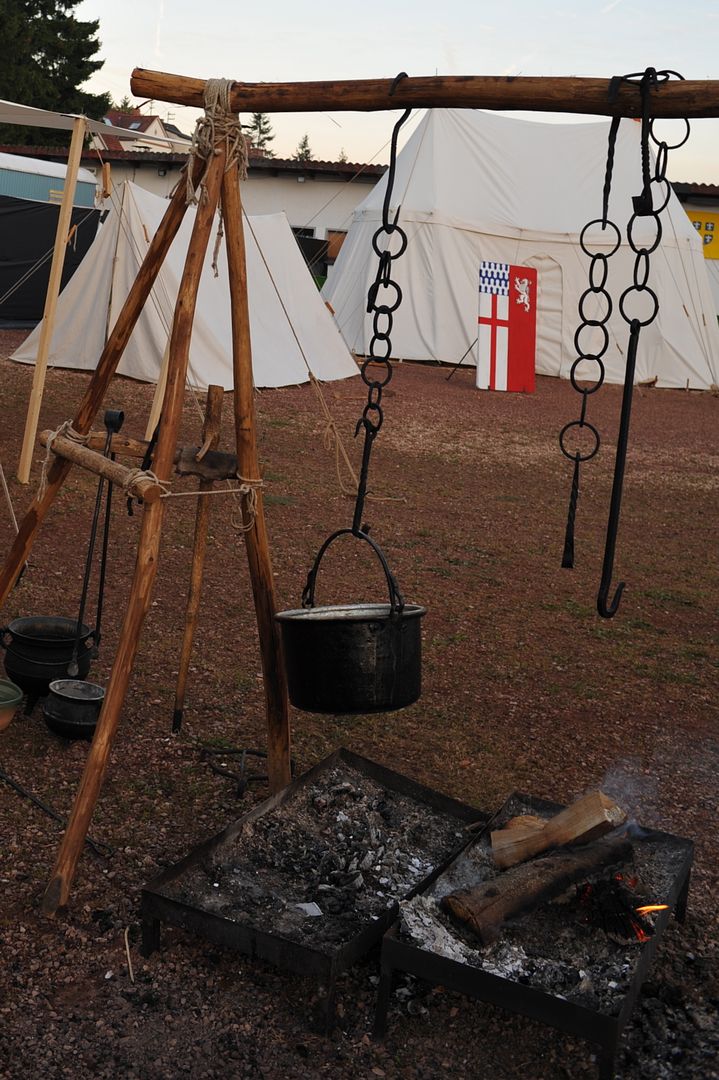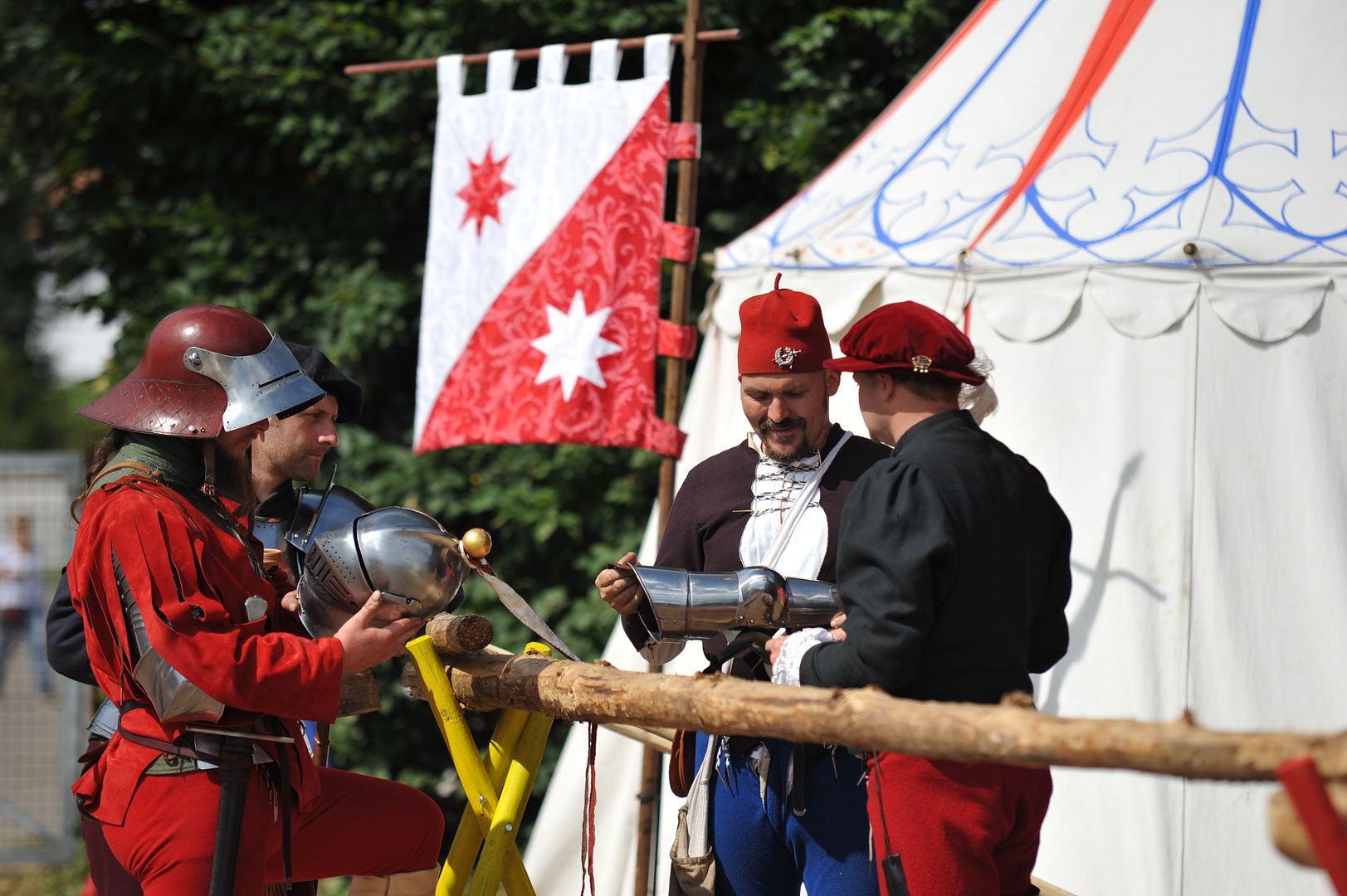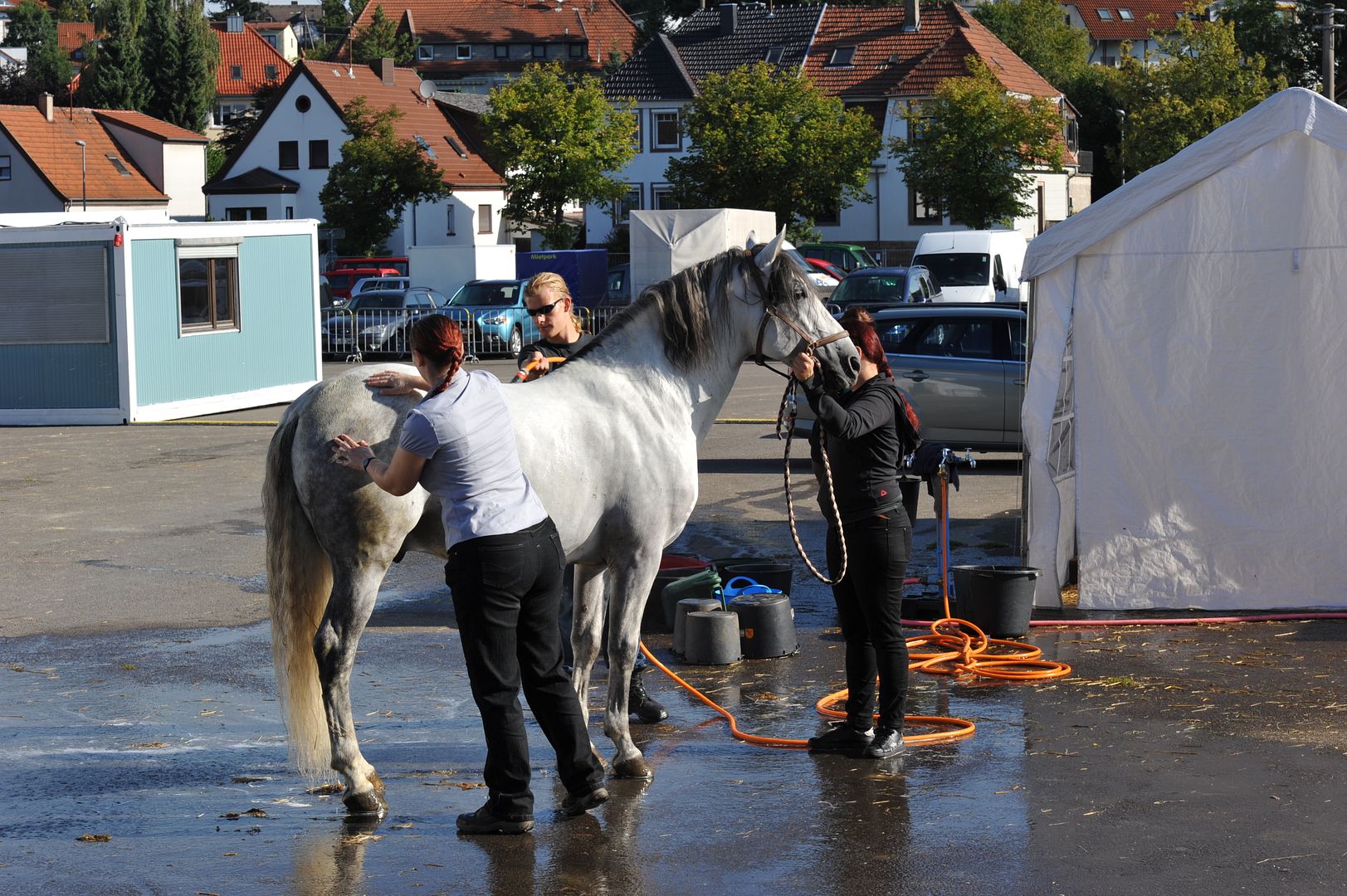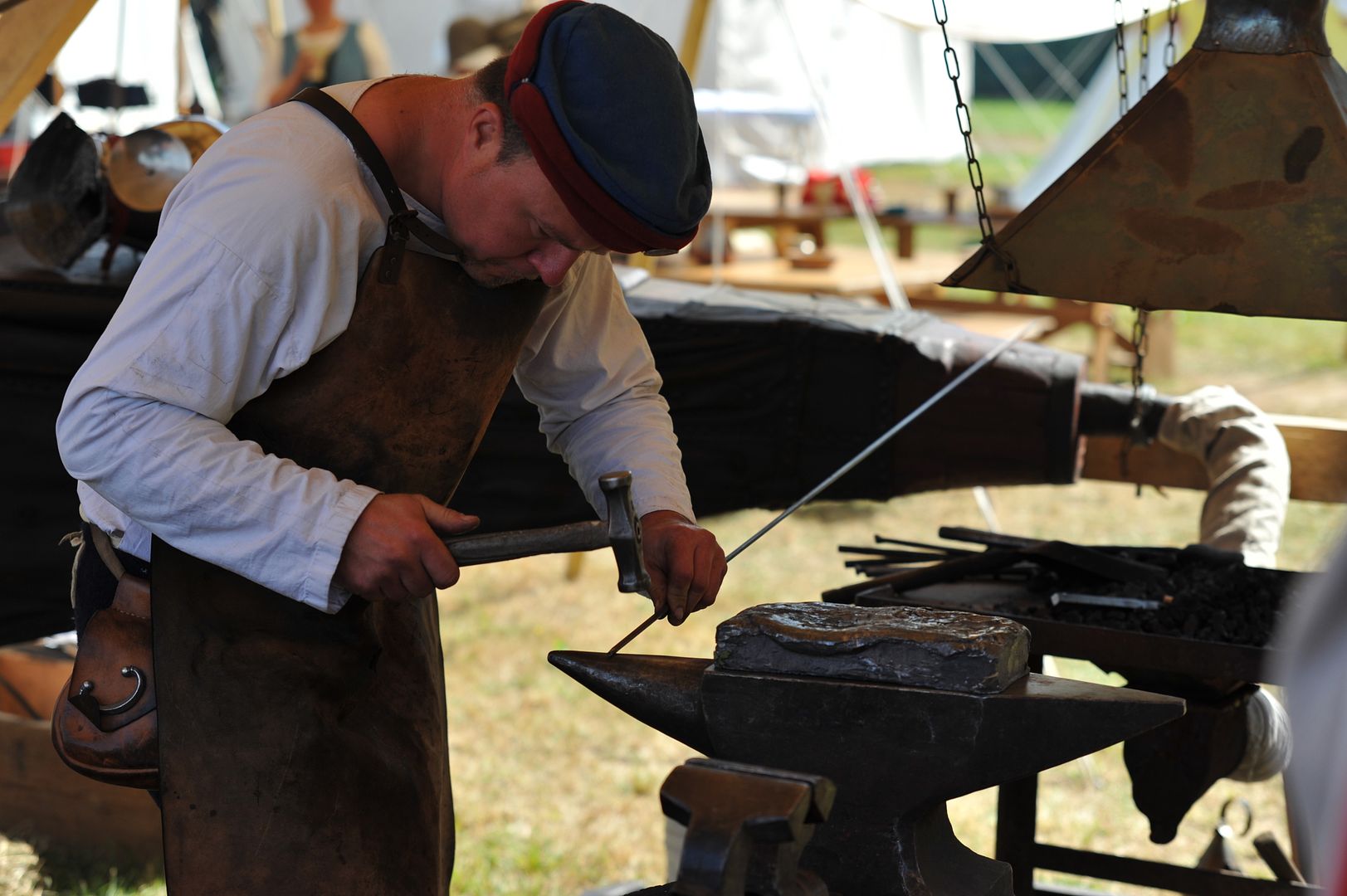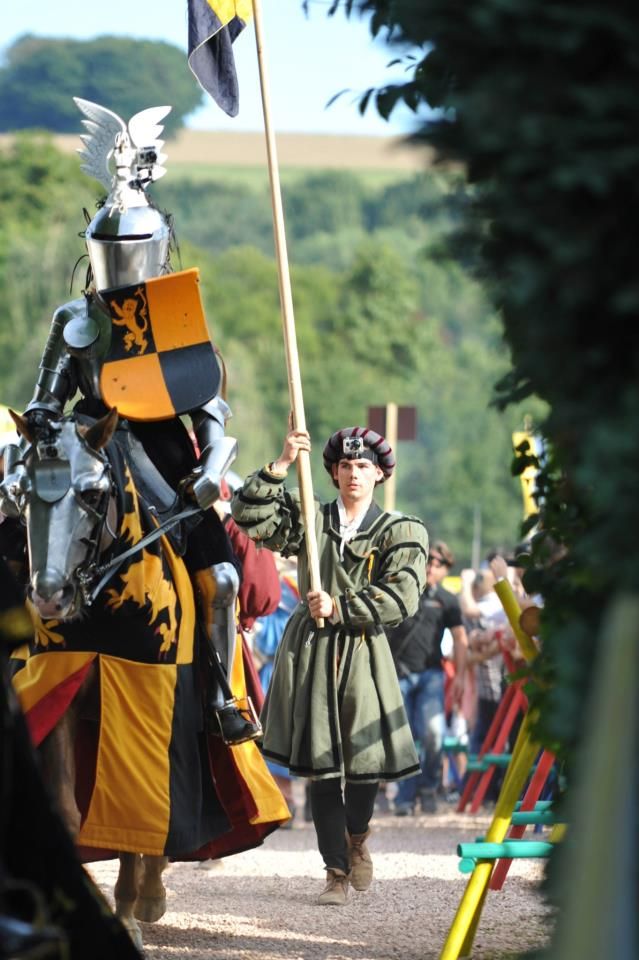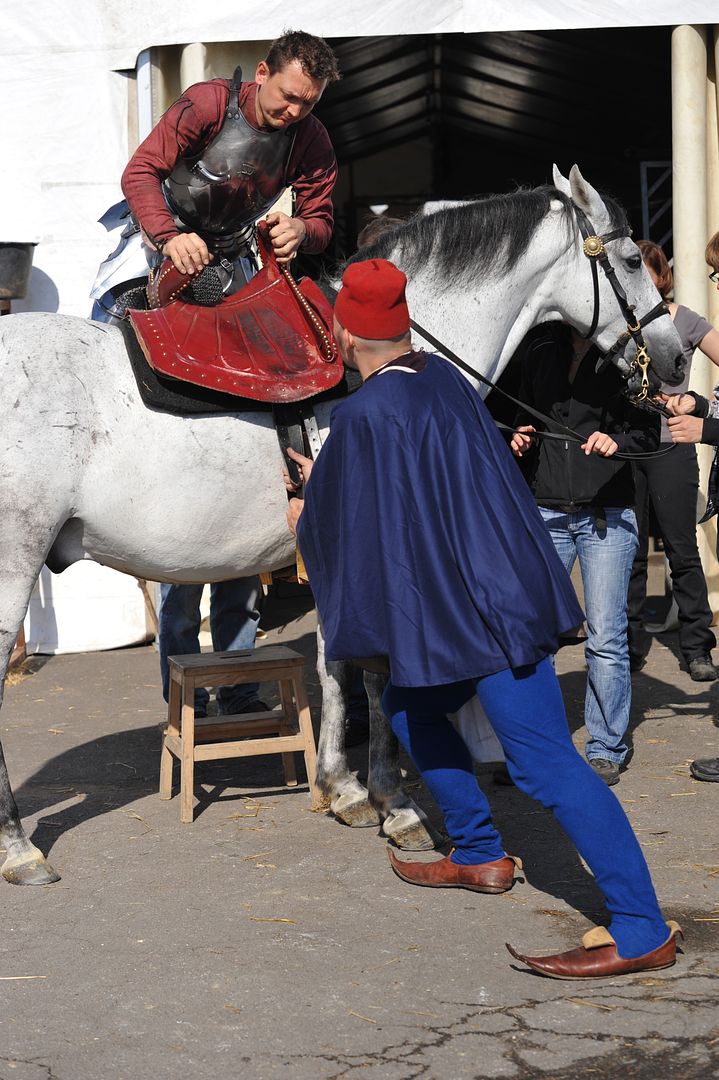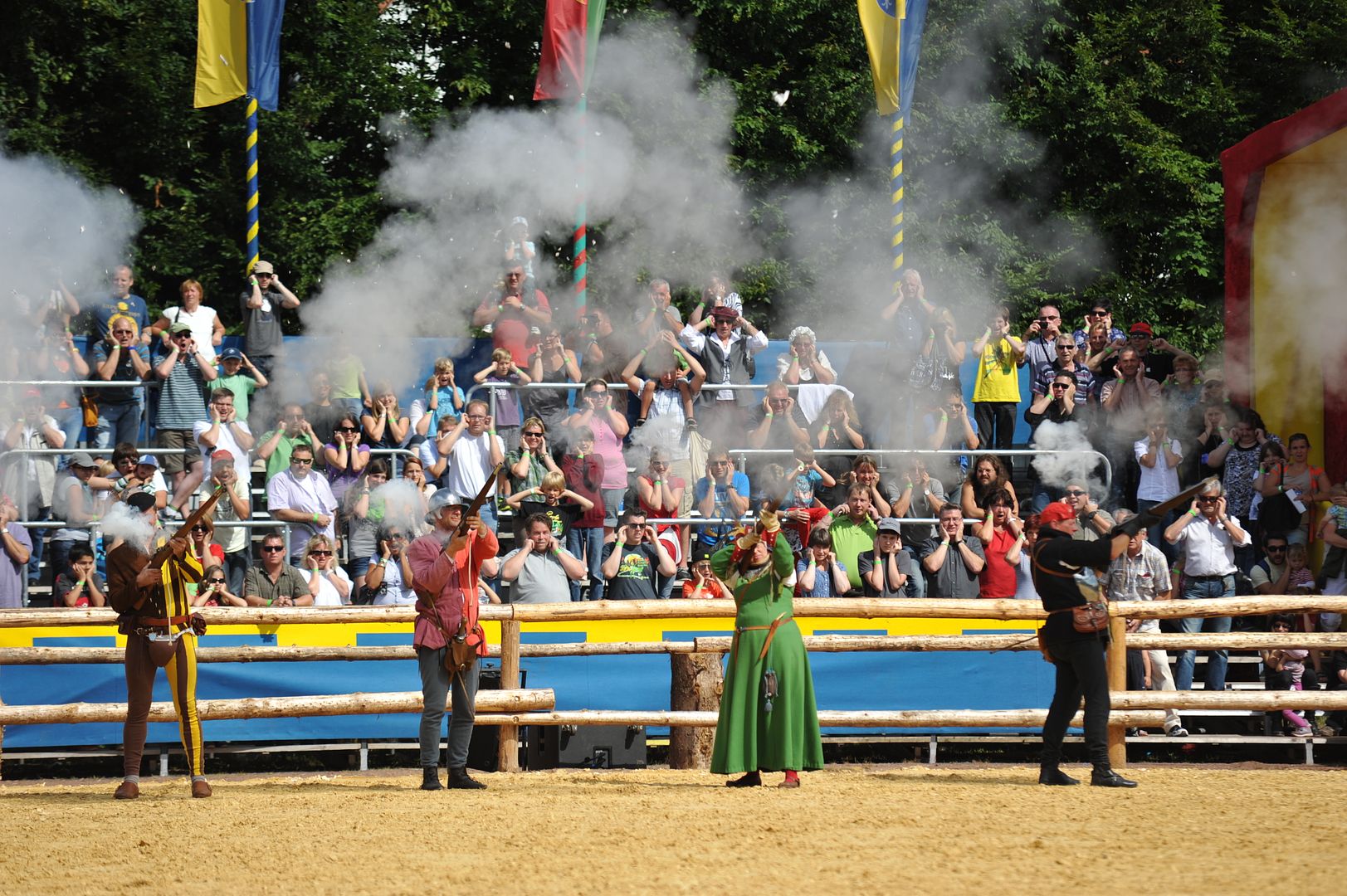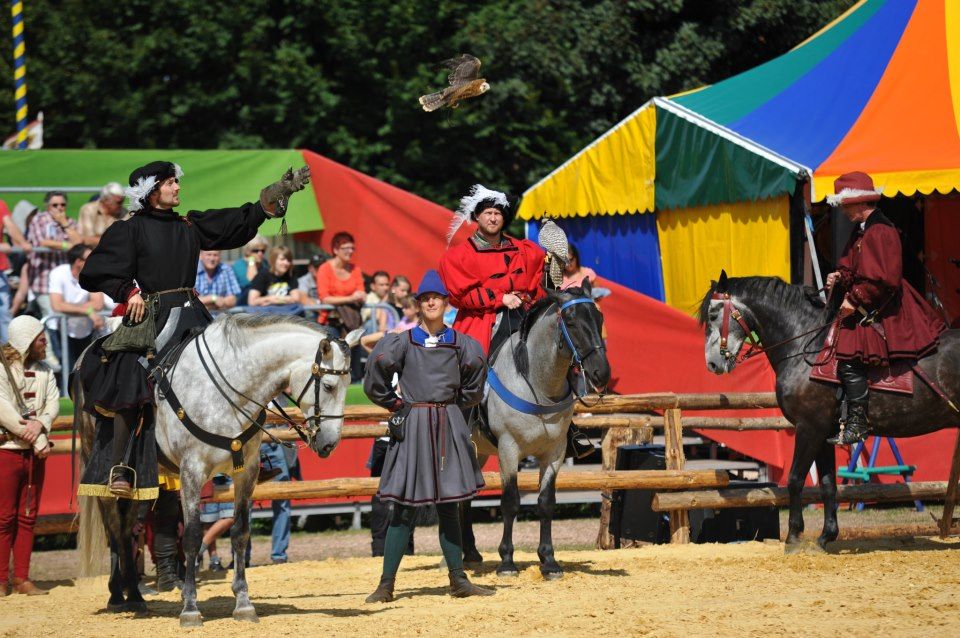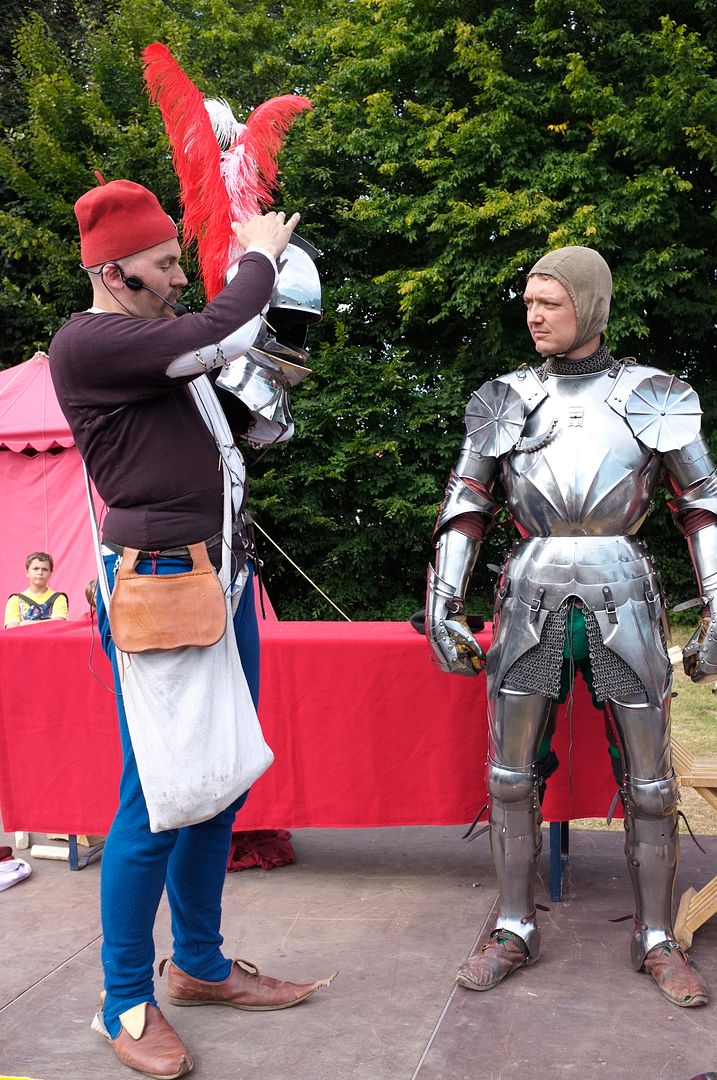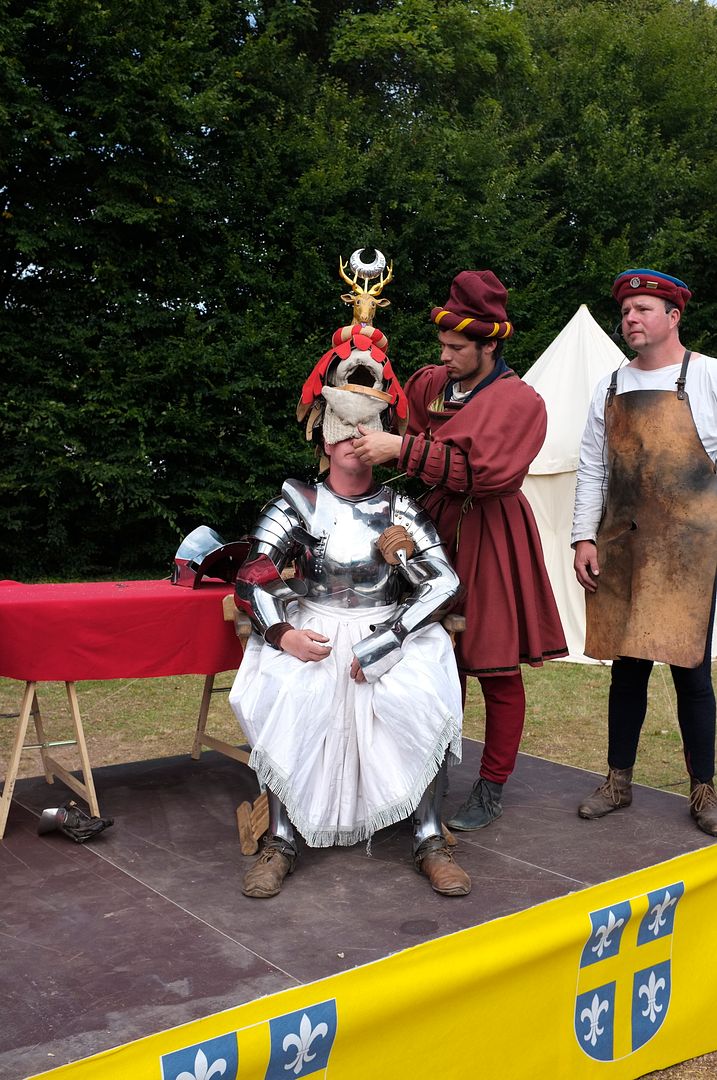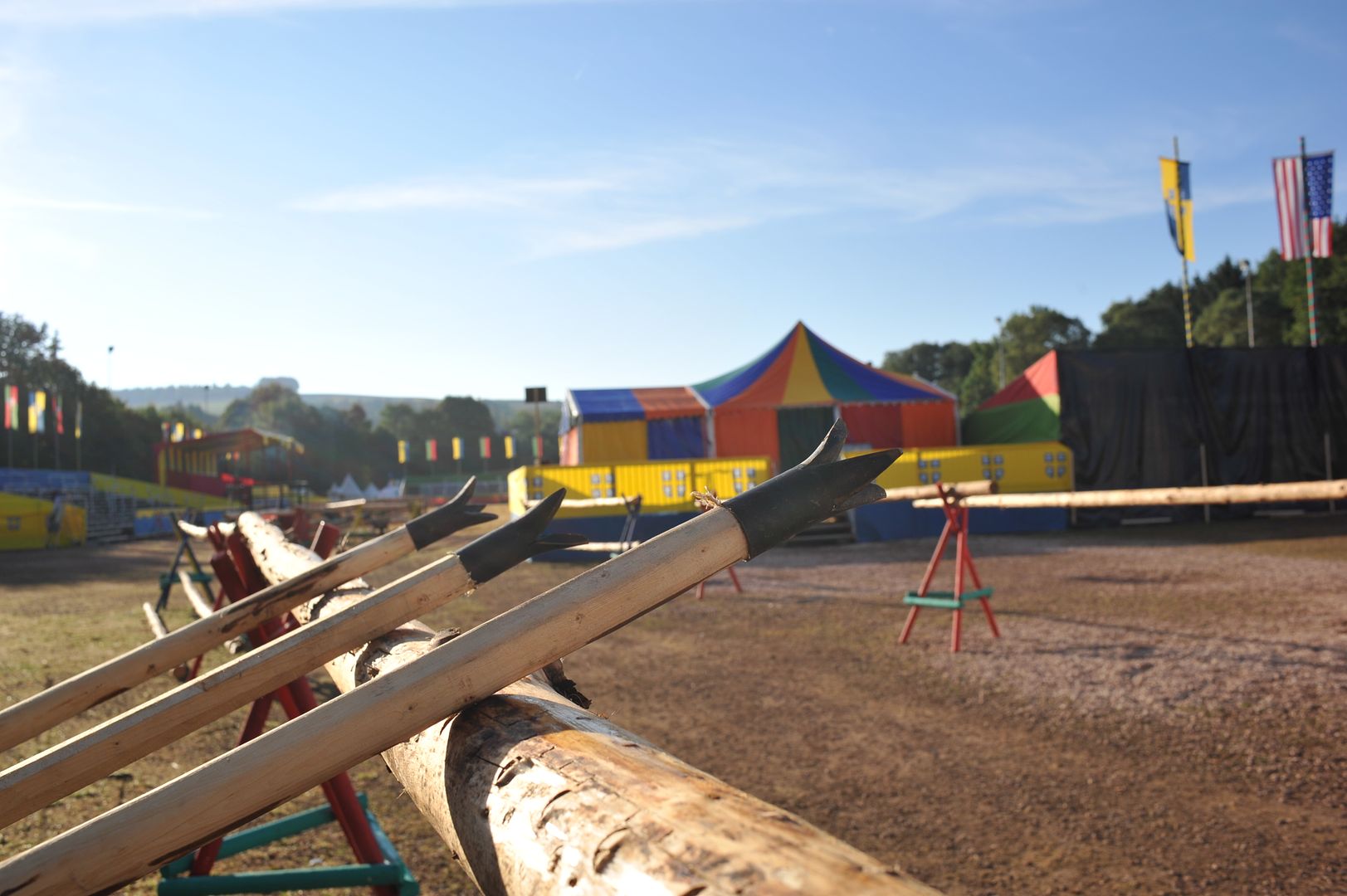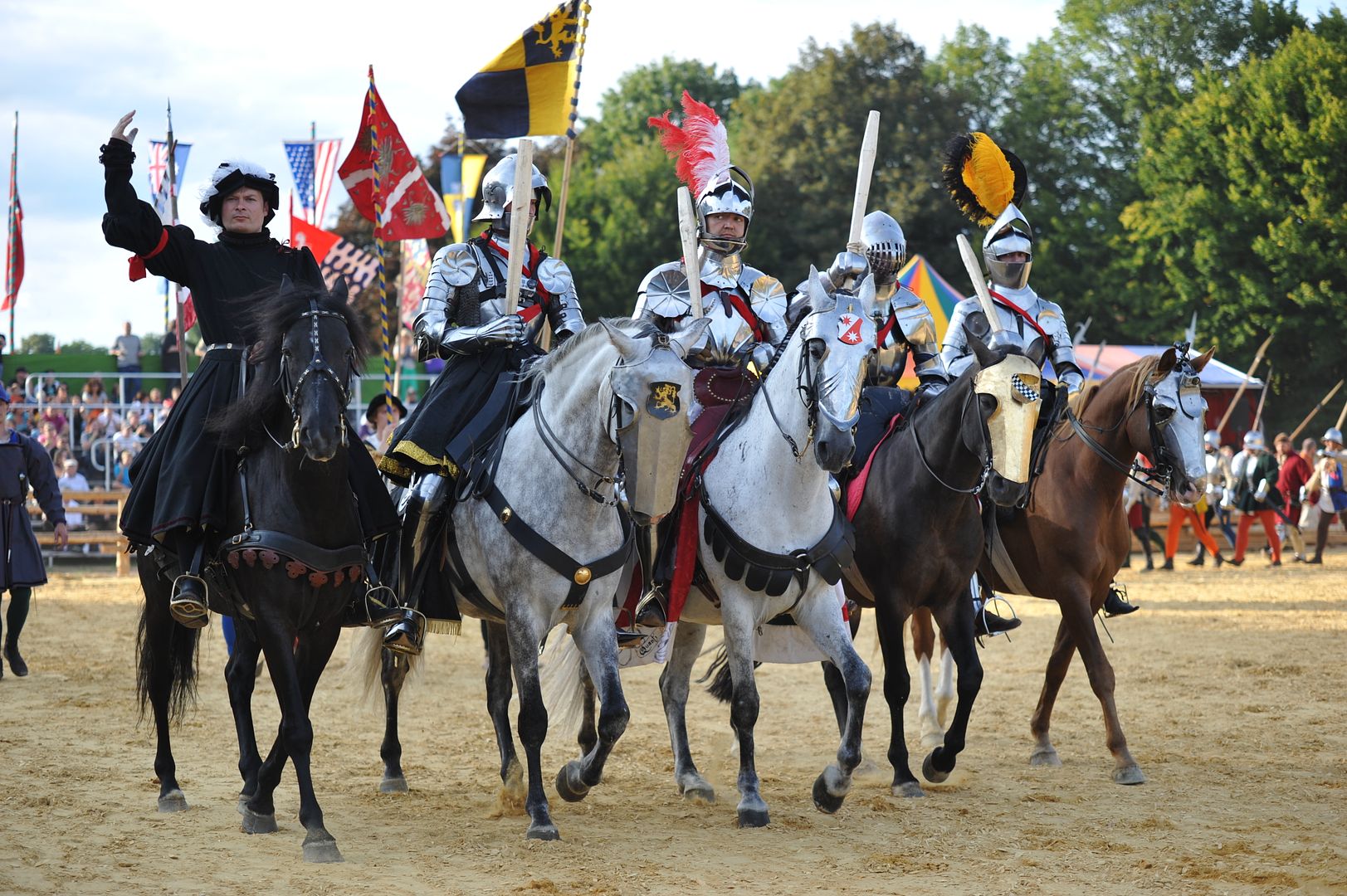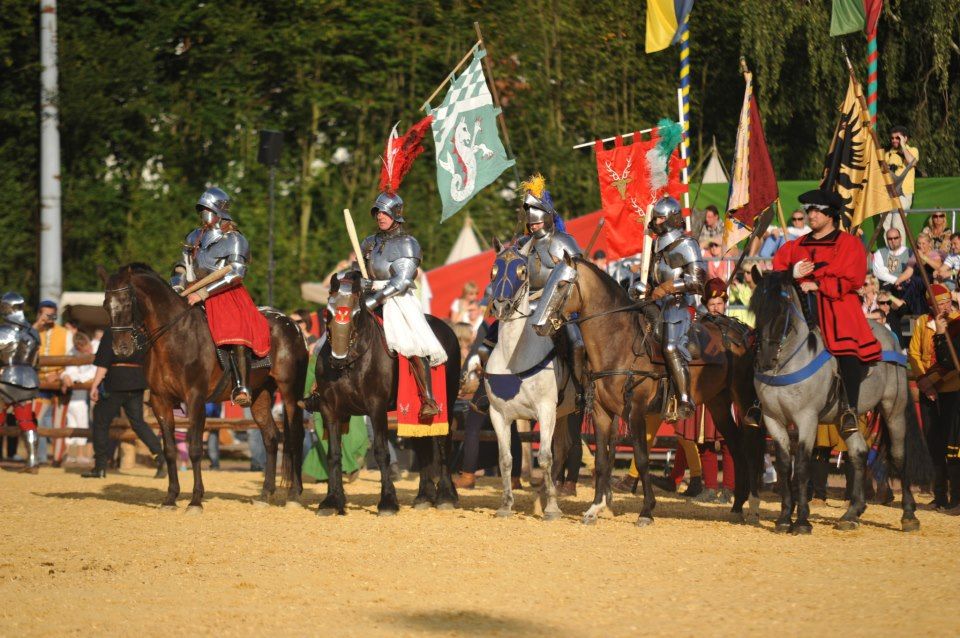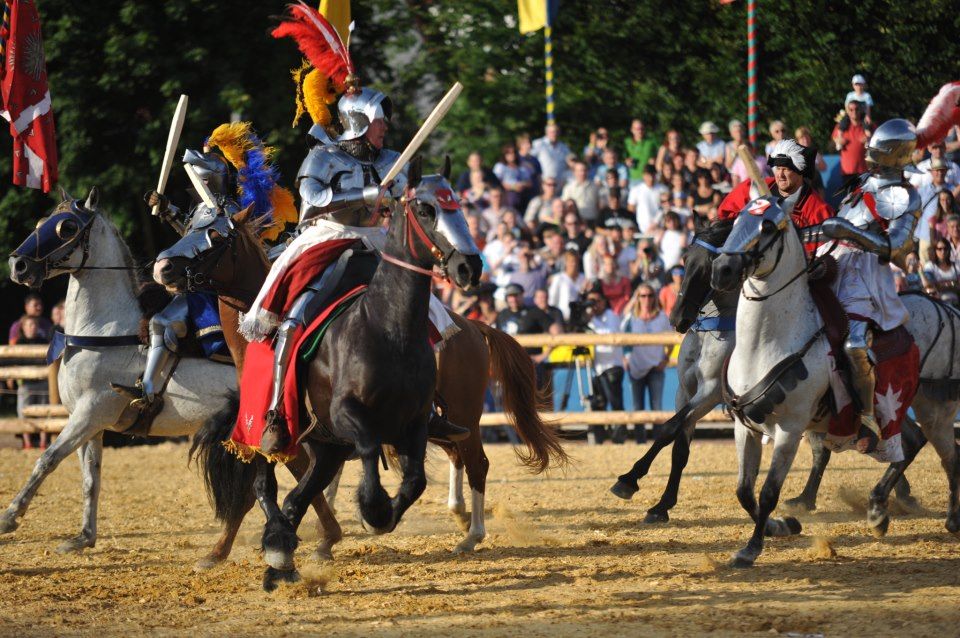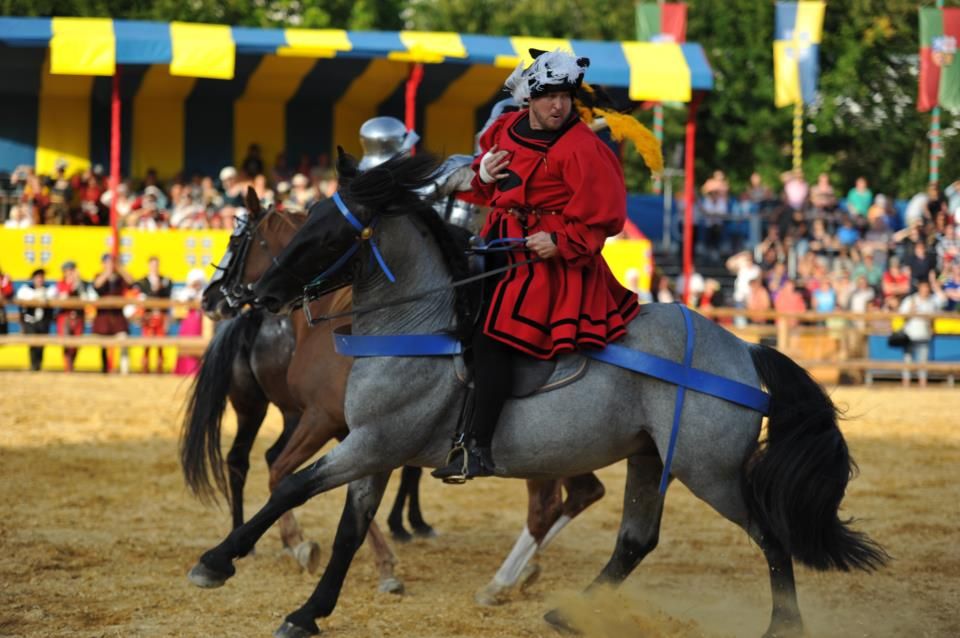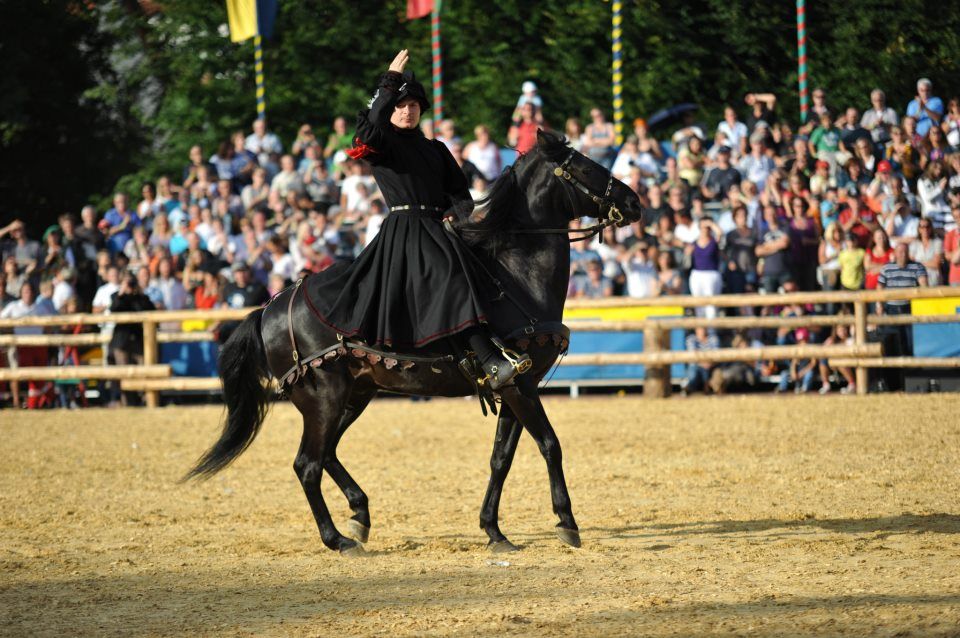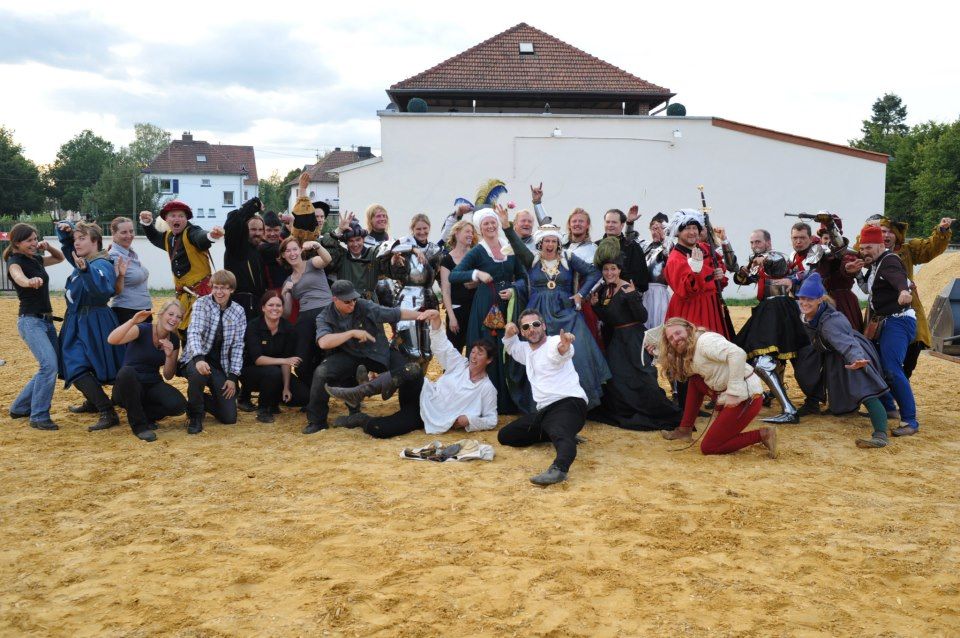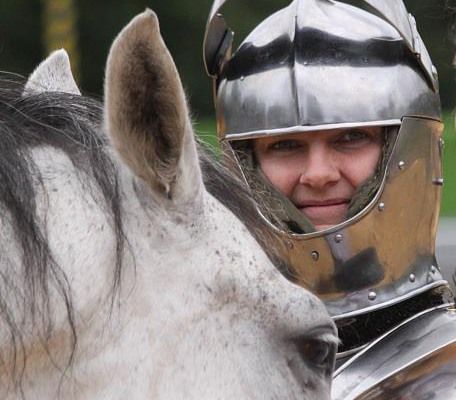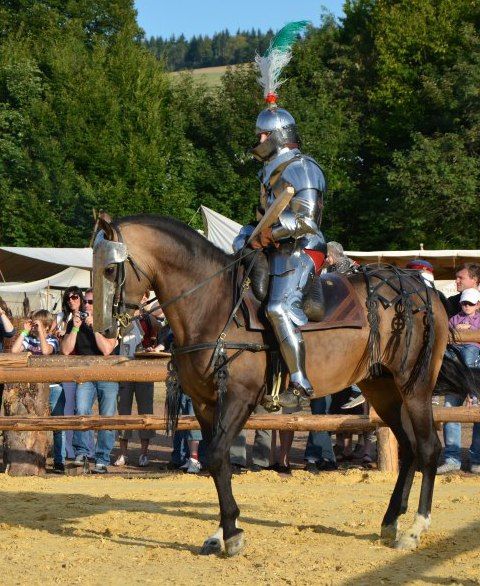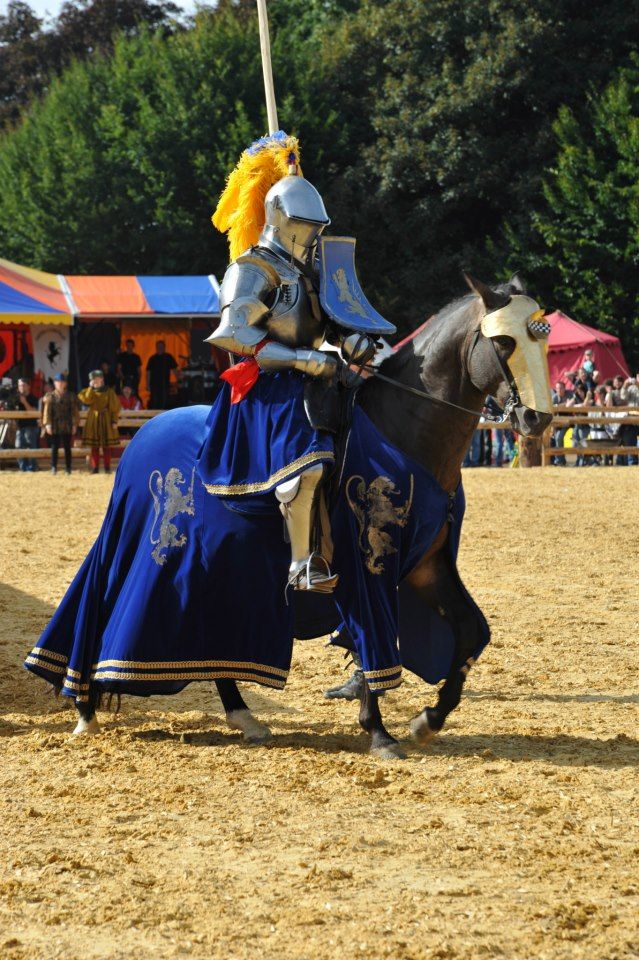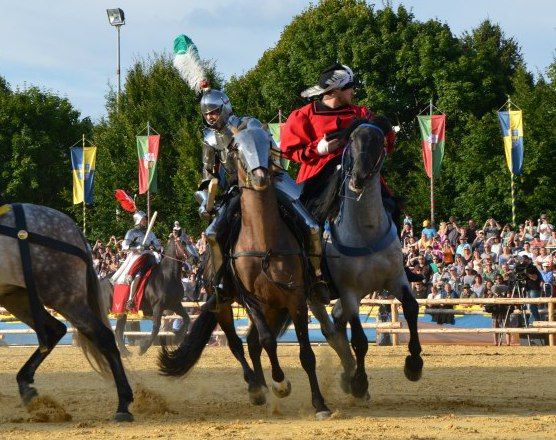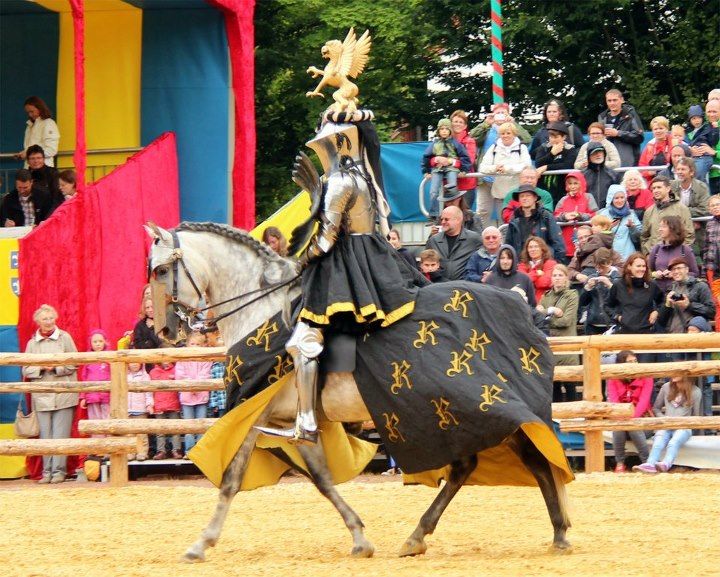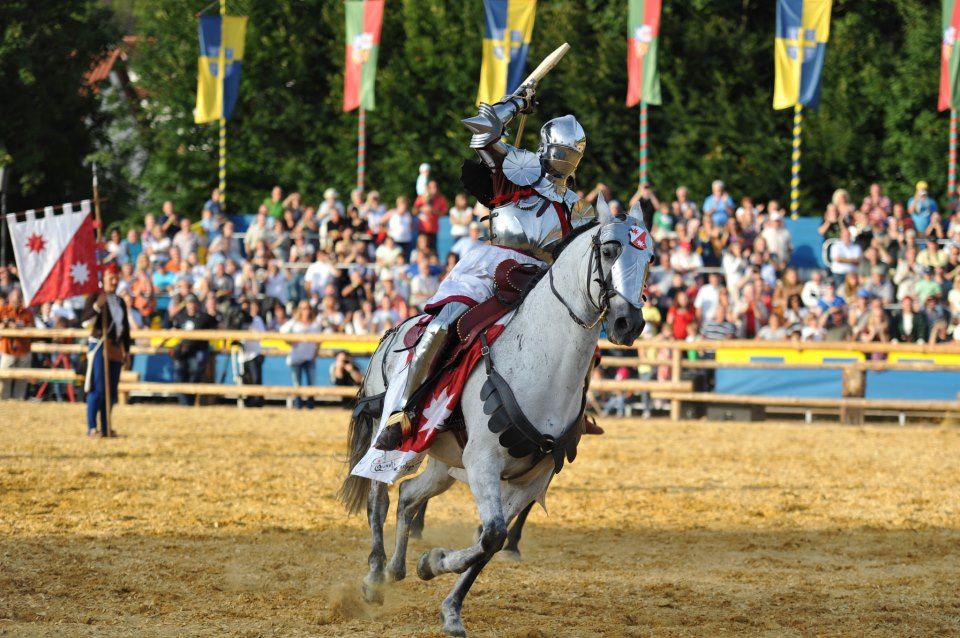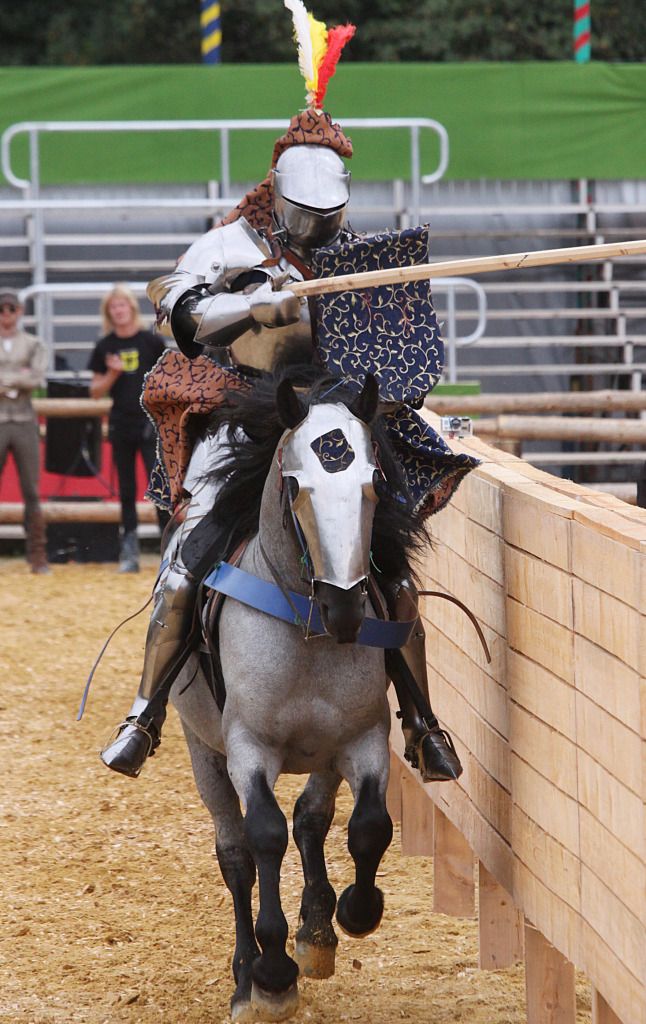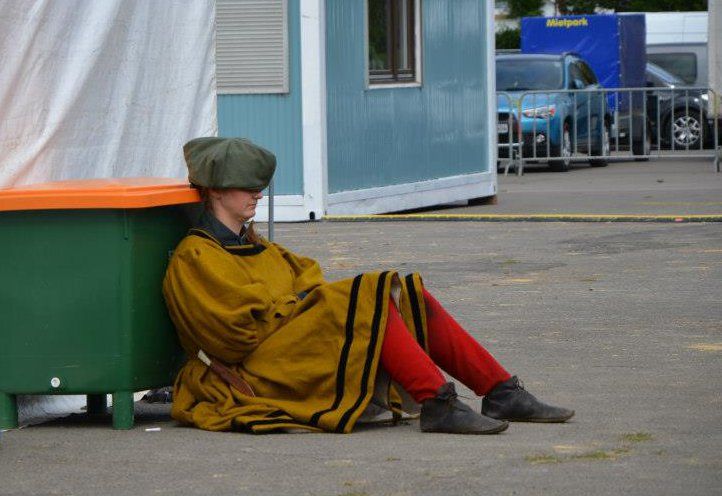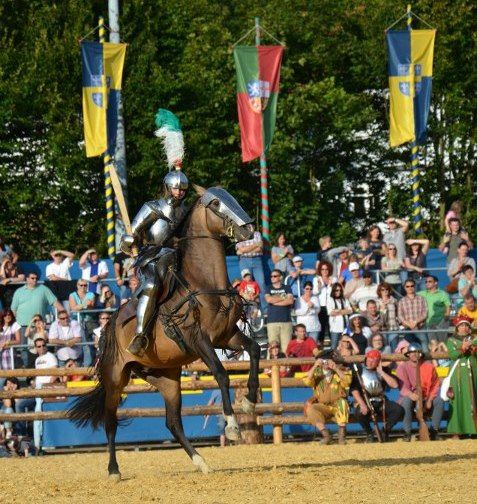

St Hallvard's Tournament will be taking place this weekend, May 23 - 25, on the grounds of the historic Akershus Fortress in Oslo, Norway. It was organized by Petter Ellingsen of the jousting troupe Ridderhest and will be a featured part of the Oslo Middelalder Festival. The participants will compete in both the mounted melee and the joust. The jousting will be done with tapered solid lances with steel coronels, like those used in the Grand Tournament of Sankt Wendel. This means that the skill and armour requirements for the jousters are higher than at many other tournaments.
There will be ten jousters from three different countries competing for the championship of the tournament.
Alix van Zijl of the Netherlands
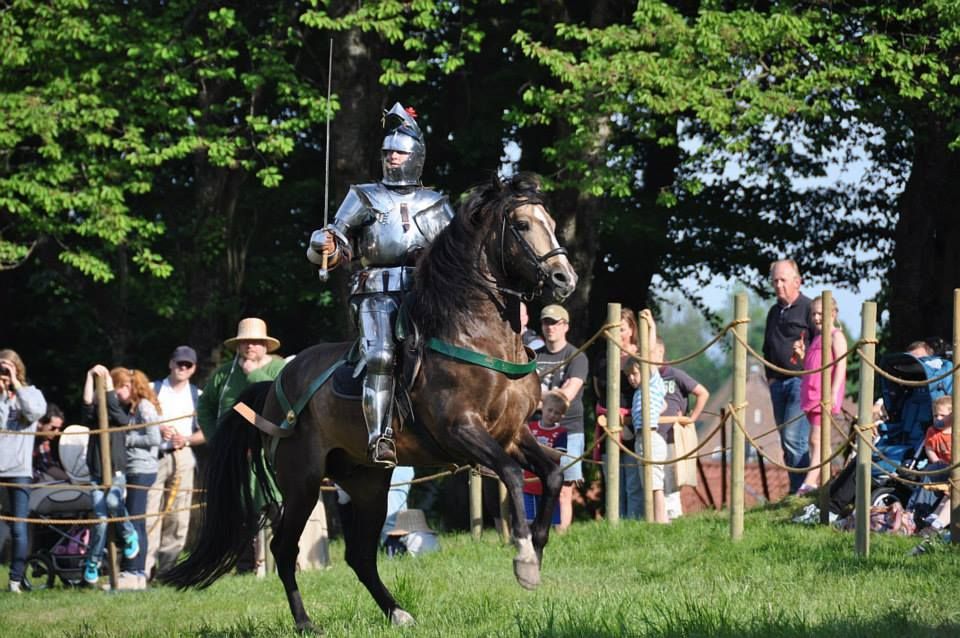
Alix van Zijl on Torero(photo by Katla Menada)
Alix van Zijl is a veterinarian who runs a practice employing four other vets. She's been riding horses since childhood and has competed in dressage. In 2003, she began training in historical riding with Joram van Essen and Arne Koets. In 2009, she ordered a custom made museum quality Milanese Armour, and in 2010, she competed in her first public joust. She is currently a board member of the historical riding group Stichting HEI. She fought in the mounted melee at the Grand Tournament of Sankt Wendel in 2012, and became the first woman in Europe to compete in a joust using tapered solid lances with steel coronels during the White Bear Tournament in Nyborg, Denmark in 2013. Alix rides her own Andalusian stallion, Torero. She bought him in Spain when he was four years old and has trained him herself according to the baroque principles taught at the Hofreitschule in Buckeburg, Germany.
Andrew McKinnon of Australia
Andrew McKinnon had never ridden a horse before turning 40. Yet when he discovered that real jousting still exists, he began training with Rod Walker and less than three years later competed in his first joust. Since then Andrew has competed successfully in jousts in Australia, New Zealand and France. He first competed with tapered solid lances at the Blacktown Medieval Faire in Sydney, Australia. Andrew is currently organizing the Tournament of St Ives which will take place in northern Sydney in 2014, and will feature jousting with tapered solid lances. Andrew's armour is an Italian spring steel harness circa 1460-1470 made by fellow Australian jouster Luke Binks. When not jousting, Andrew works on developing his dressage skills and playing the blues. He also owns a communications company with his wife Andrea, and has three strapping sons.
Arne Koets of the Netherlands
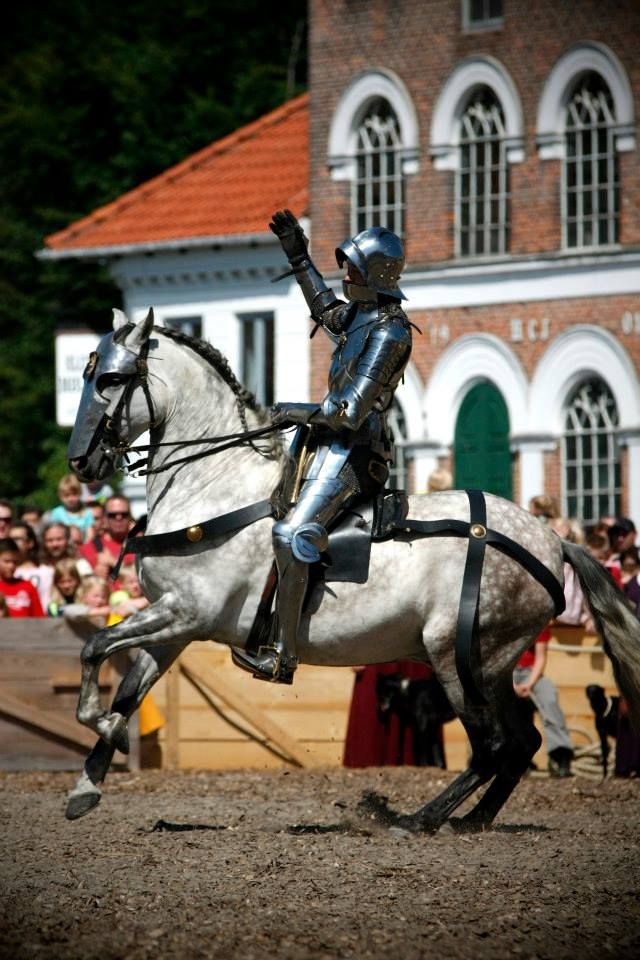
Arne Koets on Maximillian(photo by IsisSturtewagen/Stichting HEI)
Though of Norwegian descent, Arne Koets currently lives in Germany. He has been interested in military history for as long as he can remember and is one of the founding members of Stichting HEI. He began riding in 2001 and participated in his first joust in 2002. He has since participated in over 750 jousts in fifteen countries on three separate continents. In 2010, he won the Ironfest Joust, the first international jousting tournament to use solid tapered lances with steel coronels in modern times. In 2012, he organized and competed in the Grand Tournament of Sankt Wendel. When not jousting, he studies and teaches the historical dressage necessary for mounted combat.
Bertus Brokamp of the Netherlands
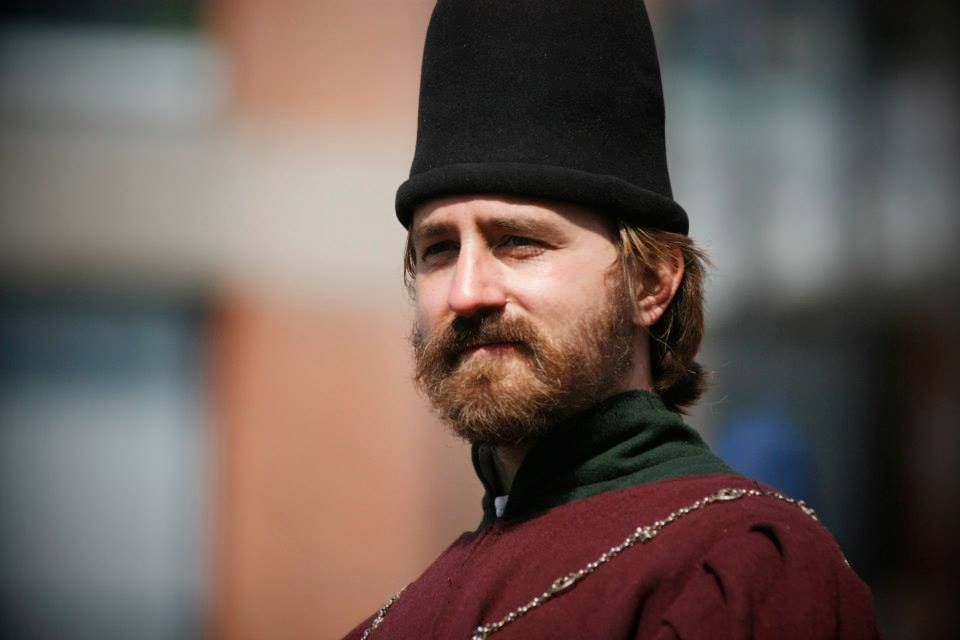
Bertus Brokamp(photo by Isis Sturtewagen/Stichting HEI)
Bertus first became involved in medieval martial arts in 2001. He later joined forces with Stichting HEI and began learning how to ride in 2004. He started out working as ground crew for the mounted members of the group, then in 2007, he participated in his first joust and also became a member of the board. That same year he received his Master of Science degree by writing a thesis on landweren, the late medieval defense lines in the Netherlands and Holy Roman Empire. In 2011, Bertus became the proud owner of the Andalusian stallion, Talento. After some intensive training, Talento was ridden by Wouter Nicolai in the Grand Tournament of Sankt Wendel in 2012. Since then, Talento has continued to carry jousters into the tilt and has been trained in classical dressage. Bertus broke his first tapered solid lance in 2013, during the White Bear Tournament in Nyborg, Denmark.
Ivar Mauritz-Hansen of Norway
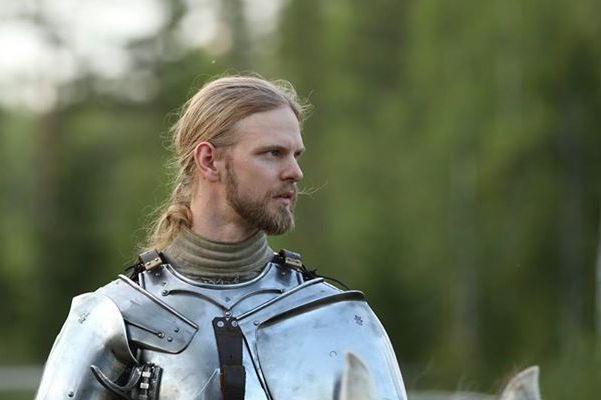
Ivar Mauritz-Hansen(photo by Renate Skeie)
Ivar has participated in many demonstrations and competitions in Norway and northern Europe, both on foot and on horseback. He started out training in Olympic style fencing when he was nine years old. Through the years since, he has learned to fight with the epee, longsword and pole axe on the ground, and now competes with a lance on horseback. He began riding in 2006 and broke his first lance in 2008.
Joram van Essen of the Netherlands
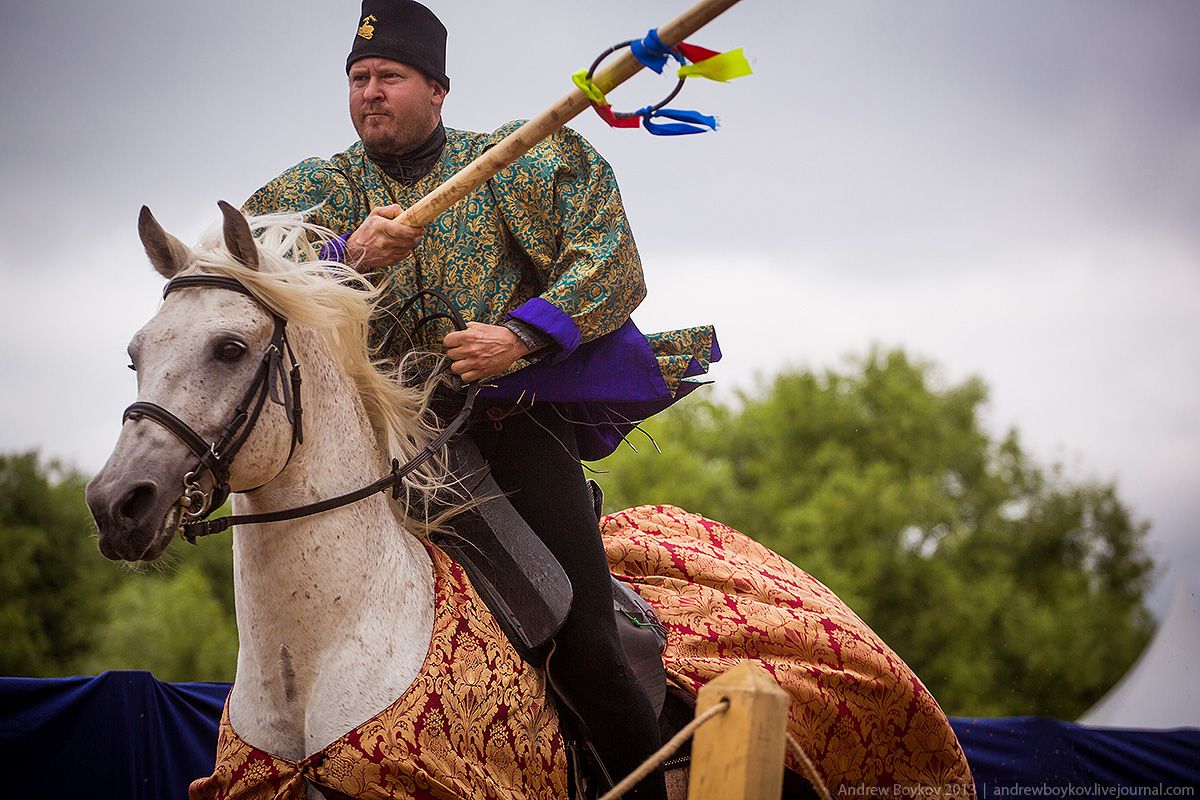
Joram van Essen at the Times & Epochs joust in Russia(photo by Andrew Boykov)
Joram van Essen was born in New Zealand, but moved to the Netherlands in 1999 to pursue his passion for historical european martial and equestrian arts. He was a founding member of Stichting HEI which was started in 2000 to promote historical education and authentic historical re-creation in the Netherlands. He has competed in numerous jousts around the world, including the prestigious international jousts at the Royal Armouries in Leeds, England, at the Times & Epochs international joust in Moscow, Russia and at Nyborg Slott in Denmark. In 2012, he was tournament champion of the Grand Tournament of Sankt Wendel, considered one of the most historically accurate jousts of modern times. Joram’s philosophy is that jousting is an Art, which requires training, dedication and team work between horse and rider.
Luke Binks of Australia
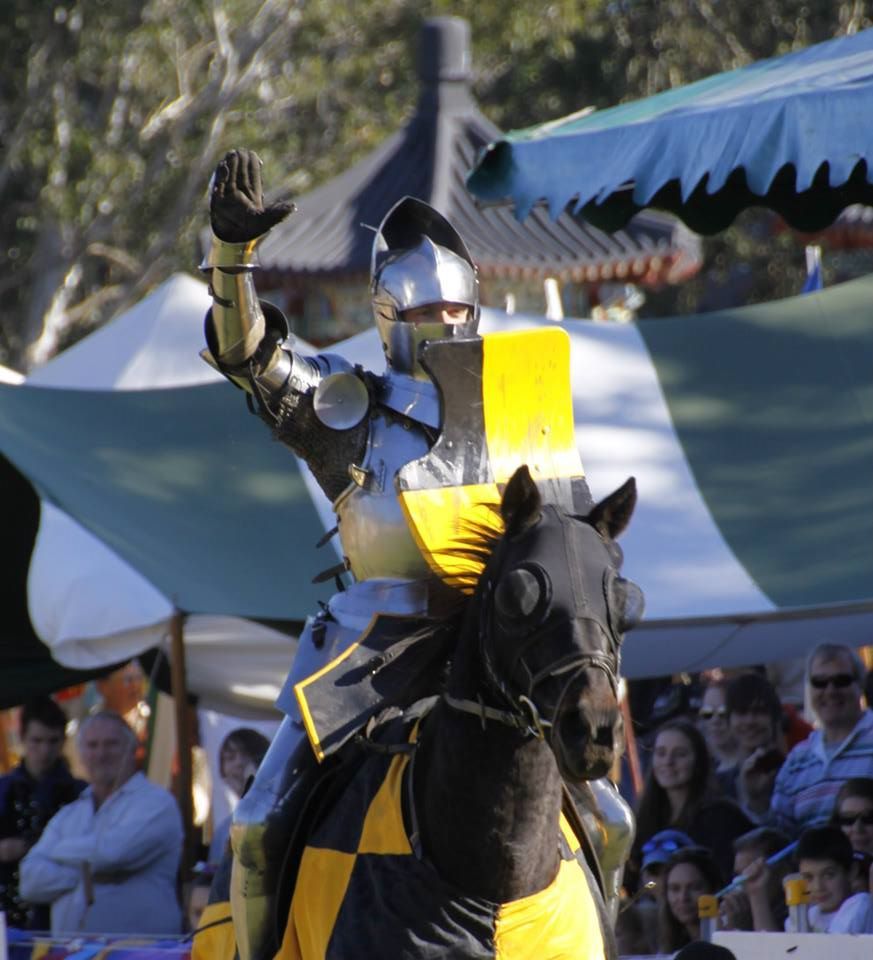
Luke Binks at Blacktown Medieval Faire(photo by Garry Davenport)
Luke Binks has had a lifelong passion for knights and the chivalric culture of the middle ages. Not satisfied with what he could learn from books, in 2002, Luke began making armour, learning to fight and to ride horses. The following year, Luke competed in his first international joust. Since that time, Luke has competed in jousts in aproximately a dozen countries around the world, including tournaments in Australia, Europe and North America. He has also spent time living and working on all three of the above mentioned continents, in search of like minded people, the ultimate pass with a lance and the skilled clash of a sword.
Per Estein Prøis-Røhjell of Norway
Per Estein Prøis-Røhjell, aka Pelle, owns and runs Trollspeilet with his wife Hanne. Trollspeilet is a company which offers riding instruction all over Norway and further abroad. Hanne also writes a blog about their work. Pelle and Hanne have two children. Pelle has participated in jousting tournaments in Denmark, Sweden, Germany and France as well as in his home country of Norway. In 2012, he was tournament champion at the Tournament of St Olav in Trondheim, Norway. Pelle recently retired his best tournament horse, Hugo, and many people are curiously waiting to see how well he will do with a new and inexperienced horse in 2014.
Petter Ellingsen of Norway
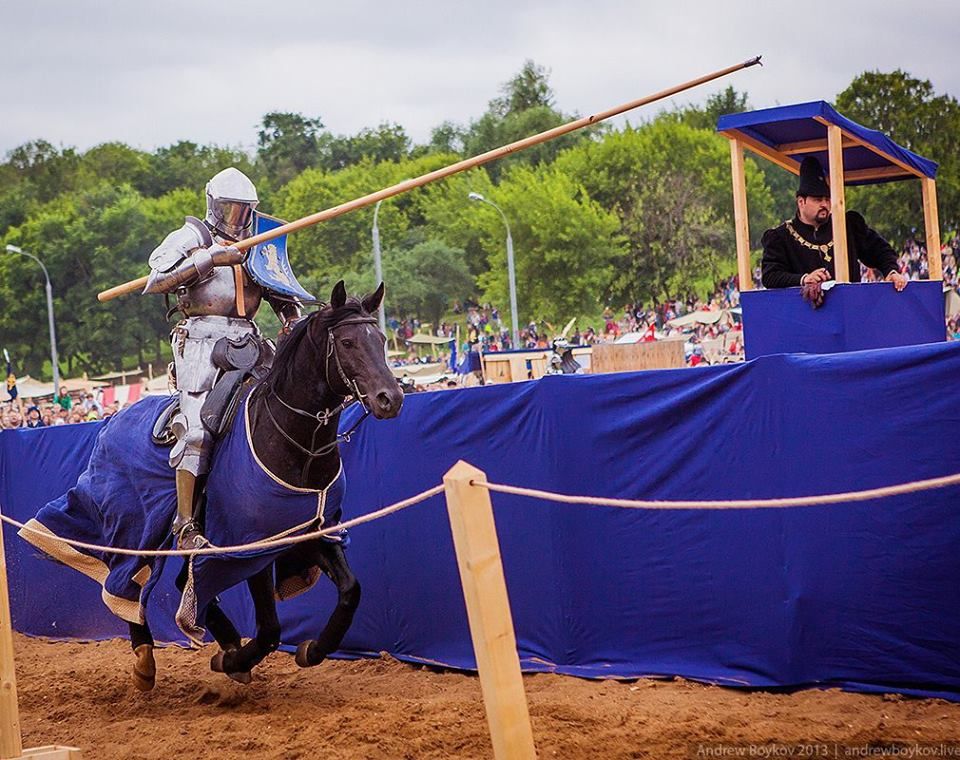
Petter Ellingsen at the Times & Epochs joust in Russia(photo by Andrew Boykov)
Petter Ellingsen began riding in 1998 with the sole purpose of learning to joust. He has striven to accurately recreate the way medieval knights rode. Eleven years ago, Petter began jousting internationally and has since jousted in thirteen different countries around the world. He has participated in more than 400 shows, tournaments and events. In 2012, he competed in the acclaimed Grand Tournament of Sankt Wendel in Germany. in 2013, he jousted in front of over 200,000 people at the Times & Epochs jousting tournament in Moscow, Russia. Petter runs his own company, Ridderhest, which trains and supplies horses for video productions and live events. Recently, his horses were featured in a reality tv series called "The Last Viking". He also happens to be the organizer of this tournament.
Wouter Nicolai of the Netherlands
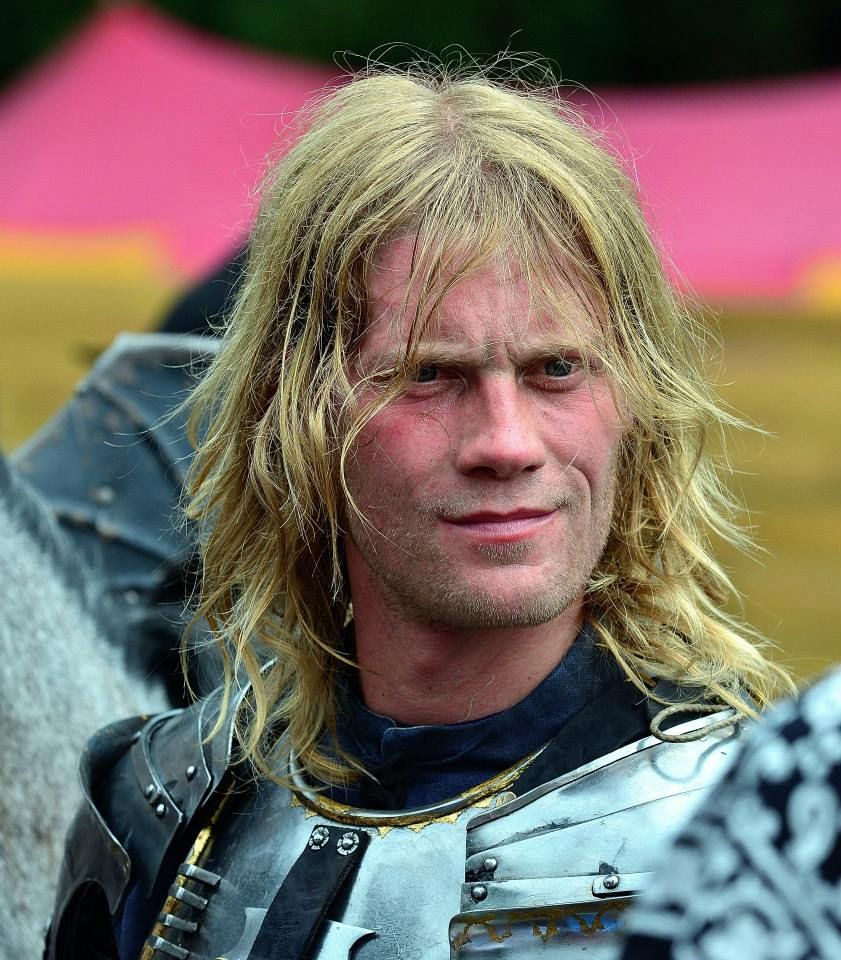
Wouter Nicolai at Arundel 2013(photo by Richard Pearn)
As a member of Stichting HEI, the premier Dutch display team for medieval mounted soldiery, Wouter is one of the Netherlands’ top historical jousters and is a highly active international competitor. In 2013, he competed in the White Bear tournament at Nyborg Slott in Denmark, in the Arundel International Tournament in England, and the Tournament of the Phoenix in the USA(at which he was named Most Chivalrous). His occupation as a professional jouster at the well-known Archeon Museum Park enables him to constantly hone his skills with horse, lance and sword. Wouter is also active in researching and reconstructing historical horse equipment, such as medieval and roman saddles.
Related articles:
Promotional Video for St. Hallvard's Jousting Tournament
There are numerous articles about The Grand Tournament of Sankt Wendel, several of which feature interviews with jousters who will be competing in St Hallvard's Tournament
Mounted Skill at Arms & the First Round of Jousting at "Times & Epochs 2013"
The Mounted Melees at the "Times & Epochs 2013" Jousting Tournament
Historical Jousting Tournament in Nyborg Slot in Denmark
There will be ten jousters from three different countries competing for the championship of the tournament.
Alix van Zijl of the Netherlands
Alix van Zijl on Torero(photo by Katla Menada)
Alix van Zijl is a veterinarian who runs a practice employing four other vets. She's been riding horses since childhood and has competed in dressage. In 2003, she began training in historical riding with Joram van Essen and Arne Koets. In 2009, she ordered a custom made museum quality Milanese Armour, and in 2010, she competed in her first public joust. She is currently a board member of the historical riding group Stichting HEI. She fought in the mounted melee at the Grand Tournament of Sankt Wendel in 2012, and became the first woman in Europe to compete in a joust using tapered solid lances with steel coronels during the White Bear Tournament in Nyborg, Denmark in 2013. Alix rides her own Andalusian stallion, Torero. She bought him in Spain when he was four years old and has trained him herself according to the baroque principles taught at the Hofreitschule in Buckeburg, Germany.
Andrew McKinnon of Australia
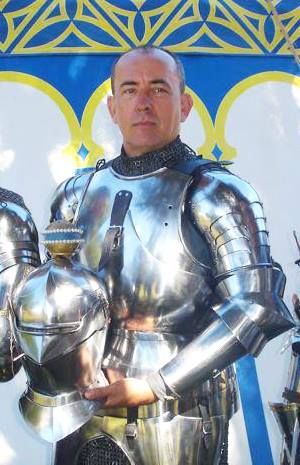
Andrew McKinnon had never ridden a horse before turning 40. Yet when he discovered that real jousting still exists, he began training with Rod Walker and less than three years later competed in his first joust. Since then Andrew has competed successfully in jousts in Australia, New Zealand and France. He first competed with tapered solid lances at the Blacktown Medieval Faire in Sydney, Australia. Andrew is currently organizing the Tournament of St Ives which will take place in northern Sydney in 2014, and will feature jousting with tapered solid lances. Andrew's armour is an Italian spring steel harness circa 1460-1470 made by fellow Australian jouster Luke Binks. When not jousting, Andrew works on developing his dressage skills and playing the blues. He also owns a communications company with his wife Andrea, and has three strapping sons.
Arne Koets of the Netherlands
Arne Koets on Maximillian(photo by IsisSturtewagen/Stichting HEI)
Though of Norwegian descent, Arne Koets currently lives in Germany. He has been interested in military history for as long as he can remember and is one of the founding members of Stichting HEI. He began riding in 2001 and participated in his first joust in 2002. He has since participated in over 750 jousts in fifteen countries on three separate continents. In 2010, he won the Ironfest Joust, the first international jousting tournament to use solid tapered lances with steel coronels in modern times. In 2012, he organized and competed in the Grand Tournament of Sankt Wendel. When not jousting, he studies and teaches the historical dressage necessary for mounted combat.
Bertus Brokamp of the Netherlands
Bertus Brokamp(photo by Isis Sturtewagen/Stichting HEI)
Bertus first became involved in medieval martial arts in 2001. He later joined forces with Stichting HEI and began learning how to ride in 2004. He started out working as ground crew for the mounted members of the group, then in 2007, he participated in his first joust and also became a member of the board. That same year he received his Master of Science degree by writing a thesis on landweren, the late medieval defense lines in the Netherlands and Holy Roman Empire. In 2011, Bertus became the proud owner of the Andalusian stallion, Talento. After some intensive training, Talento was ridden by Wouter Nicolai in the Grand Tournament of Sankt Wendel in 2012. Since then, Talento has continued to carry jousters into the tilt and has been trained in classical dressage. Bertus broke his first tapered solid lance in 2013, during the White Bear Tournament in Nyborg, Denmark.
Ivar Mauritz-Hansen of Norway
Ivar Mauritz-Hansen(photo by Renate Skeie)
Ivar has participated in many demonstrations and competitions in Norway and northern Europe, both on foot and on horseback. He started out training in Olympic style fencing when he was nine years old. Through the years since, he has learned to fight with the epee, longsword and pole axe on the ground, and now competes with a lance on horseback. He began riding in 2006 and broke his first lance in 2008.
Joram van Essen of the Netherlands
Joram van Essen at the Times & Epochs joust in Russia(photo by Andrew Boykov)
Joram van Essen was born in New Zealand, but moved to the Netherlands in 1999 to pursue his passion for historical european martial and equestrian arts. He was a founding member of Stichting HEI which was started in 2000 to promote historical education and authentic historical re-creation in the Netherlands. He has competed in numerous jousts around the world, including the prestigious international jousts at the Royal Armouries in Leeds, England, at the Times & Epochs international joust in Moscow, Russia and at Nyborg Slott in Denmark. In 2012, he was tournament champion of the Grand Tournament of Sankt Wendel, considered one of the most historically accurate jousts of modern times. Joram’s philosophy is that jousting is an Art, which requires training, dedication and team work between horse and rider.
Luke Binks of Australia
Luke Binks at Blacktown Medieval Faire(photo by Garry Davenport)
Luke Binks has had a lifelong passion for knights and the chivalric culture of the middle ages. Not satisfied with what he could learn from books, in 2002, Luke began making armour, learning to fight and to ride horses. The following year, Luke competed in his first international joust. Since that time, Luke has competed in jousts in aproximately a dozen countries around the world, including tournaments in Australia, Europe and North America. He has also spent time living and working on all three of the above mentioned continents, in search of like minded people, the ultimate pass with a lance and the skilled clash of a sword.
Per Estein Prøis-Røhjell of Norway
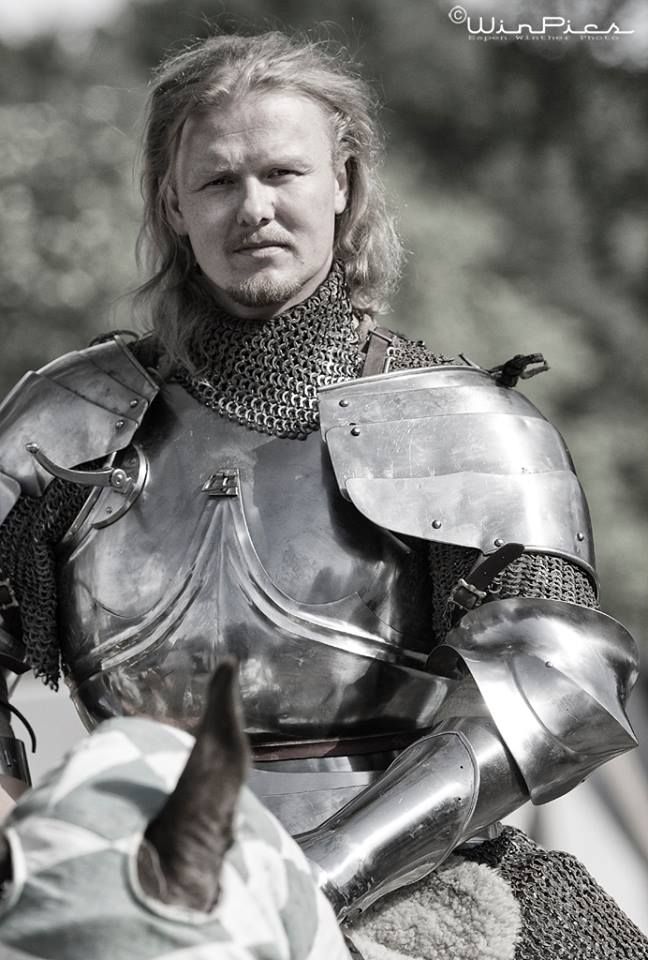
Per Estein Prøis-Røhjell, aka Pelle, owns and runs Trollspeilet with his wife Hanne. Trollspeilet is a company which offers riding instruction all over Norway and further abroad. Hanne also writes a blog about their work. Pelle and Hanne have two children. Pelle has participated in jousting tournaments in Denmark, Sweden, Germany and France as well as in his home country of Norway. In 2012, he was tournament champion at the Tournament of St Olav in Trondheim, Norway. Pelle recently retired his best tournament horse, Hugo, and many people are curiously waiting to see how well he will do with a new and inexperienced horse in 2014.
Petter Ellingsen of Norway
Petter Ellingsen at the Times & Epochs joust in Russia(photo by Andrew Boykov)
Petter Ellingsen began riding in 1998 with the sole purpose of learning to joust. He has striven to accurately recreate the way medieval knights rode. Eleven years ago, Petter began jousting internationally and has since jousted in thirteen different countries around the world. He has participated in more than 400 shows, tournaments and events. In 2012, he competed in the acclaimed Grand Tournament of Sankt Wendel in Germany. in 2013, he jousted in front of over 200,000 people at the Times & Epochs jousting tournament in Moscow, Russia. Petter runs his own company, Ridderhest, which trains and supplies horses for video productions and live events. Recently, his horses were featured in a reality tv series called "The Last Viking". He also happens to be the organizer of this tournament.
Wouter Nicolai of the Netherlands
Wouter Nicolai at Arundel 2013(photo by Richard Pearn)
As a member of Stichting HEI, the premier Dutch display team for medieval mounted soldiery, Wouter is one of the Netherlands’ top historical jousters and is a highly active international competitor. In 2013, he competed in the White Bear tournament at Nyborg Slott in Denmark, in the Arundel International Tournament in England, and the Tournament of the Phoenix in the USA(at which he was named Most Chivalrous). His occupation as a professional jouster at the well-known Archeon Museum Park enables him to constantly hone his skills with horse, lance and sword. Wouter is also active in researching and reconstructing historical horse equipment, such as medieval and roman saddles.
Related articles:
Promotional Video for St. Hallvard's Jousting Tournament
There are numerous articles about The Grand Tournament of Sankt Wendel, several of which feature interviews with jousters who will be competing in St Hallvard's Tournament
Mounted Skill at Arms & the First Round of Jousting at "Times & Epochs 2013"
The Mounted Melees at the "Times & Epochs 2013" Jousting Tournament
Historical Jousting Tournament in Nyborg Slot in Denmark